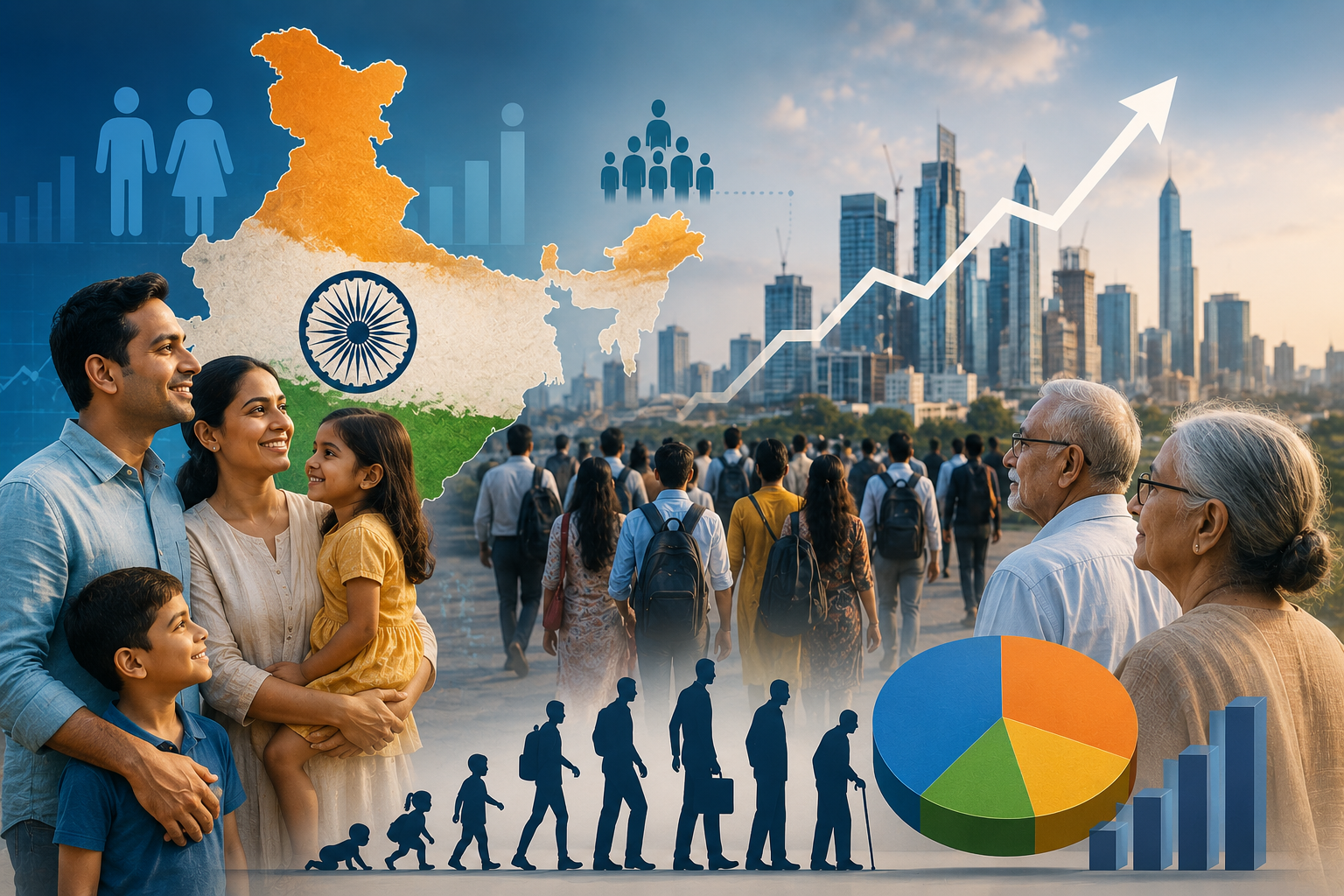
Demographic transition enters a new phase as lower birth rates reshape India's economic, social and policy landscape
India's fertility rate has remained steady at 2.0 children per woman in 2023-24, reinforcing a demographic transformation that has been underway for decades. While the figure places the country below the commonly accepted replacement fertility level of 2.1, experts say the milestone should not be interpreted as the beginning of population decline.
Instead, the latest data signals that India is moving from an era of rapid population expansion toward long-term demographic stabilisation. The transition carries significant implications for economic growth, labour markets, healthcare systems, education planning and social welfare policies.
For policymakers and investors alike, understanding the implications of this demographic shift is becoming increasingly important as India seeks to harness its demographic dividend while preparing for future population ageing.
What Does a Fertility Rate of 2.0 Mean?
The Total Fertility Rate (TFR) measures the average number of children a woman is expected to have during her lifetime based on prevailing age-specific fertility patterns.
A fertility rate of 2.0 does not imply that every family has exactly two children. Rather, it represents a national average across different regions, income groups and social categories.
More importantly, a fertility rate below replacement level does not automatically lead to an immediate decline in population. Demographic trends unfold over decades and are influenced by age structures, mortality rates, migration patterns and economic conditions.
India's current fertility level reflects a mature stage of demographic transition that many developed and emerging economies have experienced before.
The Journey from High Fertility to Population Stabilisation
India's demographic transformation has been one of the most remarkable social changes in modern history.
In the early 1970s, the average Indian woman had nearly five children. Since then, fertility rates have steadily declined due to rising literacy, improved healthcare, urbanisation and increased access to family planning services.
Successive National Family Health Surveys have documented this gradual decline, highlighting how economic development and social progress have altered family size preferences across the country.
Today's fertility rate of 2.0 represents the culmination of decades of structural change rather than a temporary demographic phenomenon.
Why Replacement Level Is Considered 2.1
Demographers typically consider 2.1 children per woman as the replacement fertility level required to maintain a stable population over the long term.
The additional 0.1 child accounts for mortality risks and demographic variations that prevent every child from eventually replacing a parent in the next generation.
However, replacement levels vary slightly between countries depending on healthcare outcomes, life expectancy and mortality rates.
Being slightly below replacement level does not immediately alter population growth patterns, particularly in countries with a large young population such as India.
Education and Women's Empowerment Driving Change
One of the most significant drivers of India's fertility decline has been the expansion of education, especially among women.
Higher educational attainment has contributed to later marriages, delayed childbirth and greater awareness of reproductive health. Women are increasingly pursuing higher education and career opportunities, influencing family planning decisions and reducing average family size.
At the same time, growing participation of women in the workforce has changed household priorities, with many families opting to invest more resources in fewer children.
These trends reflect broader social changes associated with economic development and rising aspirations.
Urbanisation and Rising Living Costs Influence Family Decisions
Rapid urbanisation has also played a crucial role in reshaping fertility patterns.
As more Indians move to cities, families face higher costs related to housing, education, healthcare and childcare. Urban lifestyles often encourage smaller households due to financial constraints and changing social norms.
Many parents now prioritise quality of education, healthcare and future opportunities over larger family sizes, leading to a sustained reduction in fertility rates across urban centres.
Although rural areas continue to record higher fertility levels than cities, the gap has narrowed significantly over time.
Why Population Will Continue Growing Despite Lower Fertility
A key reason India's population will continue expanding despite below-replacement fertility is a demographic phenomenon known as population momentum.
India still has one of the world's largest youth populations. Millions of young people are entering reproductive age each year, ensuring that the absolute number of births remains high even as individual families have fewer children.
This age structure creates a lag between falling fertility rates and eventual population stabilisation. As a result, India's population is expected to continue growing for several decades before reaching a peak and eventually stabilising later in the century.
This demographic momentum differentiates India from ageing economies such as Japan, South Korea and several European countries.
State-Level Differences Highlight Uneven Transition
India's demographic transition is far from uniform.
Several southern and western states have already reached fertility levels significantly below replacement rates and are beginning to prepare for ageing populations and slower workforce growth.
In contrast, parts of northern and central India continue to record higher fertility rates, contributing disproportionately to future population growth.
States such as Bihar, Uttar Pradesh and Jharkhand remain above the national average, while states including Sikkim, Punjab, West Bengal and Goa have fertility rates comparable to many developed economies.
These differences are likely to influence migration patterns, labour markets and resource allocation in the coming decades.
Demographic Dividend Still Offers Economic Opportunity
Despite declining fertility, India continues to enjoy a demographic advantage relative to many advanced economies.
A large working-age population provides opportunities for economic expansion, increased productivity and higher consumption. If supported by adequate job creation, skill development and investment, this demographic dividend can become a powerful driver of long-term growth.
However, experts warn that demographic advantages are not automatic. The ability to create quality employment opportunities will determine whether India fully benefits from its youthful population.
Failure to generate sufficient jobs could turn a demographic opportunity into a social and economic challenge.
Future Policy Priorities Begin to Shift
As fertility declines and population growth gradually moderates, policy priorities are likely to evolve.
Governments will increasingly focus on employment generation, healthcare infrastructure, pension systems, social security and elderly care. Education systems may also need to adapt to changing demographic realities and workforce requirements.
Over time, India's policy framework will need to balance the needs of a large young workforce with preparations for an ageing population.
This transition is already visible in several states where population ageing is advancing faster than the national average.
Outlook: A New Demographic Era for India
India's fertility rate stabilising at 2.0 marks a historic milestone in the country's demographic journey. While population growth is expected to continue for many years due to population momentum, the underlying trend points toward gradual stabilisation rather than endless expansion.
For businesses, investors and policymakers, the shift presents both opportunities and challenges. A large workforce, expanding middle class and improving human capital remain key strengths, but long-term planning will increasingly need to account for changing population dynamics.
As India moves deeper into this new demographic phase, the focus will shift from managing population growth to maximising the economic and social potential of its people.