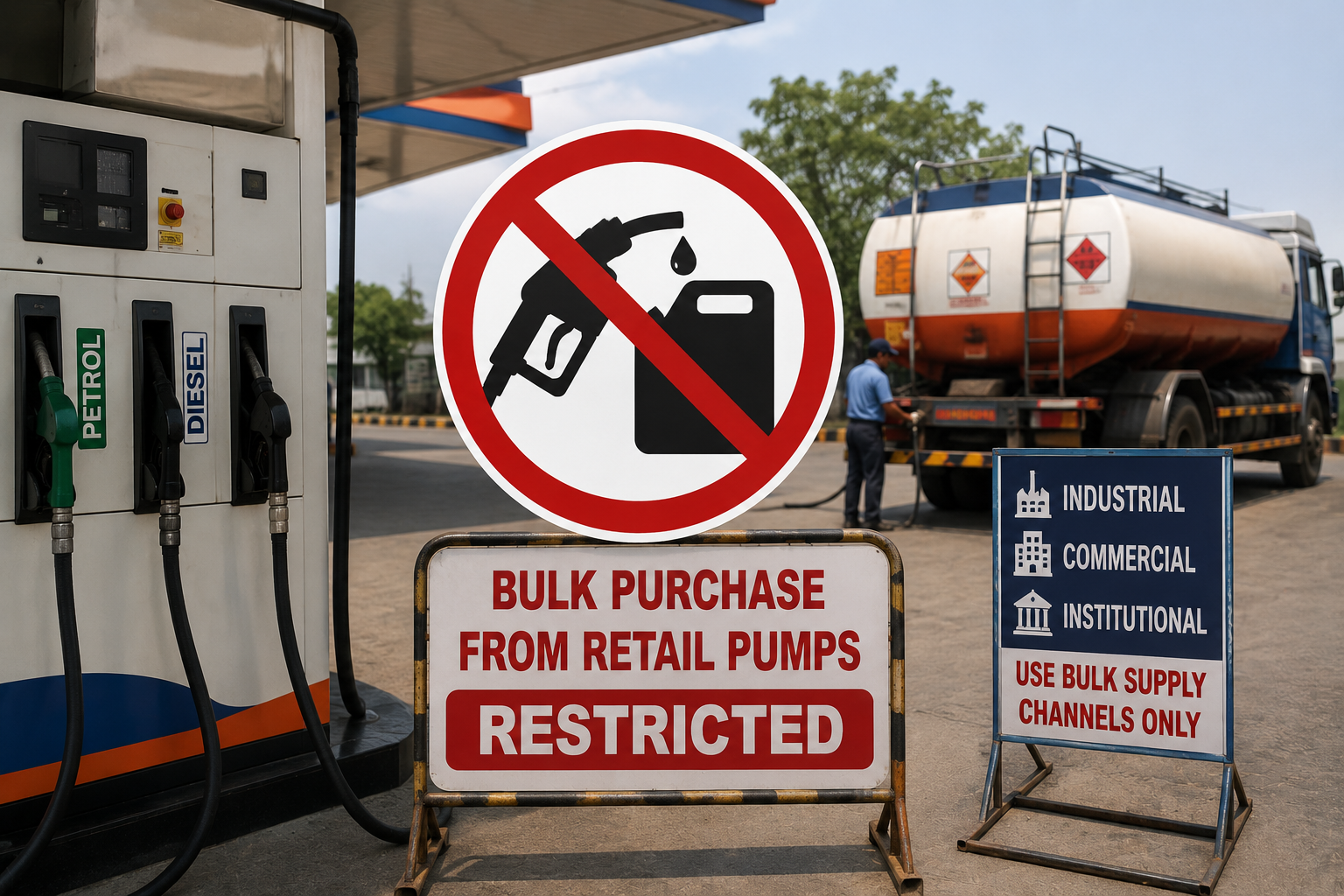
Industrial and Commercial Consumers Directed to Source Petrol and Diesel Through Bulk Channels as Authorities Move to Prevent Hoarding and Market Distortions
The Indian government has imposed temporary restrictions on industrial, commercial and institutional consumers purchasing petrol and diesel from retail fuel stations, in a move aimed at protecting fuel availability for ordinary consumers and maintaining stability in the country's energy distribution network.
The decision comes amid heightened geopolitical tensions and disruptions in global petroleum supply chains that have created unusual demand patterns in certain regions of the country. Officials say the measure is intended to prevent hoarding, curb fuel diversion and ensure that retail fuel supplies remain available for households, transport operators and essential services.
The restrictions will initially remain in force for up to 90 days, although the government has retained the option to extend them depending on market conditions.
What Triggered the Government's Intervention?
The government's action follows a sharp rise in diesel and petrol purchases at retail fuel outlets by industrial and commercial users.
In recent months, many bulk consumers shifted their purchases from traditional bulk supply arrangements to retail petrol pumps due to the significant price difference between retail and bulk fuel rates.
This pricing gap emerged after state-owned oil marketing companies moderated retail fuel prices to shield ordinary consumers from the sharp rise in global crude oil costs triggered by geopolitical developments in West Asia.
While retail consumers benefited from controlled pump prices, industrial and institutional buyers continued to face market-linked pricing under bulk procurement contracts.
The resulting price differential created a strong financial incentive for large consumers to source fuel from retail stations instead of designated bulk channels.
Diesel Price Gap Creates Unusual Demand Surge
The difference between retail and bulk diesel prices became particularly pronounced.
In several markets, bulk diesel prices remained significantly higher than retail rates, encouraging industries, telecom operators, infrastructure companies and commercial establishments to purchase fuel through retail outlets.
This shift led to unusually high sales volumes at petrol pumps, particularly those operated by public-sector oil marketing companies.
Industry data indicated a noticeable jump in fuel sales at state-owned retailers as bulk users increasingly redirected demand toward retail channels.
Officials became concerned that continued growth in such purchases could strain supplies intended for ordinary motorists and transport operators.
New Rules for Industrial and Commercial Users
Under the new framework, industrial, commercial and institutional consumers will no longer be permitted to purchase petrol and diesel through standard retail fuel stations.
Instead, these users must obtain supplies through approved bulk procurement mechanisms or their own dedicated fuel storage and distribution systems.
The government believes this will restore the intended distinction between retail and bulk fuel markets while ensuring that retail infrastructure remains focused on serving individual consumers and transportation needs.
The order effectively redirects large-volume buyers back to established bulk supply channels that are designed specifically for commercial consumption.
Restrictions on Diesel Purchases Tightened
The new regulations also introduce stricter controls on diesel purchases from retail outlets.
Diesel sales will now be limited primarily to vehicle fuel tanks and approved containers that comply with safety regulations.
Authorities have also imposed daily purchase limits to discourage stockpiling and unauthorized redistribution of fuel.
The government has clarified that diesel acquired through retail channels cannot be resold under any circumstances.
These measures are intended to prevent arbitrage opportunities arising from pricing differences and to reduce the risk of fuel diversion into unauthorized markets.
Ensuring Equitable Fuel Availability
Officials have emphasized that the primary objective of the restrictions is to guarantee equitable access to fuel across the country.
As geopolitical uncertainty continues to affect global energy markets, policymakers are seeking to ensure that essential consumers do not face localized shortages due to excessive purchases by large commercial users.
The government believes that unrestricted bulk buying through retail channels could distort distribution patterns and create supply imbalances in certain regions.
By separating retail and commercial demand, authorities hope to maintain a more predictable and efficient allocation of fuel supplies.
Impact on Oil Marketing Companies
The restrictions could significantly influence fuel sales patterns among oil marketing companies.
State-owned retailers had recently witnessed strong growth in diesel and petrol sales as commercial users increasingly shifted purchases toward retail outlets.
The new rules are expected to normalize demand distribution and reduce abnormal spikes in retail fuel consumption.
For oil marketing companies, the move may help improve inventory management and strengthen supply planning across their nationwide distribution networks.
However, companies may also need to adapt logistics operations to accommodate increased activity through bulk sales channels.
Why Fuel Security Has Become a Priority
Global energy markets have experienced heightened volatility in recent months due to geopolitical tensions, supply-chain disruptions and fluctuating crude oil prices.
These developments have raised concerns among policymakers regarding the resilience of domestic fuel distribution systems.
India remains one of the world's largest energy consumers and imports a significant portion of its crude oil requirements. As a result, international disruptions can quickly influence domestic fuel markets.
The latest restrictions reflect a broader strategy to safeguard energy security and maintain uninterrupted access to essential fuels during periods of uncertainty.
State Governments Given Enforcement Powers
To ensure effective implementation, state governments and union territory administrations have been directed to actively monitor fuel distribution and take action against violations.
Authorities have been empowered to investigate cases involving hoarding, black marketing, unauthorized procurement and fuel diversion.
The government has also authorized oil marketing companies and fuel retailers to enforce the new regulations at the operational level.
Strict penalties may apply in cases where individuals or businesses attempt to circumvent the restrictions.
Potential Impact on Businesses
Industries that rely heavily on diesel for power generation, transportation, construction activities and manufacturing operations may face adjustments as they transition back to bulk procurement channels.
While the new framework is not expected to affect fuel availability for legitimate commercial users, businesses may need to revisit procurement strategies and logistics arrangements.
Companies operating large vehicle fleets, infrastructure projects and backup power systems are likely to be among those most affected by the changes.
Industry associations are expected to engage with policymakers to address operational concerns during the implementation phase.
The Bigger Picture: Balancing Consumer Protection and Market Stability
The government's decision highlights the delicate balance between protecting consumers and maintaining market efficiency during periods of global uncertainty.
Retail fuel prices were moderated to shield households and transport users from the full impact of rising international energy costs. However, the resulting price differential created unintended consequences that encouraged bulk users to exploit lower retail rates.
The latest restrictions are designed to correct these distortions while preserving the benefits of consumer-focused pricing policies.
The Bottom Line
India's temporary restrictions on bulk petrol and diesel purchases through retail fuel stations represent a proactive effort to safeguard fuel availability, prevent hoarding and ensure stable distribution during a period of heightened geopolitical and energy-market uncertainty.
By directing industrial and commercial consumers back to dedicated bulk supply channels, the government aims to protect ordinary consumers, improve fuel allocation and maintain uninterrupted supplies across the country. While the measures may require operational adjustments for businesses, policymakers believe they are necessary to preserve market stability and strengthen the resilience of India's fuel distribution system.