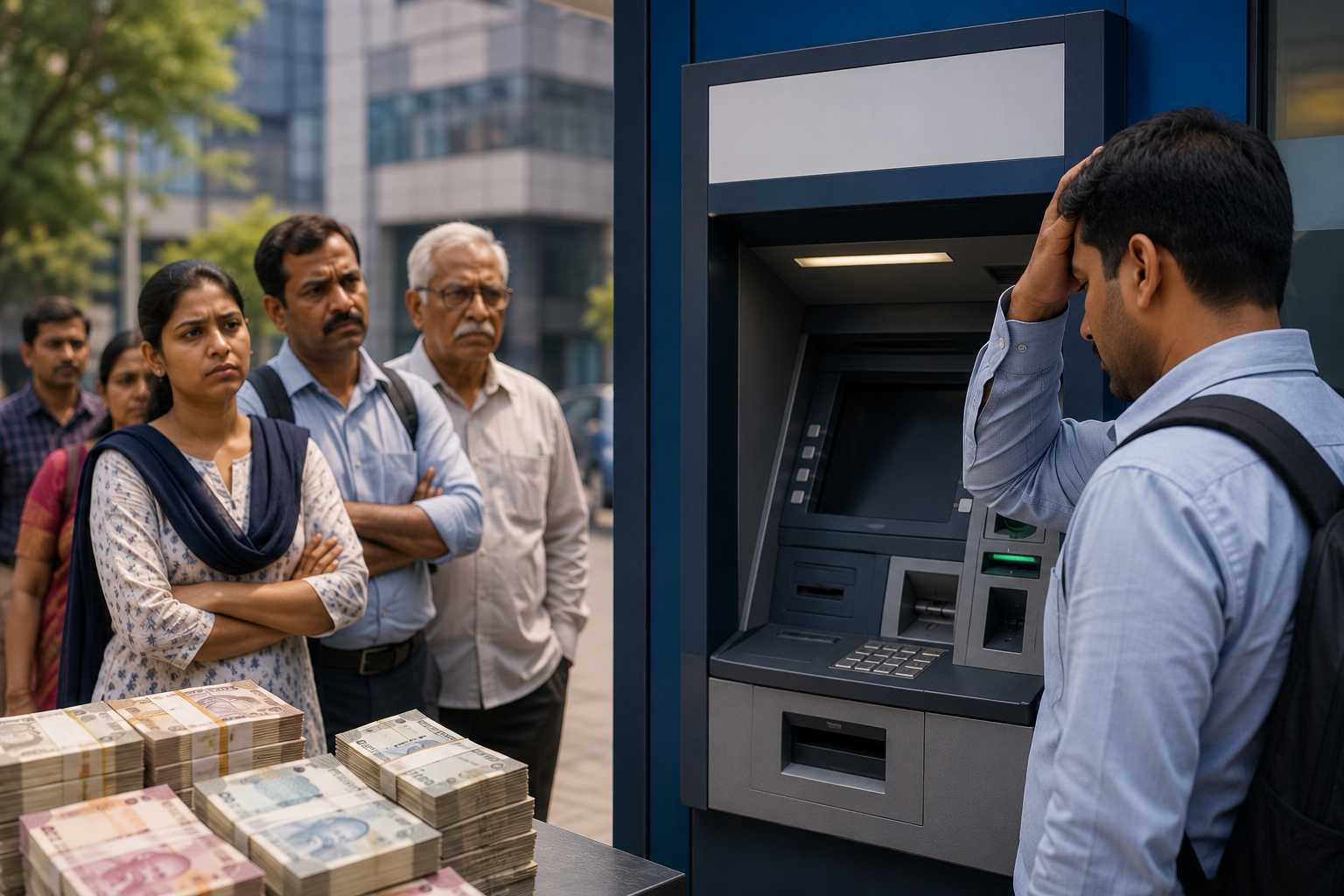
Rising Logistics Costs, Stagnant Interchange Fees and Operational Bottlenecks Create Fresh Challenges for India's Cash Distribution Network
Nearly a decade after demonetisation transformed India's payments landscape, cash continues to play a crucial role in the economy. Yet, even as the amount of currency circulating in the system has reached record levels, many automated teller machines (ATMs) across the country are struggling with inadequate cash replenishment.
Recent data has highlighted a significant gap between the amount of cash required to service India's ATM network and the actual cash made available for loading. The development has reignited concerns about the efficiency of the country's cash-distribution infrastructure and raised questions about whether India's ATM ecosystem is keeping pace with growing demand.
Industry participants say the problem is not a shortage of currency itself, but rather a combination of rising operational costs, outdated fee structures and logistical inefficiencies that are creating bottlenecks in the movement of cash.
Cash Remains an Important Part of India's Economy
Despite the rapid growth of digital payments, cash continues to hold a significant place in India's financial system.
Currency in circulation (CiC) crossed ₹42 trillion in 2026, reflecting steady growth in the use of physical cash across the economy. The figure represents nearly 12 per cent of India's gross domestic product, underscoring that cash remains an essential medium of exchange for millions of individuals and businesses.
The continued expansion of currency circulation challenges earlier assumptions that digital payments would dramatically reduce the role of cash following demonetisation.
Instead, India has witnessed the simultaneous growth of both digital transactions and cash usage, creating a hybrid payments ecosystem.
Understanding the ATM Cash Availability Gap
While currency circulation remains high, the availability of cash for ATM replenishment has emerged as a major concern.
Recent figures indicate that the amount of cash intended for ATM loading significantly exceeded the actual cash made available. The resulting fulfillment rates fell well below ideal levels, suggesting that many ATM operators struggled to replenish machines adequately.
This gap has raised concerns about service reliability, particularly in semi-urban and rural areas where ATMs continue to serve as a critical access point for banking services.
Industry experts emphasize that the issue should not be interpreted as evidence of a nationwide cash shortage. Rather, it reflects operational challenges in distributing available currency efficiently across the ATM network.
Why Currency in Circulation Does Not Tell the Full Story
One of the most common misconceptions is that higher currency in circulation automatically translates into greater ATM cash availability.
In reality, a substantial portion of the currency circulating in the economy may not be immediately accessible for ATM loading.
Currency in circulation refers to money that has already moved outside central bank currency chests and into the broader economy. Once cash enters circulation, it may be held by households, businesses, retailers, financial institutions or informal sectors.
As a result, the total volume of currency in circulation does not necessarily indicate how much cash is readily available for redistribution through ATMs.
This distinction helps explain why ATM cash shortages can occur even during periods of record-high currency circulation.
Rising Logistics Costs Are Squeezing the ATM Ecosystem
One of the biggest challenges facing the ATM industry is the sharp increase in logistics and cash-management costs.
Transporting cash across India's vast geography requires extensive coordination involving banks, cash-in-transit (CIT) operators, security providers and ATM management companies.
Fuel costs, employee wages, insurance expenses, vehicle maintenance and security requirements have all increased significantly over recent years.
However, many stakeholders argue that the revenue structure supporting ATM operations has not kept pace with these rising expenses.
The growing mismatch between costs and compensation is making ATM servicing less economically viable, particularly in remote and low-transaction locations.
Static Interchange Fees Create Financial Pressure
A major point of contention within the industry is the ATM interchange fee structure.
Interchange fees are payments made between banks when customers use ATMs belonging to other institutions. These fees form a critical source of revenue that supports ATM maintenance and cash replenishment activities.
Industry participants argue that interchange fees have remained largely stagnant despite substantial increases in operating costs.
As a result, ATM operators and service providers face mounting financial pressure, reducing incentives to expand networks or maintain optimal cash levels across all locations.
Stakeholders have repeatedly called for a review of the fee structure to better reflect current economic realities and ensure the long-term sustainability of ATM services.
Multiple Stakeholders, Multiple Interests
The ATM ecosystem involves a complex network of participants, each with different commercial interests.
Banks seek to control costs while maintaining customer service standards. ATM operators aim to improve profitability and network efficiency. Cash-in-transit companies focus on managing logistics expenses, while regulators prioritize financial inclusion and system stability.
These competing priorities can sometimes create operational friction, slowing efforts to resolve cash availability issues.
Industry observers believe that greater coordination among stakeholders will be necessary to address structural bottlenecks and improve cash distribution efficiency.
Financial Inclusion Still Depends on ATM Accessibility
While digital payments have expanded rapidly, ATMs continue to play a vital role in promoting financial inclusion.
For millions of people in rural and semi-urban India, cash remains the preferred payment method and ATMs serve as an important gateway to banking services.
Small businesses, informal workers, agricultural communities and senior citizens often rely heavily on cash transactions for daily economic activity.
Persistent ATM cash shortages could therefore disproportionately affect segments of the population that remain less integrated into the digital economy.
Ensuring reliable access to cash remains an important policy objective even as digital payment adoption continues to rise.
Digital Growth Has Not Replaced Cash Demand
India's digital payments revolution has undoubtedly transformed consumer behavior.
Unified Payments Interface (UPI) transactions continue to break records, while mobile wallets, QR-code payments and online banking services have become increasingly common.
However, the growth of digital payments has not resulted in a corresponding decline in cash demand.
Instead, both forms of payment have expanded simultaneously, reflecting the diverse needs of India's economy. Consumers often use digital payments for convenience while continuing to maintain cash balances for emergencies, local transactions and areas where digital acceptance remains limited.
This dual-payment reality means that ATM infrastructure remains an essential component of the financial system.
Industry Seeks Structural Reforms
Stakeholders are increasingly advocating for reforms that address the underlying economic challenges facing the ATM sector.
Key proposals include revising interchange fees, improving cash forecasting systems, enhancing operational coordination and leveraging technology to optimize cash management.
Industry participants also support measures that encourage greater investment in ATM infrastructure, particularly in underserved regions where financial inclusion objectives remain paramount.
Such reforms could help create a more sustainable business model while ensuring consistent cash availability for consumers.
The Bottom Line
India's ATM cash shortages highlight a growing disconnect between rising currency circulation and the operational realities of cash distribution. The issue is not a lack of cash in the economy but rather the challenges involved in moving and managing that cash efficiently.
Escalating logistics expenses, stagnant interchange fees and coordination challenges among industry participants have combined to create pressure on the ATM ecosystem. While digital payments continue to expand rapidly, cash remains an indispensable part of India's economic landscape.
Addressing these structural issues will be essential to ensuring that India's financial infrastructure remains inclusive, efficient and capable of meeting the evolving needs of consumers in the years ahead.