₹20 Lakh Crore Development Vision Aims to Transform NCR Into the World's Largest and Most Connected Urban Region
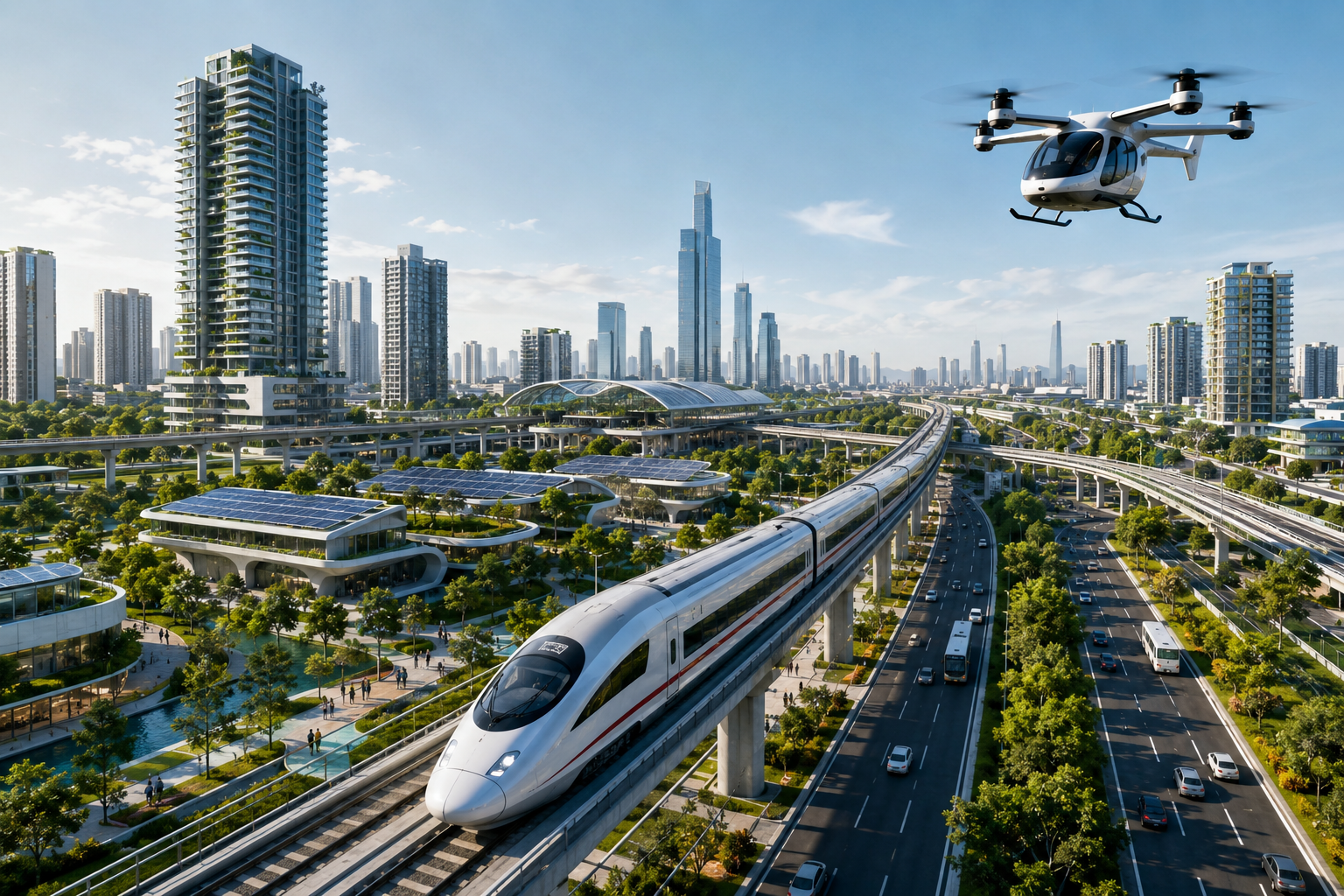
The National Capital Region (NCR) is set to undergo one of the most ambitious urban transformations in India's history under the proposed Regional Plan 2041. The blueprint envisions a future where residents can travel between Delhi and major NCR cities within 30 minutes, supported by high-speed rail networks, advanced mobility systems, and a series of new self-sustaining smart townships.
The plan, which is scheduled for discussion by the National Capital Region Planning Board (NCRPB), seeks to address the challenges of rapid urbanisation while creating a balanced and sustainable model for future growth. With Delhi-NCR expected to emerge as the world's largest urban agglomeration within the next decade, policymakers are preparing for an unprecedented population surge and infrastructure demand.
Vision of a "30-Minute NCR"
One of the most transformative aspects of the Regional Plan 2041 is the concept of a "30-Minute NCR."
The proposal aims to significantly reduce travel times between Delhi and major urban centres across Haryana, Uttar Pradesh, and Rajasthan through the development of high-speed transportation corridors. Authorities plan to examine the feasibility of fast rail networks capable of connecting key NCR cities to Delhi in less than half an hour.
In addition to high-speed rail, the plan explores emerging mobility solutions such as heli-taxi services and integrated rapid transit systems.
The broader transportation framework also targets one-hour connectivity through conventional rail services and two-to-three-hour accessibility by road, creating a highly interconnected regional economy.
Up to Eight New Greenfield Smart Cities Proposed
To accommodate future population growth, the Regional Plan proposes the development of up to eight new greenfield townships across the NCR region.
Unlike traditional urban expansion models, these townships are expected to be designed as self-sufficient cities that combine residential, commercial, industrial, educational, healthcare, and recreational infrastructure within integrated urban ecosystems.
The objective is to reduce excessive pressure on Delhi by creating alternative growth centres capable of generating employment, attracting investment, and supporting high-quality urban living.
Urban planners believe these new townships could become important economic hubs while helping to decentralize population growth across the region.
Inspired by Global Smart City Models
The proposed urban centres will draw inspiration from advanced smart city projects developed under the Delhi-Mumbai Industrial Corridor (DMIC).
The focus will be on creating technologically enabled and environmentally sustainable communities equipped with modern infrastructure, including:
- Smart transportation systems
- Digital governance platforms
- Renewable energy integration
- Efficient water management networks
- Advanced waste treatment facilities
- Sustainable urban design
- Green public spaces
The vision is to create globally competitive cities capable of attracting both domestic and international investments.
Walk-to-Work and Walk-to-Study Ecosystems Encouraged
The Regional Plan also seeks to address one of NCR's biggest challenges—long daily commutes.
To reduce travel dependence and improve quality of life, institutions, universities, industrial establishments, and major employers will be encouraged to develop housing facilities on their own land.
The proposal allows eligible institutions to utilize approximately 15-20 per cent of their allotted land for residential infrastructure, including:
- Student accommodation
- Faculty housing
- Employee residences
- Worker housing
- Transit hostels
The strategy aims to create integrated "walk-to-work" and "walk-to-study" communities, reducing congestion while promoting sustainable urban development.
Preparing for Massive Population Growth
The urgency behind NCR 2041 stems from projections that the region could become the world's largest urban agglomeration by 2030, surpassing Tokyo.
According to estimates, more than three crore additional residents may need to be accommodated over the next 15 years.
Such growth will require significant expansion in:
- Housing infrastructure
- Transportation networks
- Healthcare facilities
- Educational institutions
- Water supply systems
- Energy infrastructure
- Employment generation capacity
Without coordinated planning, experts warn that urban congestion, pollution, housing shortages, and infrastructure stress could become significantly more severe.
₹20 Lakh Crore Investment Opportunity
The scale of transformation envisioned under NCR 2041 is reflected in its investment requirements.
The plan estimates that approximately ₹20 lakh crore will be needed over the coming years to fund transportation projects, housing development, civic infrastructure, smart city technologies, and economic growth initiatives.
The investment could come from a combination of:
- Government funding
- Public-private partnerships
- Institutional investments
- Infrastructure funds
- Real estate development projects
The enormous capital requirement also presents substantial opportunities for multiple sectors of the economy.
Infrastructure and Real Estate Sectors Stand to Benefit
If implemented successfully, the NCR 2041 vision could create significant opportunities for companies operating across several industries.
Infrastructure and Construction
Engineering firms, EPC contractors, cement manufacturers, steel producers, and infrastructure developers could benefit from large-scale project execution opportunities.
Real Estate Development
The creation of new urban centres and transportation corridors is expected to unlock residential, commercial, industrial, and mixed-use development opportunities across NCR.
Transportation and Mobility
High-speed rail projects, metro systems, logistics hubs, and future mobility solutions could attract substantial investment and innovation.
Smart City Technology Providers
Companies involved in digital infrastructure, IoT solutions, urban technology, renewable energy, and sustainability services may emerge as key beneficiaries.
Challenges That Could Influence Execution
While the vision is ambitious, implementation will require overcoming several challenges.
Key issues include:
- Land acquisition complexities
- Multi-state coordination
- Regulatory approvals
- Environmental clearances
- Financing requirements
- Project execution timelines
Experts believe strong coordination among central agencies, state governments, urban local bodies, and private-sector stakeholders will be critical for the success of the plan.
A New Economic Growth Engine for North India
Beyond urban planning, NCR 2041 has the potential to become a major economic growth catalyst.
Improved connectivity, modern infrastructure, and decentralized development could attract new industries, create employment opportunities, boost productivity, and enhance the region's global competitiveness.
The plan also aligns with India's broader goals of infrastructure-led growth, sustainable urbanization, and economic modernization.