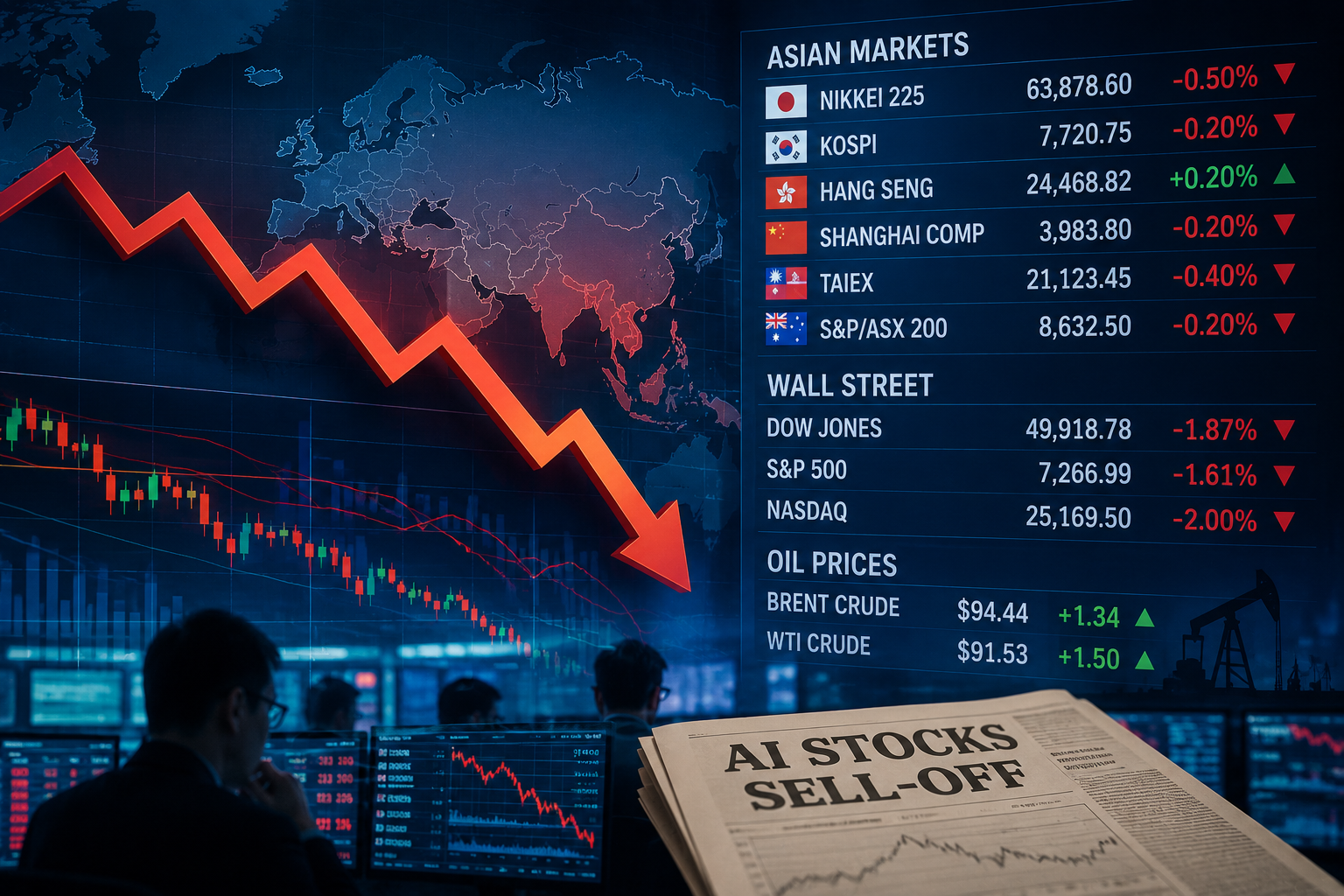
Nvidia, Super Micro and Other AI Giants Lead Global Sell-Off Amid Valuation Concerns and Rising Oil Prices
Asian stock markets traded mostly lower on Thursday after a fresh wave of selling in artificial intelligence-linked stocks triggered sharp declines across Wall Street. Investor sentiment remained under pressure as concerns over stretched valuations, rising inflation risks, higher oil prices, and uncertainty surrounding US interest-rate policy combined to create a risk-off environment across global financial markets.
The weakness highlights growing nervousness among investors after the extraordinary rally in AI-related stocks over the past year. Market participants are increasingly questioning whether current valuations can be justified amid slowing economic growth and rising macroeconomic risks.
Asian Equities Reflect Global Risk Aversion
Most major Asian indices ended the session in negative territory as investors reacted to the overnight weakness in US markets.
Japan's Nikkei index declined, while South Korea's Kospi and Australia's S&P/ASX 200 also traded lower. Taiwan's benchmark index slipped as technology stocks came under pressure following the sharp correction in global semiconductor and AI-related shares.
Chinese markets were relatively resilient, with Hong Kong's Hang Seng posting modest gains while the Shanghai Composite Index edged lower. However, broader sentiment across the region remained cautious as investors monitored developments in the technology sector and global geopolitical landscape.
The mixed performance underscores the uncertainty currently dominating international markets.
Wall Street's AI Leaders Continue to Lose Momentum
The latest decline was largely driven by renewed selling in artificial intelligence stocks, which have been among the strongest performers in global markets over the past two years.
The S&P 500 recorded its second consecutive decline, while the Nasdaq Composite—heavily weighted toward technology companies—suffered steeper losses. The Dow Jones Industrial Average also experienced a significant pullback as investors reduced exposure to risk assets.
Technology shares that had previously led the market's record-breaking rally became the primary source of weakness as concerns emerged regarding sustainability of future growth expectations.
Market participants are increasingly debating whether the AI sector is experiencing a healthy correction or the beginning of a more prolonged adjustment after an extended period of exceptional gains.
Nvidia and AI Stocks Face Valuation Scrutiny
At the center of the sell-off remains Nvidia, the company that has become synonymous with the global artificial intelligence boom.
Despite continuing to benefit from strong demand for AI chips and data-center infrastructure, Nvidia shares came under pressure as investors reassessed valuations following the stock's remarkable rise over the past year.
Other AI-linked companies, including semiconductor manufacturers, cloud infrastructure providers, and AI hardware suppliers, also witnessed significant declines.
The correction reflects a broader shift in market sentiment, with investors becoming more selective after months of aggressive buying driven by enthusiasm surrounding artificial intelligence.
Analysts note that even strong companies can face short-term valuation adjustments when expectations become excessively optimistic.
Super Micro's Capital Raise Triggers Fresh Selling
One of the biggest contributors to the latest market weakness was Super Micro Computer, a major supplier of AI-focused server infrastructure.
The company announced plans to raise additional capital through the issuance of shares and convertible securities, a move that raised concerns about potential dilution for existing shareholders.
Investors often view large capital raises cautiously because they increase the number of outstanding shares and can reduce earnings per share over time.
The announcement intensified selling pressure across the broader AI ecosystem, prompting investors to reassess risk levels in high-growth technology companies.
Rising Oil Prices Add to Market Anxiety
Technology sector concerns have coincided with another major challenge for global markets: sharply rising oil prices.
Crude oil prices have continued climbing amid escalating geopolitical tensions in the Middle East and ongoing disruptions to global energy supply routes. Concerns over shipping disruptions and reduced oil availability have pushed energy prices significantly higher in recent weeks.
Higher oil prices increase transportation and manufacturing costs, contribute to inflationary pressures, and reduce consumer spending power. These factors can negatively affect corporate earnings and economic growth prospects.
As a result, rising energy prices have become another source of uncertainty for equity investors worldwide.
Inflation Concerns Revive Interest Rate Fears
The increase in oil prices comes at a time when inflation remains a major concern for policymakers and investors.
Recent economic data has suggested that price pressures are proving more persistent than many market participants had anticipated. This has led to speculation that central banks may need to maintain higher interest rates for longer than previously expected.
Investors are increasingly concerned that the US Federal Reserve could delay interest-rate cuts or even consider additional tightening measures if inflation remains elevated.
Higher interest rates tend to weigh heavily on growth-oriented sectors such as technology because future earnings become less valuable when discounted at higher rates.
AI IPO Wave May Be Draining Liquidity
Another factor contributing to market volatility is the prospect of several high-profile AI-related public offerings expected in the coming months.
Large IPOs often attract significant investor capital, prompting fund managers to reduce positions in existing holdings to free up cash for new opportunities.
Market observers believe anticipation surrounding major AI listings could be contributing to short-term selling pressure across publicly traded technology companies.
While this does not necessarily indicate weakening fundamentals, it may increase volatility in the near term.
Global Markets Enter a More Selective Phase
The recent correction suggests investors are transitioning from a phase of broad-based enthusiasm toward a more selective approach.
During the early stages of the AI boom, companies with any connection to artificial intelligence often attracted strong investor interest. However, market participants are now placing greater emphasis on profitability, execution, competitive advantages, and sustainable earnings growth.
Companies that can demonstrate clear monetization of AI investments are likely to remain attractive, while firms relying primarily on market hype may face increasing scrutiny.
What Investors Should Watch Next
Several factors will shape market direction in the coming weeks:
- Future earnings reports from major AI companies
- Global inflation trends
- Federal Reserve policy decisions
- Developments in the Middle East conflict
- Oil price movements
- Upcoming technology IPOs and capital-raising activities
These events are expected to influence both market sentiment and investor positioning across global equity markets.