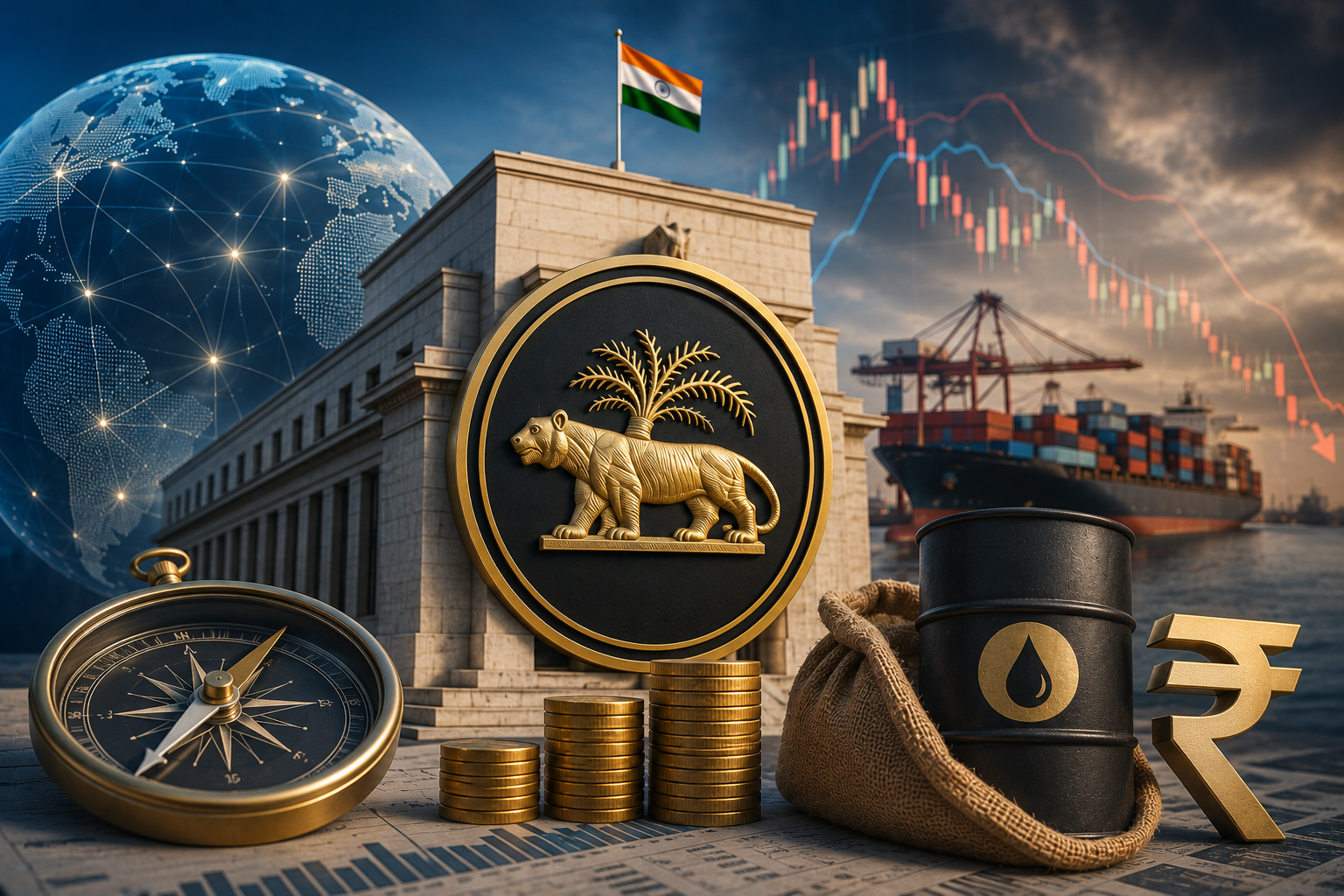
Beyond Interest Rates: Central Bank Focuses on Oil Prices, Capital Flows and Rupee Stability Amid Rising Global Uncertainty
The Monetary Policy Committee (MPC) maintained its neutral stance and left key policy rates unchanged, but the accompanying commentary highlighted concerns over rising crude oil prices, geopolitical tensions, global supply chain disruptions, volatile capital flows, and potential pressure on the Indian rupee.
For investors, the policy signals that the RBI's primary focus may no longer be inflation alone. Instead, protecting India's external stability appears to be emerging as a central theme that could shape monetary policy decisions throughout the year.
A Stable Rate Decision Masks Bigger Concerns
The decision to keep the repo rate unchanged was largely expected by economists and financial markets. Inflation has moderated significantly from previous highs, while economic growth remains relatively strong compared to most major economies.
However, the policy statement revealed a growing awareness that external developments could significantly influence India's economic outlook in the coming quarters.
The RBI raised its inflation forecast for FY27 to 5.1% and lowered its GDP growth projection to 6.6%, acknowledging that global conditions have become more challenging.
These revisions reflect concerns that higher energy costs, geopolitical disruptions, and weather-related uncertainties could simultaneously affect both growth and inflation.
Inflation Risks Are Largely Supply-Driven
Unlike traditional inflation cycles fueled by excessive consumer demand, the current inflation risks are primarily linked to supply-side factors.
The ongoing conflict in West Asia has increased volatility in global energy markets, pushing crude oil prices higher. Since India imports a substantial portion of its energy requirements, rising oil prices can quickly impact transportation costs, manufacturing expenses, and overall inflation.
Food inflation is another area being closely monitored by policymakers. Forecasts suggesting a weaker-than-normal monsoon and the possibility of El Niño weather conditions could affect agricultural output and food supplies.
The RBI has emphasized that underlying inflation remains relatively contained. Core inflation indicators continue to suggest that broad-based demand pressures are not yet a major concern.
This distinction is important because supply-driven inflation is often more difficult to control through interest rate increases alone.
Economic Growth Remains Resilient Despite Downgrade
While the RBI reduced its growth forecast for FY27 from 6.9% to 6.6%, the broader economic picture remains relatively healthy.
India's manufacturing and services sectors continue to show resilience, supported by strong domestic demand and improving business activity. Credit growth remains robust, infrastructure spending continues to expand, and private consumption has largely remained supportive.
Government capital expenditure programs and ongoing investments in infrastructure, manufacturing, and digital transformation are expected to provide additional support to economic activity.
The central bank's growth downgrade therefore reflects caution rather than concern about a significant slowdown.
The External Sector Becomes the Main Focus
The most notable aspect of the policy review was the attention devoted to India's external position.
Higher crude oil prices could widen the country's current account deficit by increasing import costs. At the same time, uncertainty in global financial markets has led to periodic capital outflows from emerging economies, including India.
Foreign portfolio investors have shown increased caution in recent months as global interest rates remain elevated and geopolitical risks persist.
These developments create challenges for currency stability and external financing, making the management of capital flows increasingly important.
The RBI's policy commentary suggests that maintaining adequate foreign exchange inflows and ensuring stability in the external account are becoming key policy objectives.
RBI Deploys New Tools Beyond Interest Rates
Recognizing that conventional monetary policy may not be sufficient to address external pressures, the RBI has introduced a series of targeted measures aimed at strengthening India's financial resilience.
Among the key initiatives announced are:
- Expanded access for foreign investors to long-duration government securities under the Fully Accessible Route (FAR).
- Incentives to attract Foreign Currency Non-Resident (FCNR) deposits.
- Concessional swap facilities for public sector enterprises raising overseas borrowings.
- Measures to improve foreign participation in India's debt markets.
- Steps to facilitate greater capital inflows and support rupee stability.
These reforms indicate that the RBI is increasingly relying on multiple policy tools rather than depending solely on interest rate adjustments.
Why the Rupee Matters More Than Ever
Currency stability remains a critical component of India's macroeconomic framework.
A sharp depreciation in the rupee can increase import costs, worsen inflationary pressures, and reduce investor confidence. Conversely, a stable currency helps manage inflation, supports foreign investment, and improves financial stability.
With global investors becoming more selective in allocating capital, maintaining confidence in India's external position is likely to remain a major priority for policymakers.
The RBI's strong foreign exchange reserve position provides an important buffer, but attracting sustainable capital inflows remains equally important.
What Investors Should Watch
The coming months are likely to be shaped by several key variables that could influence both markets and policy decisions.
Among the most important factors are:
- Crude oil price movements.
- Inflation trends.
- Monsoon performance and agricultural output.
- Global interest rate decisions.
- Geopolitical developments in West Asia.
- Foreign capital flows into Indian markets.
- Rupee stability.
Changes in any of these factors could significantly alter the outlook for inflation, growth, and monetary policy.
Outlook for FY27
The RBI's latest policy review suggests that India's economic challenges in FY27 may increasingly be linked to global developments rather than domestic weaknesses. While the economy remains fundamentally strong, policymakers are preparing for a period marked by higher uncertainty, volatile capital flows, and external shocks.
By maintaining a neutral stance while simultaneously strengthening the external sector through targeted reforms, the central bank is seeking to preserve flexibility in an increasingly unpredictable environment.
For investors, the message is clear: the trajectory of oil prices, foreign capital flows, and the rupee may prove more important than interest rate changes in determining market direction over the coming year. As global risks continue to evolve, the RBI appears focused on ensuring that India remains well-positioned to navigate potential turbulence while sustaining long-term economic growth.