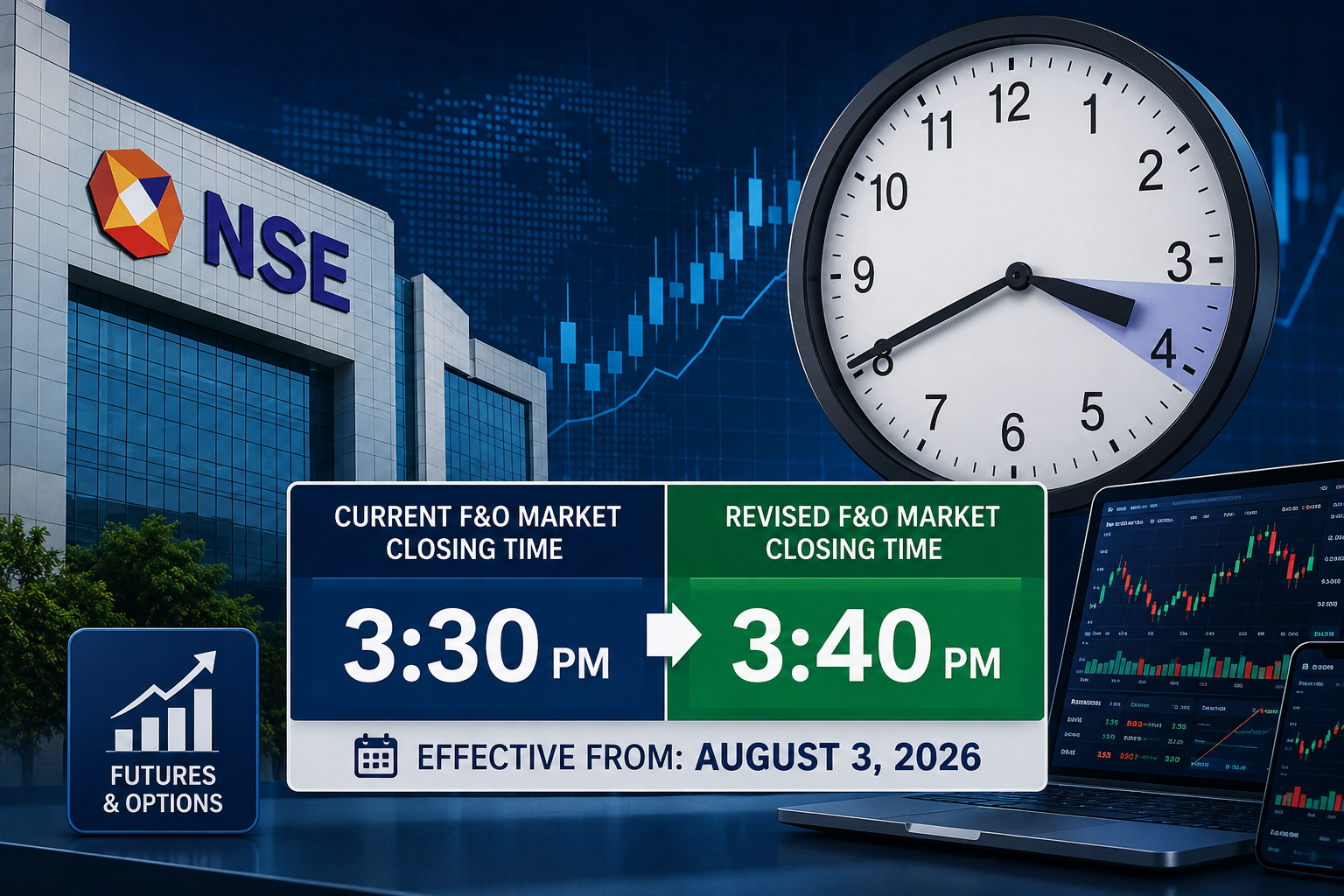
Equity Derivatives Market to Close at 3:40 PM as Exchange Introduces Major End-of-Day Trading Reforms
The National Stock Exchange (NSE) has announced significant changes to the equity derivatives trading framework, including an extension of trading hours in the Futures & Options (F&O) segment by 10 minutes. Effective August 3, 2026, trading in equity derivatives will now conclude at 3:40 PM instead of the current 3:30 PM, marking one of the most notable operational changes in recent years.
The move is part of the exchange's broader efforts to integrate the newly introduced Closing Auction Session (CAS) mechanism with the derivatives market and improve efficiency during the end-of-day trading process.
Major Change in Derivatives Market Timing
Under the revised framework, all index futures, stock futures, index options, and stock options contracts will continue trading until 3:40 PM. The extension is intended to provide market participants with additional time to react to final cash market price discovery and facilitate a smoother transition between cash and derivatives trading.
The exchange believes the change will improve market efficiency, enhance price alignment between the two segments, and strengthen the settlement process for derivative contracts.
Importantly, other market timings, including the pre-open session and trade modification windows, will remain unchanged.
Closing Auction Session Takes Center Stage
The timing revision is closely linked to the implementation of the Closing Auction Session in the cash market. The CAS framework is designed to improve the quality of closing price discovery by determining final closing prices through a transparent auction mechanism rather than relying solely on the last traded price.
Initially, the auction mechanism will apply to cash market securities that have corresponding derivative contracts. This is expected to create a more accurate and robust closing price, which plays a critical role in derivatives settlement and valuation.
Market experts believe the move brings Indian exchanges closer to international best practices followed by major global markets.
New Methodology for Price Discovery
A key feature of the revised framework is the introduction of separate reference price calculations for the cash and derivatives segments.
For stock futures contracts, the reference price will be derived from the Volume Weighted Average Price (VWAP) of trades executed between 3:00 PM and 3:15 PM. In situations where sufficient trading activity is unavailable, alternative pricing mechanisms such as the last traded price or theoretical valuation models may be used.
The exchange has also set stock futures price bands at ±3 percent of the reference price to ensure orderly trading and reduce excessive volatility during the closing phase.
Enhanced Risk Management Measures
The new framework incorporates additional safeguards aimed at maintaining market stability and protecting investors.
Orders that remain outside the revised price bands will be automatically cancelled by the system. Similarly, special order types such as stop-loss orders, disclosed quantity orders, and other unexecuted instructions may be removed during the transition process with appropriate notifications provided to market participants.
These measures are intended to minimize disruptions and ensure a smoother shift from continuous trading to the auction-based closing process.
Temporary Restrictions During Transition Window
To facilitate the transition from the Continuous Trading Session (CTS) to the Closing Auction Session, the exchange will implement temporary restrictions on order entry.
During specific transition periods, fresh order placement will not be permitted, and any new orders entered during that window will be automatically rejected. However, traders will continue to have the ability to modify or cancel existing limit orders until the auction process reaches its randomized closure.
The exchange believes these controls are necessary to preserve the integrity of the auction mechanism and ensure fair participation for all market participants.
Impact on Traders and Investors
The revised structure is expected to affect a wide range of market participants, including institutional investors, proprietary traders, hedge funds, retail traders, and market makers.
For derivatives traders, the additional 10-minute trading window could offer greater flexibility in managing positions and hedging exposures after observing final cash market developments. Institutional investors may also benefit from more efficient price discovery and improved alignment between cash and derivatives markets.
At the same time, traders will need to adapt their strategies, risk management systems, and execution algorithms to accommodate the revised trading timeline and auction-based closing framework.
Strengthening Market Infrastructure
The changes reflect NSE's ongoing efforts to modernize India's market infrastructure and improve operational efficiency. As trading volumes continue to grow and market participation broadens, exchanges are increasingly focused on enhancing transparency, strengthening risk controls, and improving the quality of price discovery.
The introduction of CAS-linked derivatives trading represents another step toward building a more sophisticated and globally competitive capital market ecosystem.
Outlook
The August 3 implementation date will mark an important milestone in the evolution of India's equity and derivatives markets. By extending F&O trading hours and integrating them more closely with the closing auction process, NSE aims to create a more efficient, transparent, and resilient market structure.
Market participants are expected to spend the coming weeks adjusting trading systems, operational workflows, and risk management practices ahead of the rollout. While the transition may require short-term adaptation, the long-term objective is to improve price accuracy, settlement efficiency, and overall market quality.
For investors and traders alike, the new framework could usher in a more refined and globally aligned end-of-day trading environment in India's rapidly growing capital markets.