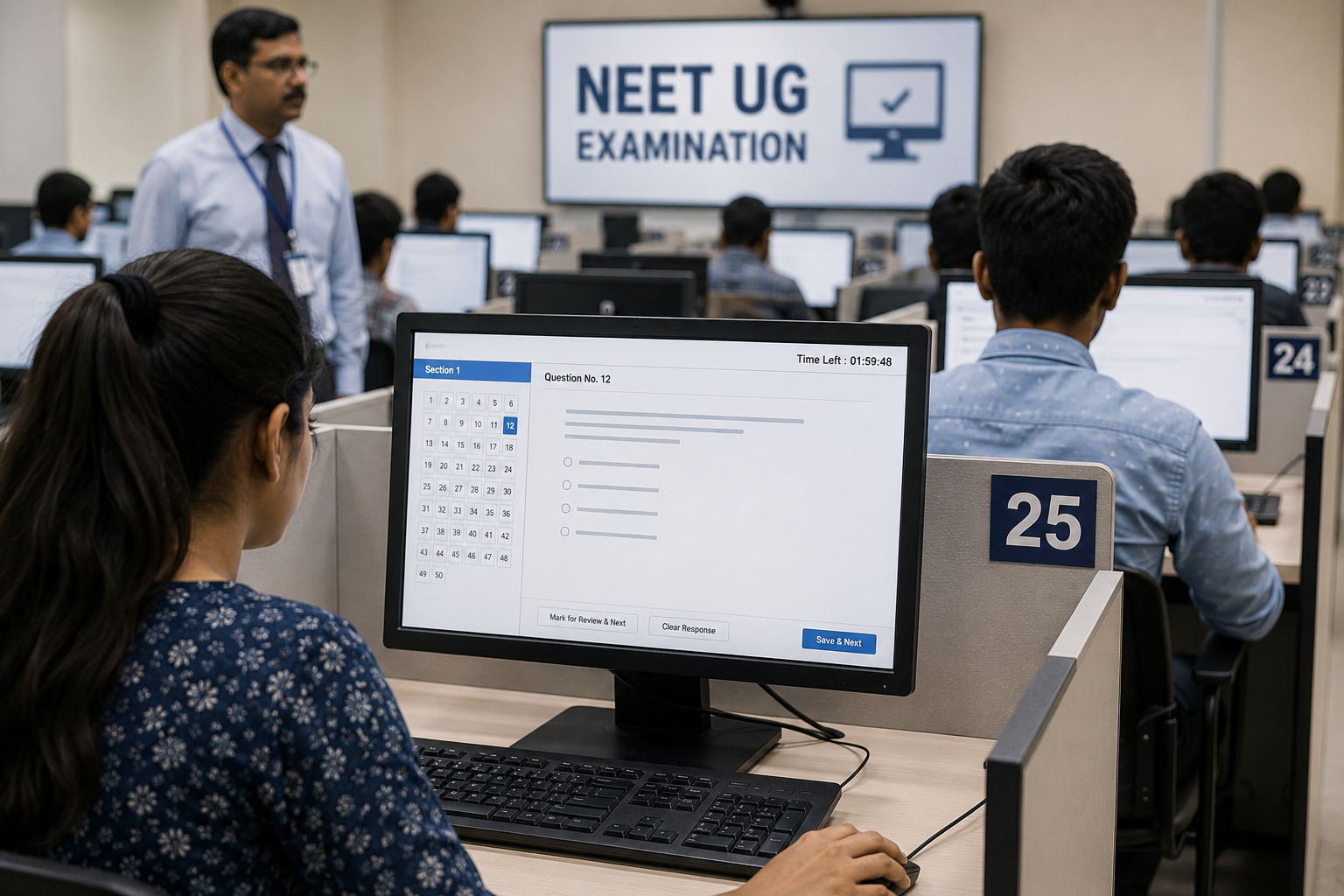
Government Announces Computer-Based NEET Exam and Fresh Measures to Restore Trust in Entrance Test System
The Union government has announced a major overhaul of India’s medical entrance examination system after the controversy surrounding the cancellation of NEET UG 2026 due to alleged paper leaks. Dharmendra Pradhan confirmed that the National Eligibility-cum-Entrance Test Undergraduate (NEET UG) will shift to a fully computer-based format from next year in an effort to strengthen security and improve transparency.
The announcement comes amid growing pressure on the National Testing Agency (NTA) following allegations that portions of the examination paper were leaked before the exam, sparking widespread concern among students, parents and education experts across the country.
The government has also confirmed that the cancelled NEET UG 2026 examination will be conducted again on June 21 with additional safeguards and procedural changes.
Paper Leak Controversy Shakes India’s Largest Medical Entrance Exam
The NEET UG 2026 examination, conducted earlier this month, was cancelled after reports emerged that a “guess paper” circulating before the exam allegedly contained actual questions from the test.
Authorities later verified that parts of the examination had indeed been compromised, forcing the government to cancel the nationwide examination and order a re-test.
The development triggered widespread criticism and raised fresh questions over the security and integrity of India’s competitive examination system, especially considering the massive scale of NEET UG, which is attempted by millions of students every year.
The controversy also reignited debates over organised exam fraud networks and the need for stronger digital safeguards in national-level recruitment and entrance examinations.
Government Adopts ‘Zero Error, Zero Tolerance’ Approach
Addressing the issue, Education Minister Dharmendra Pradhan said the government has adopted a “zero error, zero tolerance” policy for entrance examinations and promised strict action against those responsible for compromising the exam process.
The minister acknowledged that there had been a breach somewhere within the operational chain despite reforms introduced earlier based on committee recommendations aimed at improving examination security.
He said the government remains committed to ensuring that deserving candidates do not lose opportunities because of criminal activities linked to examination fraud.
Officials also stressed that systemic reforms are now being accelerated to restore confidence in the examination process.
Shift to Computer-Based Testing Marks Major Structural Change
The biggest reform announced by the government is the transition of NEET UG from the traditional OMR-sheet format to a fully Computer-Based Test (CBT) system beginning next year.
According to officials, the move is expected to significantly reduce the risk of paper leaks, manipulation and physical distribution-related vulnerabilities associated with large-scale offline examinations.
Computer-based testing will allow:
- Digital encryption of question papers
- Improved monitoring systems
- Better examination tracking
- Reduced physical handling of papers
- Faster processing and evaluation
The reform is being viewed as one of the most significant structural changes in India’s entrance examination system in recent years.
However, experts caution that the transition will require massive digital infrastructure expansion and careful execution to ensure equal access for students across urban and rural regions.
Re-Test Scheduled for June 21 with Additional Changes
The government has confirmed that the cancelled NEET UG 2026 examination will be re-conducted on June 21 without charging any additional fee from candidates.
Students will also be allowed to reselect their preferred examination city to improve convenience and logistical management.
In another important change, the duration of the examination has been extended by 15 minutes to reduce pressure on candidates during the re-test process.
Fresh admit cards are expected to be issued before the examination, while authorities have promised tighter security arrangements and stricter monitoring systems.
Pressure Mounts on National Testing Agency
The controversy has intensified scrutiny over the functioning of the National Testing Agency, which conducts several major entrance examinations in India.
Critics have questioned the agency’s operational preparedness, exam security framework and ability to prevent organised cheating networks from infiltrating high-stakes examinations.
Although the government defended the agency’s leadership, officials admitted that reforms and technological upgrades were necessary to improve reliability and restore public trust.
The NTA is now expected to strengthen:
- Cybersecurity protocols
- Question paper handling systems
- Monitoring mechanisms
- Candidate verification processes
- Digital examination infrastructure
The outcome of the upcoming re-test will likely play a major role in shaping public perception regarding the agency’s credibility.
Students Face Anxiety and Academic Uncertainty
The cancellation of the examination has caused significant emotional stress and uncertainty among lakhs of medical aspirants preparing for admission this year.
Many students have expressed concerns over:
- Reduced preparation time for the re-test
- Mental fatigue and anxiety
- Delays in counselling and admissions
- Fear regarding future examination security
Parents and student groups have demanded greater transparency, timely communication and stronger accountability mechanisms to prevent similar incidents in the future.
Education experts believe restoring confidence among students will be as important as implementing technical reforms.
Digital Transition May Create Infrastructure Challenges
While the move to CBT mode is being welcomed as a long-term reform, experts say India faces major logistical challenges in conducting one of the world’s largest entrance examinations entirely online.
The transition will require:
- Large-scale computer testing centres
- Reliable electricity and internet connectivity
- Enhanced cybersecurity systems
- Rural accessibility improvements
- Technical support infrastructure
Analysts believe authorities must ensure that students from remote and economically weaker backgrounds are not disadvantaged during the shift to digital testing.
The success of the transition will depend heavily on infrastructure readiness and effective coordination between central and state authorities.
Wider Debate Over Examination Reforms Intensifies
The NEET paper leak controversy has once again sparked national debate over the integrity of India’s competitive examination ecosystem.
Education experts and policymakers are now discussing broader reforms aimed at:
- Reducing examination malpractice
- Improving digital surveillance
- Increasing transparency in recruitment and admission systems
- Strengthening anti-cheating legislation
- Introducing faster investigative mechanisms
The incident has also drawn attention to the rapidly expanding coaching and examination industry, where high competition and commercial pressures often create vulnerabilities within the system.
Long-Term Impact on India’s Education System
The shift toward computer-based testing may eventually influence the future format of several other national entrance and recruitment examinations.
Analysts believe the government’s handling of the NEET crisis and the successful implementation of CBT mode could shape broader educational reforms across the country.
For now, authorities remain focused on conducting the June 21 re-test smoothly while ensuring stronger safeguards against malpractice and rebuilding trust among students and parents nationwide.