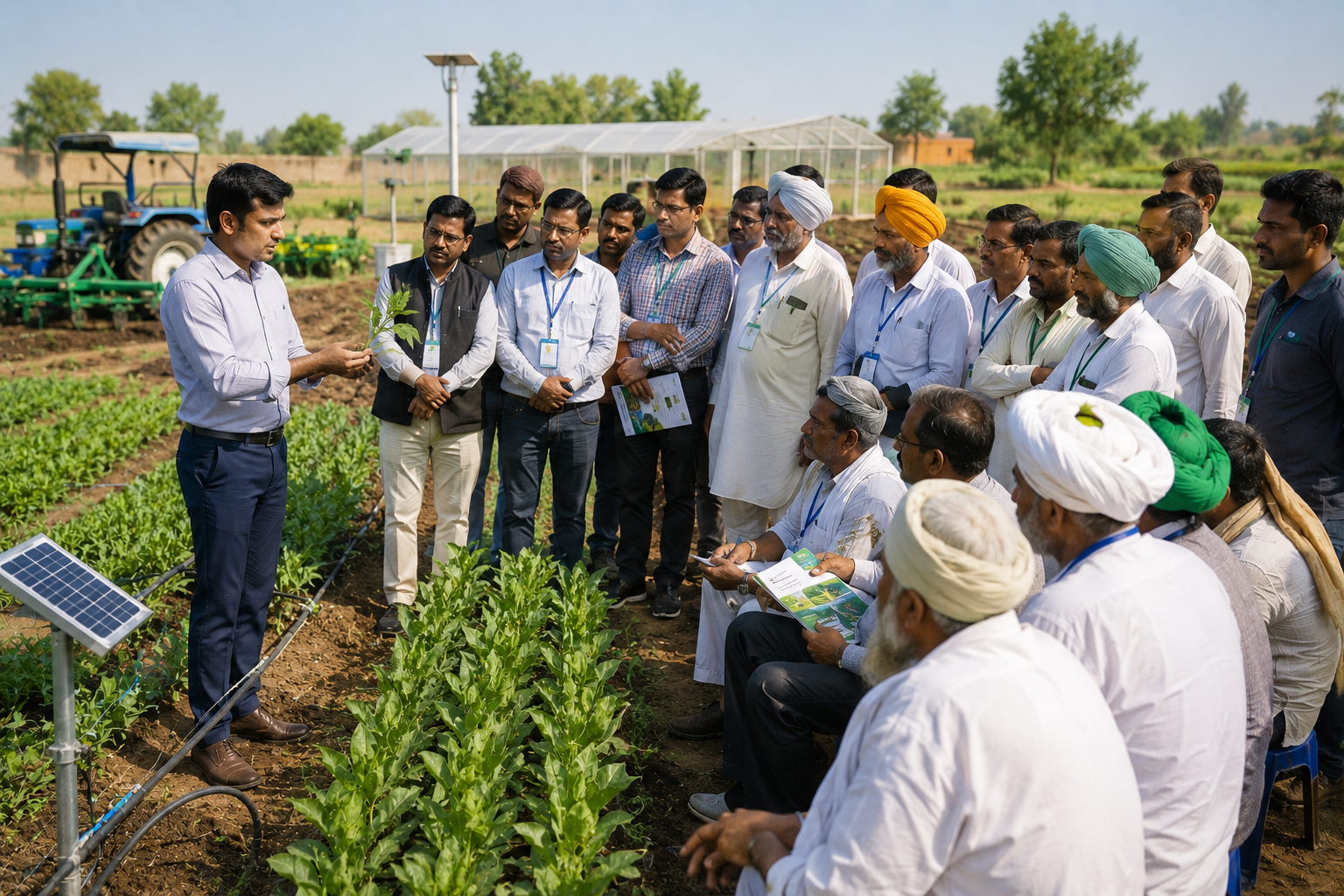
Initiative Aims to Promote Modern Farming, Technology Adoption and Better Market Awareness
The Haryana government has announced a major agricultural outreach initiative under which progressive farmers from every district of the state will be sent on exposure visits to different parts of India to learn modern farming practices, advanced technologies, and innovative agricultural models.
The announcement was made by Haryana Agriculture and Farmers Welfare Minister Shyam Singh Rana, who said the programme is intended to directly connect farmers with successful agricultural systems being implemented in other states.
The initiative forms part of the state government’s broader strategy to modernise agriculture, improve farmer income, encourage crop diversification, and promote sustainable farming practices amid changing climatic and market conditions.
Officials believe the programme can help farmers gain practical knowledge that can be applied directly in Haryana’s agricultural ecosystem.
Exposure Visits to Focus on Practical Agricultural Learning
Under the scheme, selected progressive farmers from every district in Haryana will travel to leading agricultural regions across India to study successful farming models and emerging technologies.
The exposure visits will cover:
- Advanced irrigation systems
- Precision farming techniques
- Organic and natural farming
- Integrated pest management
- Modern machinery usage
- High-yield crop practices
- Post-harvest management systems
- Agri-processing and value addition
The government hopes direct interaction with successful farmers and agricultural institutions will encourage Haryana farmers to adopt innovative and efficient cultivation practices.
Experts say practical exposure often has a stronger impact than traditional training programmes because farmers can witness real-world implementation and results.
Government Aims to Modernise Traditional Farming Practices
According to Shyam Singh Rana, the primary objective of the initiative is to bring positive transformation to traditional farming systems by introducing farmers to modern agricultural advancements.
The minister said many states have successfully adopted:
- Climate-smart agriculture
- Water-efficient cultivation
- Mechanised farming operations
- High-value horticulture models
- Technology-driven crop management systems
Through exposure visits, Haryana farmers will gain firsthand understanding of how such methods improve:
- Productivity
- Cost efficiency
- Sustainability
- Profitability
Officials believe exposure to innovative agricultural practices can accelerate rural transformation and strengthen long-term farm resilience.
Haryana Looking to Strengthen Agricultural Sustainability
Haryana remains one of India’s most important agricultural states, contributing significantly to national food grain production.
However, the state is also facing growing agricultural challenges including:
- Declining groundwater levels
- Soil degradation
- Rising input costs
- Dependence on water-intensive crops
- Climate variability
The government has increasingly focused on promoting:
- Crop diversification
- Sustainable irrigation
- Balanced fertiliser use
- Alternative crops
- Resource-efficient farming
The exposure programme is expected to support these policy objectives by encouraging farmers to explore more sustainable agricultural practices.
Farmers to Explore New Market Opportunities
Apart from learning cultivation techniques, the exposure visits will also introduce farmers to evolving agricultural market systems and business opportunities.
Participants are expected to learn about:
- Direct farm marketing models
- Food processing industries
- Farmer producer organisations (FPOs)
- Agri-export opportunities
- Contract farming systems
- Digital agriculture platforms
Officials believe improving market awareness can help farmers:
- Increase income opportunities
- Reduce dependence on traditional mandi systems
- Improve price realisation
- Develop value-added agricultural businesses
The initiative could particularly benefit younger farmers looking to combine agriculture with entrepreneurship.
Technology Becoming Key Driver of Agriculture
The programme comes at a time when Indian agriculture is increasingly adopting technology-driven solutions.
Modern agricultural systems now involve:
- Drone-based spraying and monitoring
- AI-driven crop analysis
- Precision irrigation systems
- Satellite-based weather monitoring
- Smart fertiliser application
- Farm automation tools
Many progressive farming regions across India have already integrated such technologies to improve:
- Yield quality
- Water management
- Pest control
- Operational efficiency
The Haryana government hopes exposure to these technologies will encourage wider adoption among local farmers.
Farmer-to-Farmer Knowledge Sharing Encouraged
Agricultural experts often consider farmer exposure programmes highly effective because they encourage peer-based learning and practical understanding.
Farmers participating in the visits will have opportunities to:
- Interact directly with successful cultivators
- Understand challenges and solutions
- Observe operational techniques firsthand
- Learn from real farming experiences
Such programmes often help reduce hesitation toward adopting new farming methods because participants can directly see successful implementation and financial benefits.
The initiative may also help build long-term agricultural knowledge-sharing networks across states.
Focus on Youth Participation in Agriculture
Officials are also encouraging younger farmers to participate actively in the exposure visits.
The government believes modernising agriculture and introducing technology-driven farming can help attract younger generations toward the agriculture sector.
Youth-focused agricultural initiatives increasingly emphasise:
- Agri-startups
- Smart farming
- Sustainable cultivation
- Digital agriculture platforms
- Value-added farming businesses
Analysts believe exposure to innovative agricultural models may inspire rural youth to pursue agriculture as a modern and profitable enterprise.
Sustainable and Climate-Resilient Farming in Focus
Climate resilience is expected to remain a major theme during the exposure visits.
Farmers will likely be introduced to techniques related to:
- Water conservation
- Soil health management
- Climate-adaptive crops
- Organic nutrient management
- Efficient irrigation practices
Experts warn that climate change and erratic weather patterns are creating increasing pressure on traditional farming systems across India.
Exposure to successful sustainable agriculture models could help Haryana farmers better prepare for future environmental challenges.
Potential Economic Benefits for Rural Areas
If successfully implemented, the initiative could contribute to:
- Higher farm productivity
- Better crop diversification
- Increased rural income
- Reduced cultivation costs
- Improved market access
The programme may also encourage:
- Agricultural entrepreneurship
- Rural employment generation
- Adoption of high-value crops
- Stronger agri-business ecosystems
Government officials believe modern agricultural exposure can play a major role in strengthening rural economic development.
Haryana Expanding Agricultural Reform Efforts
The exposure visit programme is part of Haryana’s broader efforts to modernise agriculture through:
- Farmer education
- Technology integration
- Infrastructure support
- Irrigation efficiency
- Sustainable farming policies
The state has increasingly invested in:
- Micro-irrigation systems
- Farmer training programmes
- Crop diversification schemes
- Horticulture promotion
- Digital agricultural services
Officials say such reforms are necessary to ensure long-term agricultural competitiveness and food security.
Outlook
The Haryana government’s decision to send progressive farmers on inter-state exposure visits reflects a growing emphasis on knowledge-driven, technology-enabled, and sustainable agriculture.
By exposing farmers to successful agricultural models from across India, the initiative aims to accelerate innovation adoption, improve productivity, and strengthen rural incomes.
As Indian agriculture continues evolving amid climate pressures, technological disruption, and changing market dynamics, practical learning programmes like these could become increasingly important in shaping the future of farming and rural development.