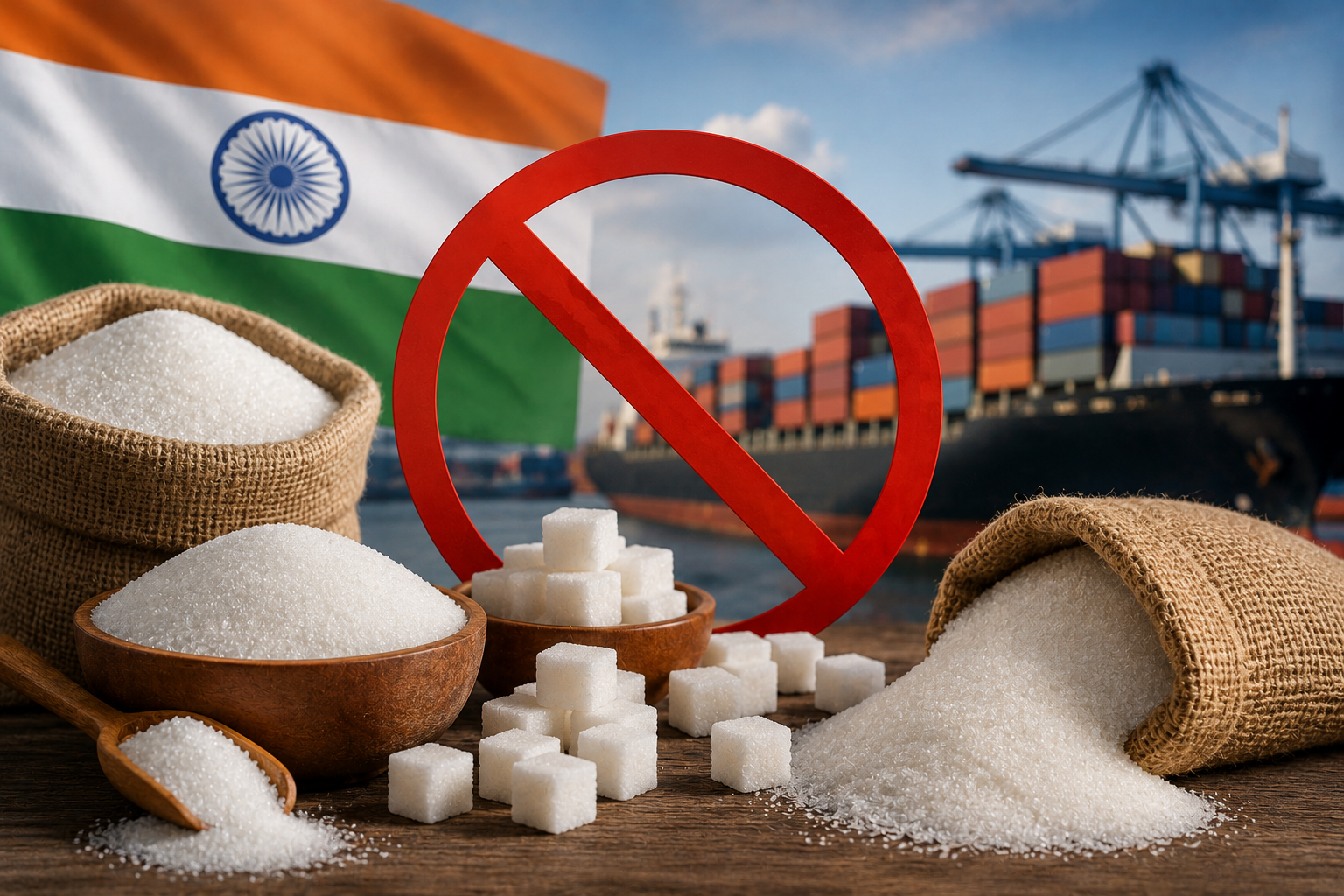
Government Imposes Immediate Export Ban on Sugar
India has imposed an immediate ban on exports of raw, white, and refined sugar until September 30, or until further orders, in a major policy move aimed at protecting domestic supplies and controlling local price pressures.
The decision was announced through a notification issued by the Directorate General of Foreign Trade (DGFT) under the Ministry of Commerce and Industry. The government has officially shifted sugar exports from the “restricted” category to “prohibited,” effectively halting overseas shipments for the coming months.
However, the ban will not apply to exports to the United States and the European Union under existing tariff-rate quota (TRQ) arrangements and bilateral commitments.
The move comes amid rising concerns over domestic sugar availability, food inflation risks, and growing uncertainty in agricultural commodity markets.
Why India Has Banned Sugar Exports
India’s decision reflects increasing concerns over balancing domestic consumption needs with export commitments.
The government appears focused on:
- Ensuring adequate domestic sugar availability
- Preventing sharp price increases
- Protecting food inflation levels
- Maintaining buffer stocks
- Managing supply during festive demand periods
Sugar is considered a politically sensitive commodity in India because of its direct impact on food prices, rural incomes, and inflation trends.
With global food commodity markets remaining volatile due to weather disruptions, geopolitical tensions, and supply-chain uncertainties, policymakers are prioritising domestic stability over export earnings.
India’s Position in Global Sugar Markets
India is one of the world’s largest sugar producers and exporters, alongside countries such as Brazil and Thailand.
Over the past few years, Indian sugar exports expanded significantly due to:
- Strong domestic production
- Government export incentives
- Competitive global pricing
- Rising international demand
Indian sugar became an important source of supply for several global buyers, especially in Asia, Africa, and the Middle East.
The latest export restrictions could therefore influence global sugar availability and pricing trends in the international market.
Global Sugar Prices May Rise Further
Analysts believe the export ban could tighten global sugar supplies and increase international prices, particularly if adverse weather conditions continue affecting major producing regions.
India’s absence from the export market may:
- Reduce global sugar availability
- Increase price volatility
- Tighten supply chains for importing nations
- Shift demand toward Brazil and Thailand
Commodity traders are closely monitoring how long the restrictions remain in place and whether other exporting countries can offset the supply gap.
The move may also increase pressure on countries heavily dependent on imported sugar.
Domestic Market Stability Takes Priority
The government’s decision highlights growing concern over maintaining stable domestic prices amid fluctuating agricultural output and rising food inflation risks.
Authorities are likely trying to prevent:
- Sudden spikes in retail sugar prices
- Supply shortages during high-demand seasons
- Pressure on food inflation indicators
India’s food inflation remains an important factor for policymakers and the Reserve Bank of India, particularly at a time when fuel inflation and wholesale prices are already rising sharply.
By restricting exports, the government aims to ensure that adequate sugar stocks remain available for household consumption and industrial use.
Impact on Sugar Mills and Exporters
The export ban is expected to have mixed implications for India’s sugar industry.
While domestic supply security may improve, sugar mills and exporters could face:
- Reduced export revenues
- Inventory accumulation
- Pressure on profit margins
- Slower overseas trade activity
Companies heavily dependent on international markets may experience short-term financial strain if domestic prices remain lower than export realisations.
However, stable domestic availability could benefit industries that rely heavily on sugar as an input, including:
- Food processing
- Beverages
- Confectionery manufacturing
Farmers May Watch Government Support Measures
India’s sugar sector supports millions of sugarcane farmers across states such as:
- Uttar Pradesh
- Maharashtra
- Karnataka
Any prolonged export restrictions could eventually affect mill cash flows and farmer payments if inventory levels rise significantly.
Industry experts believe the government may continue monitoring:
- Cane production levels
- Domestic consumption trends
- Monsoon conditions
- Sugar stock availability
before taking further policy decisions.
Inflation and Food Security Remain Key Concerns
The export ban also reflects the government’s broader focus on controlling inflation and strengthening food security.
India has recently taken multiple steps to regulate exports of key food commodities whenever domestic supply pressures emerge. Policymakers remain cautious because rising food prices can:
- Increase household expenses
- Hurt lower-income consumers
- Fuel broader inflationary pressure
- Affect economic sentiment
The sugar ban is therefore part of a wider strategy to prioritise domestic market stability during a period of global commodity uncertainty.
Exceptions for US and EU Continue
Despite the broad restrictions, India will continue fulfilling export commitments to the United States and the European Union under tariff-rate quota agreements.
These arrangements allow limited quantities of sugar exports under preferential trade terms and are linked to existing international obligations.
The exemption helps India maintain trade credibility while still tightening overall export flows.
Outlook
India’s decision to ban sugar exports marks a significant intervention in agricultural commodity trade as the government prioritises domestic supply stability and inflation control.
While the move may help contain local prices and strengthen food security in the short term, it could also tighten global sugar markets and impact export-oriented businesses.
Future policy decisions are likely to depend on:
- Domestic sugar production
- Monsoon performance
- Inflation trends
- Global commodity prices
- Stock availability
For now, the government appears focused on ensuring that domestic demand remains adequately supplied amid increasing uncertainty across global agricultural and energy markets.