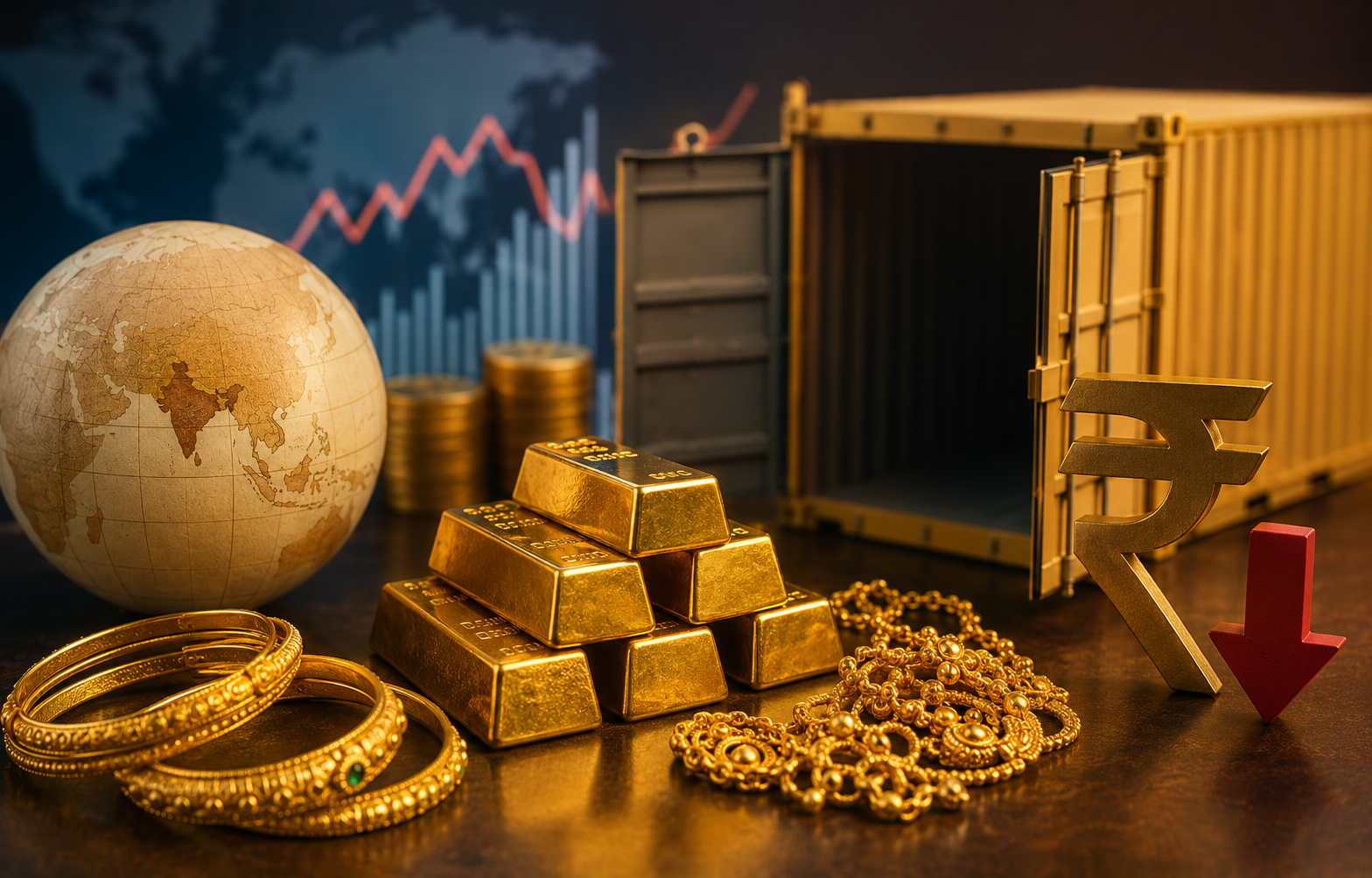
Government Targets Gold Imports to Protect External Stability
India’s decision to sharply raise customs duty on gold and silver imports reflects growing concern over the country’s widening trade deficit and rising pressure on the Current Account Deficit (CAD). The government recently increased import duty from 6 per cent to 15 per cent, aiming to curb non-essential imports, conserve foreign exchange reserves, and stabilise the rupee amid global economic uncertainty.
While the move may temporarily slow official gold imports, economists and industry experts believe that taxation alone cannot solve India’s structural dependence on gold. Instead, they warn that higher duties may revive smuggling networks, weaken formal jewellery businesses, and shift demand toward informal markets.
Record Gold Imports Raise Macro Concerns
India remains one of the world’s largest consumers of gold, driven by cultural traditions, weddings, festivals, and investment demand. According to Commerce Ministry data, gold imports surged 24 per cent to a record $71.98 billion in FY26, compared to $58 billion in FY25.
Although import volumes declined marginally, rising global gold prices significantly increased the overall import bill. Gold and silver together now account for nearly 10–11 per cent of India’s total merchandise imports, making them a major contributor to external-sector stress after crude oil.
The rise in imports comes at a time when India is already facing pressure from elevated energy prices, currency volatility, and global geopolitical uncertainties.
Why the Government Raised Import Duty
From a policy perspective, raising customs duty on gold offers immediate short-term advantages. Higher import taxes can:
- Reduce formal gold demand
- Lower dollar outflows
- Improve customs revenue
- Support rupee stability
- Signal tighter external-sector discipline
The government’s strategy appears focused on discouraging discretionary imports while protecting foreign exchange reserves without increasing politically sensitive fuel prices.
However, experts say the effectiveness of such measures is limited because gold demand in India is deeply embedded in social and financial behaviour.
India’s Deep Cultural and Financial Attachment to Gold
Unlike many other countries where gold is viewed mainly as a luxury commodity, Indian households treat gold as a long-term store of wealth and financial security.
Gold plays a central role in:
- Weddings and festivals
- Rural household savings
- Inflation protection
- Emergency financial backup
- Intergenerational wealth transfer
Because of this, demand often remains resilient even when prices rise sharply.
Analysts believe higher duties may delay purchases temporarily, but they rarely eliminate structural demand. Consumers often continue buying smaller quantities or shift purchases to informal channels.
Smuggling Risks Could Rise Again
One of the biggest concerns linked to higher gold duties is the possible resurgence of smuggling.
When the price gap between domestic and international gold widens due to higher taxes, illegal trade becomes increasingly profitable. Experts point out that India witnessed a similar situation during the 2012–13 period when gold smuggling surged after repeated duty hikes.
Higher duties now create several risks:
- Increased cross-border smuggling
- Expansion of grey-market trading
- Lower transparency in the jewellery sector
- Continued unofficial foreign exchange leakage
This could weaken the actual impact of the policy even if official import data shows improvement.
Organised Jewellers May Face Greater Pressure
Formal jewellery retailers and organised players are likely to bear the biggest burden from higher import duties.
With rising procurement costs, compliant jewellers may struggle to compete against unregulated operators offering lower prices through unofficial channels. Industry experts warn that this could:
- Reduce footfall in organised stores
- Increase cash-based transactions
- Slow down market formalisation
- Hurt transparent invoice-based businesses
Over the last decade, India has worked toward improving transparency and compliance in the jewellery market through hallmarking, GST integration, and digital invoicing. A large shift back toward informal trading could reverse some of these gains.
Structural Reforms Seen as the Real Solution
Economists increasingly believe that India’s long-term solution lies not in repeatedly raising import duties, but in reducing dependence on imported physical gold altogether.
Experts suggest the government should strengthen:
- Sovereign Gold Bonds (SGBs)
- Gold Exchange Traded Funds (ETFs)
- Electronic Gold Receipts (EGRs)
- Gold monetisation schemes
- Gold recycling infrastructure
These financial alternatives allow investors to gain exposure to gold without increasing physical imports.
Electronic Gold Receipts, in particular, are being viewed as a potentially transformative reform because they provide transparent, exchange-traded exposure to gold holdings.
Household Savings Behaviour Holds the Key
India’s massive household gold ownership remains one of the biggest untapped resources in the economy. Experts believe encouraging households to monetise idle gold through deposit schemes and lending systems could significantly reduce fresh import demand.
Financial analysts say better liquidity, tax clarity, and stronger investor awareness could gradually encourage households to move toward financial gold products instead of physical bullion.
At the same time, expanding gold recycling can help meet domestic demand without increasing import dependence.
CAD Management Requires a Broader Strategy
While the higher duty hike may provide temporary support to India’s external balances, experts believe it is unlikely to deliver meaningful long-term CAD relief on its own.
India’s broader macroeconomic challenge involves balancing:
- Rupee stability
- Inflation risks
- Household savings behaviour
- Cultural consumption patterns
- Fiscal revenue needs
- Market formalisation
As oil prices and global uncertainties continue to influence India’s trade position, policymakers may need a more balanced and structural approach rather than relying solely on taxation.
Outlook
Higher gold import duties may slow official imports in the short term, but India’s deep-rooted demand for gold is unlikely to disappear. Without stronger reforms in financial gold adoption, recycling, and monetisation, the country may simply witness a shift from formal imports to informal trade channels.
For lasting relief to the Current Account Deficit, India will need to gradually transform how households save, invest, and store wealth — reducing dependence on imported physical gold while strengthening alternative financial instruments.