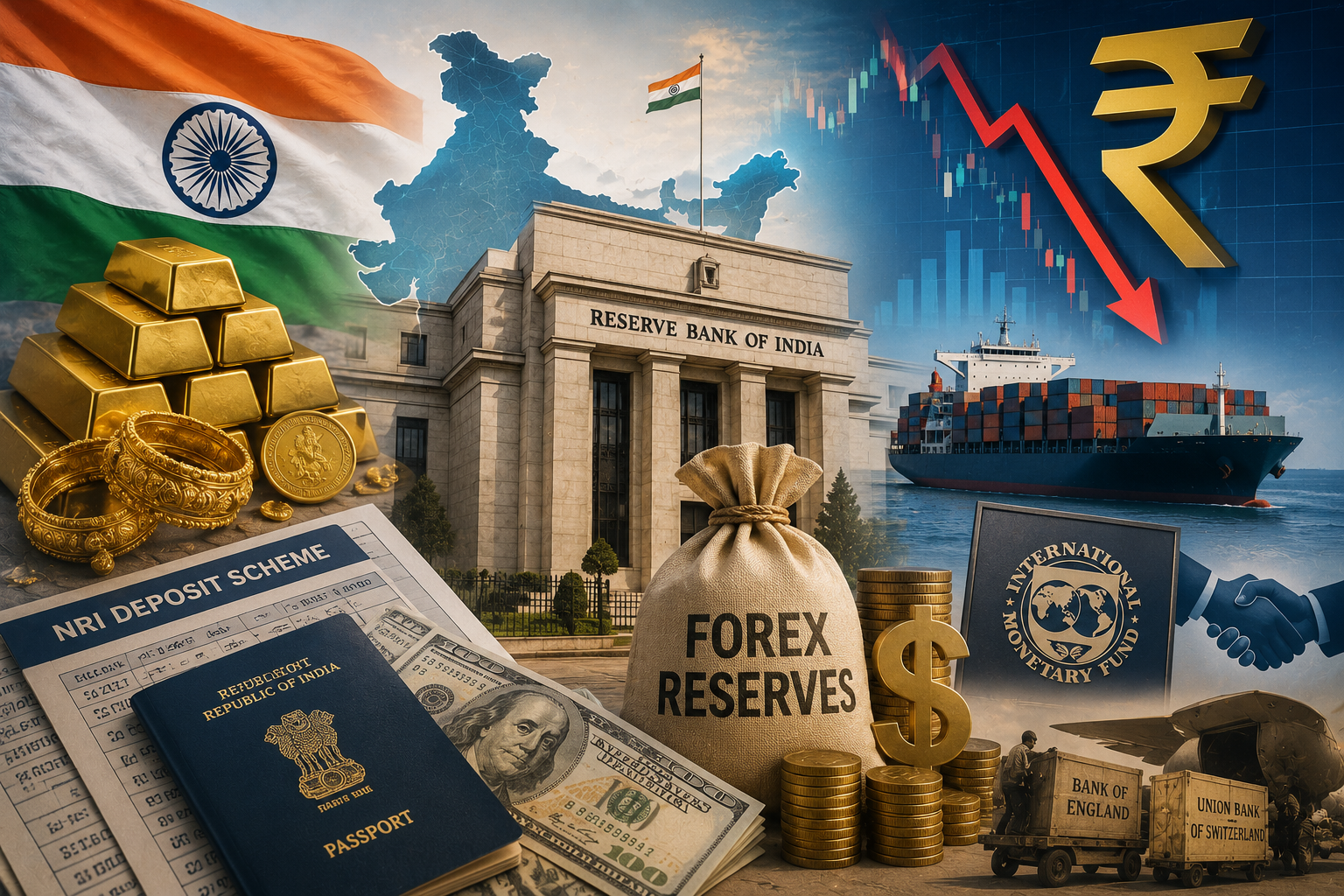
PM Modi’s Austerity Appeal Revives Focus on India’s Historical Forex Defence Measures
Prime Minister Narendra Modi’s recent appeal for austerity and responsible consumption amid escalating geopolitical tensions in West Asia has once again brought attention to how India historically protected its foreign exchange reserves during periods of economic stress and external shocks.
The Prime Minister urged citizens to:
- Conserve fuel
- Avoid unnecessary foreign travel
- Postpone gold purchases
- Reduce non-essential dollar outflows
The appeal comes at a time when rising crude oil prices, geopolitical uncertainty and currency volatility are increasing pressure on India’s external sector.
On Tuesday, the Indian rupee weakened to a record low of 95.63 against the US dollar in early trade, highlighting concerns surrounding the country’s import bill, current account deficit and foreign exchange reserves.
According to the Reserve Bank of India (RBI), India’s forex reserves stood at approximately $691.11 billion as of March 2026.
India’s Historical Approach to Defending Forex Reserves
Over the decades, India has relied on a combination of policy tools to defend the rupee and maintain external sector stability during crises.
India’s Core Forex Defence Strategy
- Reducing dollar outflows
- Attracting foreign currency inflows
- Seeking emergency external financing when necessary
Successive governments and policymakers have used measures such as:
- Gold import restrictions
- NRI deposit mobilisation schemes
- Foreign currency bonds
- IMF-backed emergency financing
- Currency intervention by RBI
These strategies have helped India navigate multiple global and domestic economic shocks over the years.
Gold Import Curbs Used to Reduce Dollar Outflows
2022: Government Raised Gold Import Duty
One of the more recent examples came in 2022 when the Indian government sharply increased gold import duties to curb excessive imports and reduce pressure on forex reserves.
Key Policy Move
- Gold import duty raised from 10.75% to 15%
The decision was taken amid:
- Rising crude oil prices
- Weakening rupee
- Russia-Ukraine conflict
- Expanding current account deficit
India is one of the world’s largest gold consumers and depends heavily on imports to meet domestic demand.
Why Gold Imports Matter for India
High gold imports significantly increase India’s dollar outflows because gold purchases are largely denominated in US dollars.
Impact of Rising Gold Imports
- Higher import bill
- Pressure on forex reserves
- Widening current account deficit
- Increased demand for dollars
- Rupee depreciation risks
Economists have often viewed gold import management as an important tool for protecting India’s external account during periods of economic stress.
2013 FCNR(B) Scheme Helped Stabilise the Rupee
RBI Mobilised Massive Dollar Deposits From NRIs
One of India’s most successful forex stabilisation measures was launched in 2013 when the Reserve Bank of India introduced a concessional swap window to attract foreign currency deposits from Non-Resident Indians (NRIs).
The move came during a period of severe rupee weakness caused by global market turbulence following concerns around US Federal Reserve tapering.
Key Features of the FCNR(B) Scheme
- RBI initially targeted $10 billion
- Eventually mobilised around $30 billion
- Special swap facility offered to banks
- Minimum three-year deposit tenure
- Fixed swap rate of 3.5%
The scheme significantly boosted India’s forex reserves and restored investor confidence.
FCNR Scheme Reduced External Vulnerability
The inflows helped India:
- Strengthen dollar reserves
- Stabilise the rupee
- Improve liquidity
- Reduce pressure on imports
- Ease external financing concerns
Economists continue to regard the FCNR(B) programme as one of India’s most effective currency defence measures.
India Millennium Deposit Scheme in 2000
SBI Raised Billions to Support Forex Reserves
In 2000, State Bank of India launched the India Millennium Deposit Scheme to strengthen forex reserves amid rising oil prices and growing pressure on the rupee.
Highlights of the Scheme
- Attractive 8.5% return offered
- Mobilised around $5.5 billion
- Targeted overseas Indian investors
At the time, India’s forex reserves had declined significantly and the rupee had weakened sharply against the dollar.
The scheme helped improve reserve levels and stabilise market sentiment.
1998 Resurgent India Bonds After Nuclear Sanctions
India Faced Severe External Pressure Post Pokhran-II
Following India’s Pokhran-II nuclear tests in 1998, economic sanctions imposed by the United States and other countries sharply reduced capital inflows and increased pressure on India’s foreign exchange position.
To counter the crisis, State Bank of India launched Resurgent India Bonds aimed at attracting foreign currency inflows from NRIs.
Key Achievements of the Programme
- Raised approximately $4.23 billion
- Strengthened forex reserves
- Supported rupee stability
- Improved investor confidence
The programme became an important source of dollar inflows during heightened geopolitical and economic uncertainty.
1991 Balance of Payments Crisis Remains Historic Turning Point
India Faced One of Its Worst Economic Crises
India’s most severe forex crisis occurred in 1991 when the country faced a major balance-of-payments emergency driven by:
- Unsustainable borrowing
- High fiscal deficits
- Weak export performance
- Rising import dependence
- Political instability
At the peak of the crisis:
- Current account deficit surged to 3.1% of GDP
- Forex reserves fell to critically low levels
- India reportedly had reserves sufficient for only a few weeks of imports
The crisis marked one of the most difficult economic phases in independent India’s history.
India Pledged Gold to Raise Emergency Funds
In response to the crisis, the Indian government secured emergency financing support from the International Monetary Fund (IMF).
As part of the effort:
- 67 tonnes of gold reserves were pledged
- Gold was airlifted to foreign banks
- India raised approximately $600 million in emergency funds
Gold Transfers Included
- 47 tonnes sent to the Bank of England
- 20 tonnes sent to Union Bank of Switzerland
The episode remains one of the most symbolic moments in India’s economic history.
India Development Bonds Introduced in 1991
Special Bonds Targeted Overseas Indians
During the same crisis period, State Bank of India launched India Development Bonds to attract foreign exchange inflows from NRIs.
The bonds helped:
- Improve dollar liquidity
- Support forex reserves
- Ease pressure on the external account
The programme reflected India’s increasing reliance on overseas Indian capital during periods of external vulnerability.
RBI Continues Active Currency Management
Central Bank Intervening to Stabilise Rupee
The Reserve Bank of India continues to actively manage currency volatility through multiple measures.
Recent RBI Actions
- Selling dollars from forex reserves
- Controlling speculative rupee trades
- Tightening arbitrage activity
- Managing market liquidity
Analysts believe RBI intervention remains critical in limiting excessive rupee volatility during periods of geopolitical uncertainty.
West Asia Conflict Raises Fresh External Sector Risks
Rising Crude Oil Prices Increasing Pressure on India
The ongoing conflict in West Asia has once again increased concerns regarding:
- Crude oil import costs
- Shipping disruptions
- Current account deficit
- Inflationary pressure
- Rupee stability
India imports nearly 90% of its crude oil requirements, making the economy highly vulnerable to global energy shocks.
Higher Oil Prices Could Widen CAD
Economists warn that sustained crude oil prices above $100 per barrel could sharply increase India’s import bill and widen the current account deficit.
Key Risks Being Monitored
- Rising energy costs
- Weakening rupee
- Imported inflation
- Foreign capital flow volatility
- Pressure on fiscal balance
The situation has revived concerns similar to earlier periods of external account stress.
India’s Forex Position Stronger Than Earlier Crises
Current Reserve Levels Provide Strong Buffer
Despite current challenges, analysts note that India’s forex reserve position today is significantly stronger compared to previous crises such as 1991 or 2013.
Strengths Supporting India
- Large forex reserves
- Improved external financing capability
- Stronger banking system
- Diversified export base
- Better macroeconomic management
However, policymakers remain cautious as prolonged geopolitical tensions could continue to pressure global markets.
Austerity and Prudence Once Again Become Policy Themes
Government Encouraging Responsible Consumption
PM Modi’s recent appeal reflects growing concerns about preserving macroeconomic stability during uncertain global conditions.
The government’s message emphasizes:
- Energy conservation
- Reduced non-essential imports
- Responsible spending
- Forex preservation
Economists believe such measures could help moderate external pressures if geopolitical tensions persist.
Outlook: External Stability Remains Key Economic Priority
As global uncertainty, crude oil volatility and geopolitical tensions continue to rise, protecting India’s external sector stability remains a major priority for policymakers.
Analysts believe India’s historical experience in managing forex crises offers valuable lessons for navigating the current environment.
Key Areas Likely to Remain in Focus
- Forex reserve management
- Import control measures
- Energy conservation
- Currency stability
- External financing preparedness
While India’s macroeconomic position remains far stronger than in earlier crisis periods, policymakers are expected to remain vigilant as global risks continue evolving.