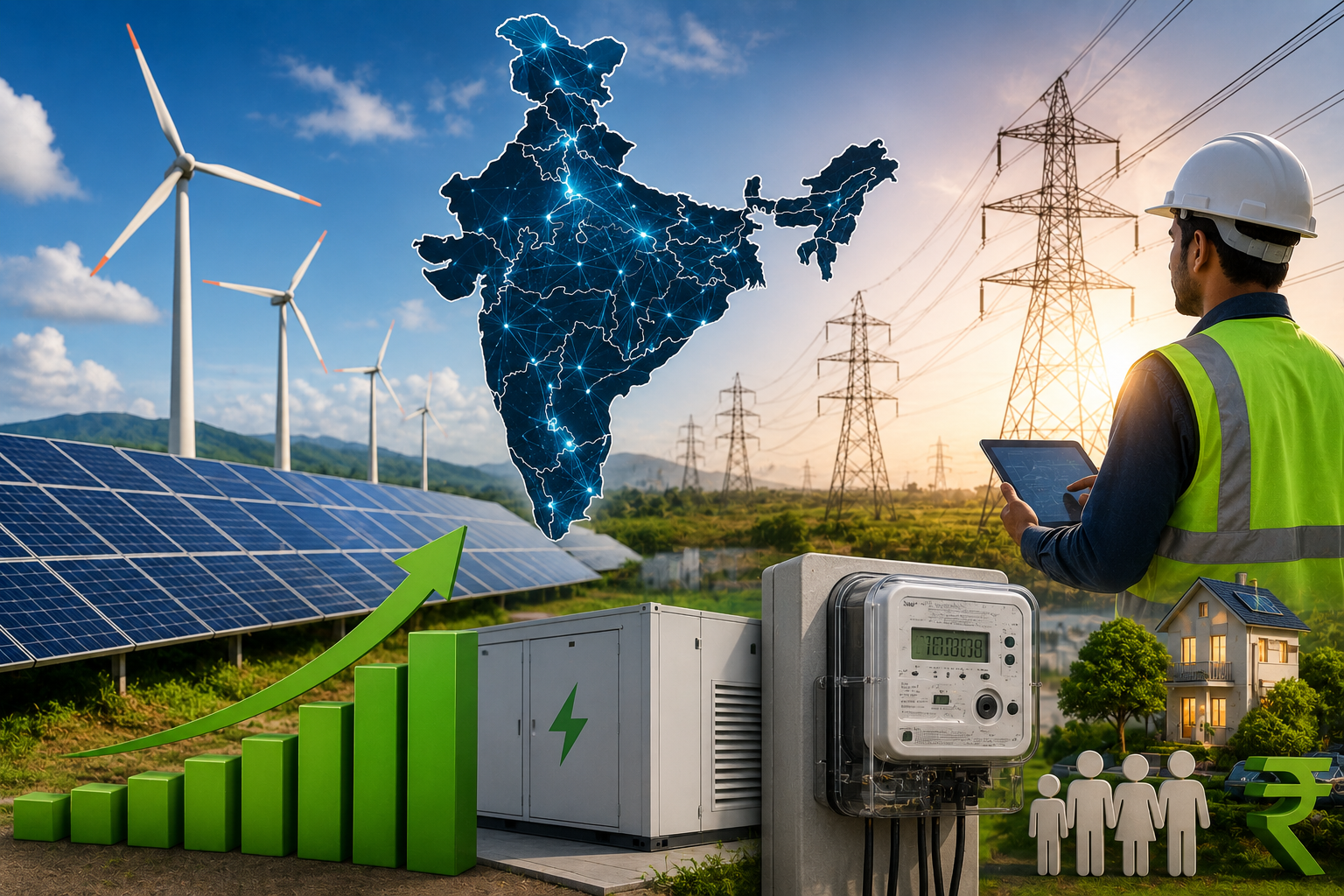
Industry Leaders Seek Broader Renewable Distribution Across India
India’s renewable energy industry has called for state-specific renewable energy bidding and more decentralised project planning to reduce infrastructure stress, strengthen grid stability and ensure balanced growth of clean energy capacity across the country.
Speaking at the annual summit of the Confederation of Indian Industry (CII), renewable energy executives and industry representatives warned that India’s green energy expansion is becoming excessively concentrated in a few states due to current policy incentives and transmission charge waivers.
Industry leaders also proposed several reforms including:
- State-specific renewable energy bids
- Substation-level bidding
- Direct electricity subsidy transfers
- Wider smart meter adoption
- Faster signing of power purchase agreements (PPAs)
The recommendations come as India accelerates efforts toward achieving its ambitious target of 500 GW renewable energy capacity.
Renewable Capacity Becoming Over-Concentrated
According to industry executives, nearly 70% of India’s renewable energy generation capacity is currently concentrated in just five states because developers naturally prefer regions with the best solar irradiance and wind conditions.
Key Issues Emerging From Concentration
- Overburdened transmission networks
- Land acquisition challenges
- Rising land prices
- Right-of-way disputes
- Regional infrastructure imbalance
- Delays in transmission expansion
Rajiv Ranjan Mishra said renewable energy development must evolve into an “all-India affair” instead of remaining concentrated in select regions.
ISTS Waiver Driving Concentrated Development
Industry leaders highlighted the waiver of inter-state transmission system (ISTS) charges as one of the primary reasons behind the clustering of renewable projects in a handful of states.
The waiver incentivizes developers to build projects in areas with:
- Higher solar irradiance
- Stronger wind potential
- Lower marginal generation costs
While this approach has helped reduce renewable power tariffs, experts warned that broader infrastructure and system costs are increasingly being ignored.
Grid and Transmission Infrastructure Under Pressure
The concentration of renewable projects in specific regions has significantly increased pressure on transmission infrastructure.
Challenges Highlighted by Industry
- Transmission bottlenecks
- Delayed evacuation infrastructure
- Grid congestion
- Rising project execution costs
- Law and order issues around infrastructure projects
Mishra warned that excessive concentration could eventually slow India’s renewable energy transition if transmission infrastructure fails to keep pace with generation growth.
State-Specific Bidding Seen as Strategic Solution
Industry executives argued that state-specific renewable energy bidding could help distribute projects more evenly across India and reduce stress on the grid.
Benefits of State-Level Bidding
- Balanced renewable deployment
- Better regional grid stability
- Lower transmission congestion
- Faster infrastructure planning
- Improved energy security
According to Mishra, policymakers should focus on total system cost rather than only the lowest generation tariff while designing renewable energy auctions.
Industry Pushes for Substation-Level Bidding
Parag Sharma also advocated substation-level renewable energy bidding to improve transmission efficiency and optimize infrastructure usage.
According to Sharma, the renewable energy network planning originally envisioned by the Central Electricity Authority assumed geographically distributed renewable resources, but actual project development became heavily concentrated instead.
Why Substation-Level Bidding Matters
- Better utilization of existing substations
- Reduced transmission overload
- More efficient renewable integration
- Lower grid stress
Industry leaders believe decentralised planning could strengthen long-term sustainability of India’s renewable expansion.
Dholera Example Highlights Cost Versus Efficiency Debate
Sharma cited Dholera as an example where substantial land availability exists for renewable projects but developers remain reluctant due to slightly higher power generation costs.
According to him:
- Renewable power at Dholera may cost 30–40 paise more
- Developers continue prioritizing the absolute lowest tariff
- Broader transmission efficiency considerations are often ignored
This reflects the growing policy debate between ultra-low-cost renewable power and long-term infrastructure sustainability.
Smart Meters Seen as Key Power Sector Reform
Industry leaders also strongly emphasized the importance of smart meter adoption in improving the financial health of power distribution companies (discoms).
Mishra said smart meters can address multiple structural challenges in India’s electricity distribution system.
Benefits of Smart Meter Deployment
- Accurate consumption tracking
- Reduced electricity theft
- Better billing efficiency
- Improved demand forecasting
- Enhanced operational transparency
He also called for mandatory usage of smart meter data across the power sector.
Reducing Discom Losses Remains Critical
One of the major issues highlighted during the summit was the persistent financial stress faced by India’s discoms.
Industry experts stressed the need to reduce the ACS-ARR gap — the difference between:
- Average Cost of Supply (ACS)
- Average Revenue Realised (ARR)
Reasons Behind Discom Stress
- Subsidized tariffs
- Power theft
- Inefficient billing systems
- Political interference in tariff setting
- Delayed subsidy reimbursements
Analysts believe discom reform remains essential for sustainable renewable energy growth.
Industry Calls for Direct Subsidy Transfers
Mishra also argued that governments should move toward direct benefit transfers (DBT) for electricity subsidies instead of forcing generators and discoms to absorb subsidized tariffs.
Suggested Subsidy Reform Model
- Consumers receive subsidies directly into bank accounts
- Electricity tariffs become cost-reflective
- Discom finances improve
- Private sector participation strengthens
He questioned why the government successfully uses DBT mechanisms for LPG subsidies but not for electricity subsidies.
Depoliticising Electricity Tariffs Urged
Industry leaders emphasized that politically controlled power tariffs continue to create structural inefficiencies in the power sector.
Key Concerns
- Cross-subsidization distorts pricing
- Discoms face financial pressure
- Investors face uncertainty
- Cost recovery becomes difficult
Experts argued that more market-linked and transparent tariff structures would improve long-term sustainability.
Unsigned PPAs Emerging as Major Concern
The renewable energy industry also raised concerns over a large number of unsigned power purchase agreements (PPAs).
Sharma said the industry has requested the government to extend ISTS charge waivers for nearly 42 GW of unsigned PPAs.
Why PPAs Matter
- Provide revenue visibility to developers
- Improve financing confidence
- Accelerate project execution
- Support renewable investment flows
According to Sharma, signing pending PPAs could significantly improve confidence across the renewable sector.
Renewable Bid Activity Slows in 2025
Industry representatives also highlighted concerns regarding slowing renewable energy bid activity.
Renewable Energy Bid Trends
- 2023 bids: 53 GW
- 2024 bids: 71 GW
- 2025 bids floated so far: Around 20 GW
Despite record renewable capacity additions exceeding 50 GW last fiscal year, industry executives believe government confidence may have weakened due to delays in PPA signings.
India’s 500 GW Renewable Target Faces Execution Challenges
India continues to pursue its ambitious target of achieving 500 GW of renewable energy capacity by 2030.
However, industry leaders cautioned that achieving the target will require addressing several structural bottlenecks.
Major Challenges Ahead
- Transmission expansion delays
- Financially stressed discoms
- PPA uncertainties
- Land acquisition hurdles
- Grid integration complexities
Experts believe coordinated policy reforms will be necessary to maintain momentum in India’s clean energy transition.
Renewable Energy Seen as Strategic Economic Priority
The renewable energy sector is increasingly being viewed as critical for:
- Energy security
- Reduced fossil fuel dependence
- Climate goals
- Lower import dependence
- Long-term economic sustainability
As geopolitical uncertainty and fossil fuel volatility continue globally, India’s renewable sector is expected to remain central to the country’s economic and energy strategy.
Outlook: Balanced Renewable Expansion May Become Policy Focus
Industry experts believe future renewable policy could increasingly shift toward balanced and decentralized capacity development rather than concentration in a few ultra-low-cost states.
Likely Areas of Future Policy Focus
- State-specific renewable auctions
- Faster transmission development
- Smart grid modernization
- Discom reforms
- Grid stability planning
As India scales its clean energy ambitions, balancing cost competitiveness with long-term infrastructure sustainability is likely to become one of the sector’s biggest priorities.