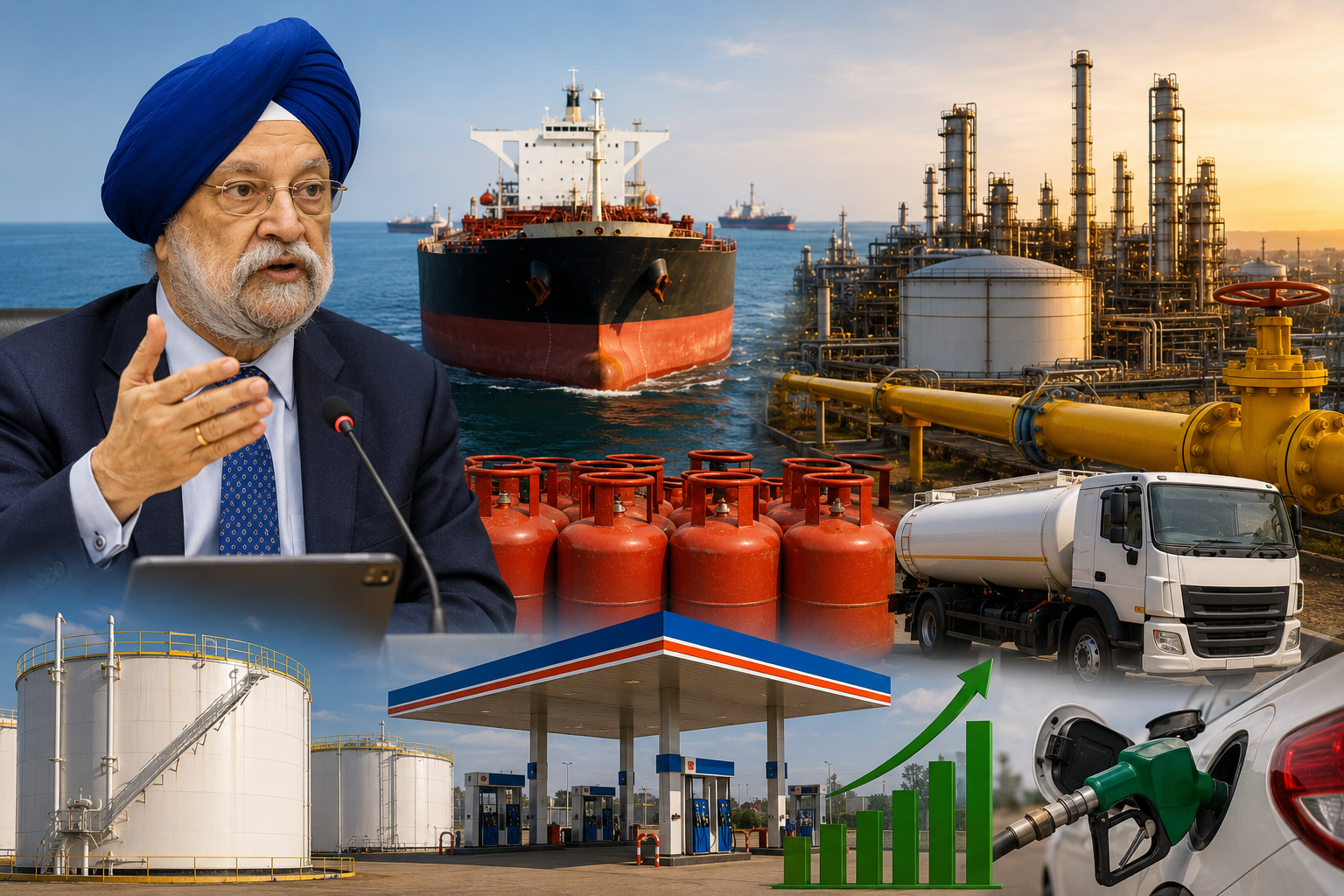
Government Boosts LPG Production and Assures Adequate Energy Stocks
Union Petroleum Minister Hardeep Singh Puri on Tuesday assured that India is not facing any fuel shortage despite escalating geopolitical tensions in West Asia and continued disruptions in global energy markets.
Speaking at the annual summit of the Confederation of Indian Industry (CII), Puri said the government has significantly ramped up domestic LPG production and maintained strong energy reserves to safeguard the country against any possible supply disruptions arising from the ongoing conflict.
The minister also described Prime Minister Narendra Modi’s recent appeal for austerity and responsible consumption as an important warning signal for citizens and businesses to prepare for a more uncertain global environment.
LPG Production Increased Sharply to Strengthen Supply Security
Puri said the government has substantially increased daily LPG production in recent weeks as part of precautionary measures to ensure uninterrupted domestic supply.
LPG Production Expansion
- Previous production levels: 35,000–36,000 tonnes per day
- Current production levels: 54,000 tonnes per day
According to the minister, the increase has been undertaken to strengthen India’s energy preparedness amid rising geopolitical risks and possible disruptions to global fuel movement.
India Has Comfortable Energy Stocks, Says Government
The minister assured that the country currently holds sufficient fuel inventories and there is no immediate concern regarding shortages of crude oil, LNG or LPG.
India’s Current Energy Reserve Position
- 69 days of crude oil and LNG stock
- 45 days of LPG stock
Puri emphasized that the government is closely monitoring the evolving geopolitical situation and remains prepared to take additional measures if necessary.
West Asia Conflict Raises Global Energy Concerns
The ongoing geopolitical conflict in West Asia and disruptions around the Strait of Hormuz have sharply increased concerns regarding global energy supply security.
India remains highly vulnerable to energy market disruptions because of its heavy dependence on imported crude oil and natural gas.
Key Risks for India
- Rising crude oil prices
- Supply-chain disruptions
- Higher import bills
- Pressure on foreign exchange reserves
- Inflationary risks
- Rupee volatility
Analysts believe maintaining stable energy supplies has become one of the government’s top economic priorities amid the ongoing crisis.
PM Modi’s Austerity Appeal Seen as “Wake-Up Call”
Puri strongly backed Prime Minister Modi’s recent appeal for austerity and responsible consumption practices.
According to the minister, the Prime Minister’s message should be viewed as an early warning to prepare for possible economic stress arising from the prolonged geopolitical conflict.
Puri’s Key Message
- India must begin preparing for tougher global conditions
- Citizens should conserve fuel wherever possible
- The country must reduce unnecessary foreign exchange outflows
- Fiscal discipline is becoming increasingly important
The minister urged businesses and households to start thinking proactively about measures that could reduce economic pressure if the crisis intensifies further.
PM Modi Calls for Fuel Conservation and Reduced Imports
During a recent public address in Hyderabad, Prime Minister Modi urged citizens to adopt more cautious consumption habits in response to the ongoing West Asia crisis.
Measures Suggested by PM Modi
- Reduce petrol and diesel consumption
- Use metro rail and public transport
- Encourage carpooling
- Increase adoption of electric vehicles
- Shift parcel transportation to railways
- Work from home where possible
- Avoid unnecessary foreign travel
- Postpone gold purchases
The Prime Minister said such measures could help conserve foreign exchange reserves and reduce pressure on the Indian economy.
Conserving Forex Reserves Becomes Major Priority
The government’s increasing focus on fuel conservation and import management reflects growing concerns about India’s external sector stability.
Higher crude oil prices combined with elevated gold imports have increased pressure on:
- Current account deficit
- Foreign exchange reserves
- Fiscal balance
- Rupee stability
Economists believe managing foreign exchange outflows will remain a major policy priority if geopolitical tensions continue.
India’s Dependence on Imported Energy Remains High
India imports nearly 90% of its crude oil requirements, making the economy highly sensitive to disruptions in global oil markets.
The Strait of Hormuz remains particularly critical because a large portion of India’s energy imports pass through the route.
Strategic Concerns for India
- Shipping disruptions in Gulf region
- Rising insurance and freight costs
- Delayed fuel cargo movement
- Volatility in global energy pricing
Analysts warn that any prolonged blockage or escalation could significantly increase India’s import bill.
Government Focuses on Energy Preparedness
Puri indicated that the government has been proactively working to strengthen India’s energy resilience.
Measures Being Prioritized
- Increasing domestic LPG production
- Maintaining strategic fuel reserves
- Monitoring supply-chain movement
- Diversifying energy sourcing
- Expanding renewable energy adoption
Officials believe these steps could help reduce the impact of prolonged global energy disruptions.
EV Push Gains Greater Strategic Importance
The Prime Minister’s appeal for increased electric vehicle adoption also highlights India’s broader push toward reducing fossil fuel dependence.
Analysts believe the current geopolitical crisis may accelerate:
- EV adoption
- Renewable energy investments
- Energy transition policies
- Public transport usage
- Domestic clean energy infrastructure
Reducing crude oil dependence is increasingly being viewed as both an economic and strategic necessity.
Businesses Urged to Prepare for Volatility
Industry leaders and policymakers are increasingly advising businesses to prepare for a prolonged period of global uncertainty.
Key Areas of Concern for Businesses
- Higher fuel and logistics costs
- Inflationary pressure
- Supply-chain disruption
- Currency volatility
- Rising operating expenses
Companies across sectors are expected to closely monitor energy prices and geopolitical developments over the coming months.
Markets Continue to Watch Oil Prices Closely
Global financial markets remain highly sensitive to developments in West Asia.
Key Factors Investors Are Monitoring
- Crude oil prices
- Strait of Hormuz shipping movement
- Diplomatic developments
- Fuel inventory levels
- Government policy measures
Analysts believe continued volatility in energy markets could impact inflation, interest rates and broader market sentiment globally.
India’s Energy Security Strategy Under Spotlight
The ongoing geopolitical tensions have once again highlighted the importance of long-term energy security planning for India.
Experts believe future policy focus may increasingly shift toward:
- Renewable energy expansion
- Domestic energy production
- Strategic reserves
- Energy diversification
- Reduced import dependence
The government’s current actions indicate a growing emphasis on preparedness and resilience amid an increasingly uncertain global environment.
Outlook: Preparedness and Conservation Likely to Remain Key Themes
While the government has assured that there is currently no fuel shortage, policymakers continue to remain cautious as the West Asia conflict evolves.
Analysts believe India’s ability to manage:
- Energy supplies
- Inflation
- Fiscal stability
- Currency pressures
- Foreign exchange reserves
will remain critical in determining the broader economic impact of the ongoing crisis.
As global uncertainty persists, energy conservation and strategic preparedness are likely to remain central themes in India’s economic response strategy.