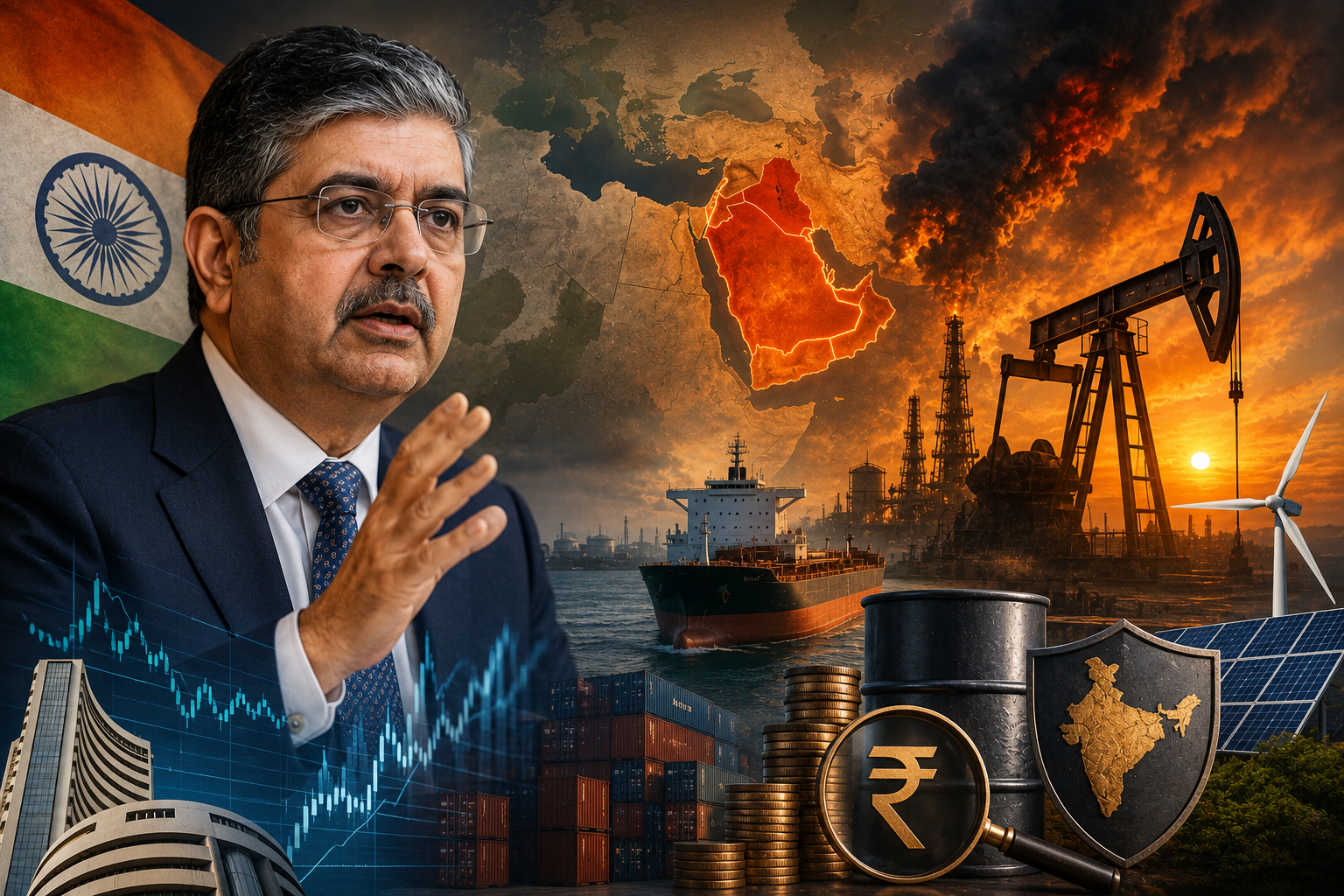
Veteran Banker Flags Rising Risks From Energy Prices and Global Uncertainty
Veteran banker Uday Kotak has cautioned that India and corporate India must prepare for major economic shocks arising from the ongoing West Asia conflict, warning that the impact of rising global energy prices has not yet fully reached consumers or businesses.
Speaking at the annual summit of the Confederation of Indian Industry (CII), Kotak said India is entering a far more uncertain global environment where geopolitical tensions, energy insecurity and economic fragmentation could create serious macroeconomic challenges.
He urged businesses, policymakers and consumers to adopt what he described as a mindset of “strategic paranoia” in order to prepare for tougher global conditions ahead.
“The Shock Is Coming”: Kotak Warns on Fuel Prices
Kotak warned that the real transmission of higher oil prices into the economy is still unfolding and could become significantly more visible in the coming months.
According to him, consumers have so far been protected because oil companies have absorbed a substantial portion of the price shock.
Key Concerns Raised by Kotak
- Fuel price transmission has not fully occurred yet
- Rising energy costs will eventually impact households
- Transportation and logistics costs may surge
- Inflationary pressure could intensify across sectors
“The shock is coming,” Kotak said, emphasizing that the impact of the Middle East crisis on daily living costs may soon become much more visible.
Lower-Income Households Likely to Face Maximum Pressure
Kotak cautioned that Indian households with limited disposable incomes could bear the biggest burden if fuel and energy costs continue to rise.
Areas Likely to Be Impacted
- Transportation expenses
- Food and grocery prices
- Manufacturing costs
- Household energy bills
- Consumer goods pricing
Analysts believe sustained elevated crude oil prices could create broad-based inflationary pressure across the Indian economy.
Calls for “Strategic Paranoia” Amid Global Tensions
One of the central themes of Kotak’s address was the need for India and Indian businesses to become more cautious and strategically prepared in an increasingly fragmented world order.
He described the current global economic environment as entering a “tribal phase,” where countries are increasingly focused on:
- Protecting strategic assets
- Securing supply chains
- Reducing external dependence
- Building economic self-reliance
Kotak urged Indian companies to move out of their comfort zones and prepare for more volatile global conditions.
India Inc Asked to Prepare for Tough Times
Kotak said Indian businesses have benefited from a decade of strong economic growth and stable development, but warned against complacency.
According to him, companies should begin preparing before economic stress intensifies rather than reacting after shocks materialize.
Key Message to Corporate India
- Build stronger balance sheets
- Maintain financial discipline
- Strengthen operational resilience
- Focus on long-term strategic positioning
He emphasized that preparation during relatively stable periods can help businesses withstand future crises more effectively.
PM Modi’s Austerity Push Gets Kotak’s Support
Kotak also expressed support for Prime Minister Narendra Modi’s recent appeal for austerity and responsible consumption.
The Prime Minister had urged citizens to:
- Reduce unnecessary fuel consumption
- Avoid excessive imports
- Postpone non-essential spending
- Prefer domestic spending and travel
Kotak said the Prime Minister’s messaging reflects deeper concerns about living beyond economic means in a volatile global environment.
“Don’t Live Beyond Your Means”
Kotak stressed that countries, businesses and individuals must avoid excessive dependence on borrowed strength or unsustainable consumption patterns.
He pointed to earlier remarks by PM Modi encouraging citizens to conduct weddings domestically as an example of broader economic messaging aimed at strengthening domestic financial discipline.
According to Kotak:
- Fiscal prudence is becoming increasingly important
- External shocks can rapidly destabilize economies
- Preparedness matters more in uncertain times
Current Account Deficit Could Widen Sharply
Kotak also warned that rising oil prices could significantly widen India’s current account deficit (CAD).
CAD Risk Scenarios Highlighted
- Oil at $60/barrel → CAD manageable near 1%
- Oil near $100/barrel → CAD could widen to 2.5%
A wider current account deficit could increase:
- Pressure on the rupee
- External financing requirements
- Inflationary risks
- Dependence on foreign capital inflows
India’s Forex Reserves Offer Some Cushion
Despite the concerns, Kotak noted that India’s foreign exchange reserves remain significantly stronger compared to previous decades.
This provides some buffer against external shocks and global capital volatility.
However, he cautioned that India may still need to prepare for significantly larger financing requirements if global conditions deteriorate further.
Key Areas of Concern
- Rising import bill
- Higher oil costs
- Capital flow volatility
- Currency pressure
Analysts believe maintaining external sector stability will remain a major policy focus in the coming months.
Renewable Energy Push Seen as Strategic Necessity
Kotak also urged businesses to focus more aggressively on renewable energy and long-term energy security.
He said India should move beyond lobbying for short-term advantages and instead invest at scale in strategic sectors that reduce external dependence.
Areas Highlighted by Kotak
- Renewable energy expansion
- Electrification
- Domestic manufacturing
- Energy efficiency
- Strategic infrastructure
He cited China as an example where electric mobility adoption has accelerated rapidly, with a significant share of vehicles now running on electricity.
Defence and Strategic Investment Need Greater Attention
Kotak also emphasized the importance of strengthening India’s defence capabilities and strategic industries.
According to him, India has an opportunity to develop:
- Low-cost defence manufacturing
- Efficient indigenous technologies
- Scalable industrial ecosystems
He suggested Indian companies could build globally competitive solutions at far lower costs compared to advanced economies.
Global Order Becoming Increasingly Fragmented
Kotak’s remarks reflect growing concerns among global business leaders regarding the changing nature of international economic relations.
Analysts believe rising geopolitical tensions are leading to:
- Economic nationalism
- Trade fragmentation
- Supply chain realignment
- Strategic resource competition
This evolving environment is pushing countries to rethink long-term economic and industrial strategies.
Businesses Advised to Focus on Resilience
Kotak repeatedly stressed the importance of resilience over short-term comfort.
Strategic Priorities for India Inc
- Stronger financial management
- Supply-chain diversification
- Energy security planning
- Domestic capability building
- Long-term investment discipline
He argued that businesses capable of adapting early to geopolitical and economic disruptions would emerge stronger over time.
Markets Closely Watching Oil Prices and Global Risks
Financial markets continue to monitor:
- Crude oil price movement
- West Asia conflict developments
- Inflation trends
- Currency stability
- Government policy measures
Any prolonged rise in energy prices could impact equities, bond markets and corporate profitability across sectors.
Outlook: Preparedness Could Become India’s Biggest Strength
Kotak’s comments underline the growing concern within India’s corporate and financial ecosystem regarding the potential economic fallout from global geopolitical instability.
While India’s long-term growth story remains strong, analysts believe the coming years may require:
- Greater economic discipline
- Faster strategic adaptation
- Energy diversification
- Stronger financial resilience
As geopolitical uncertainty and energy market volatility continue to intensify, preparation and resilience may increasingly become India’s most important economic strengths.