New Chief Minister Revives Debate on Liquor Regulation and State Revenue
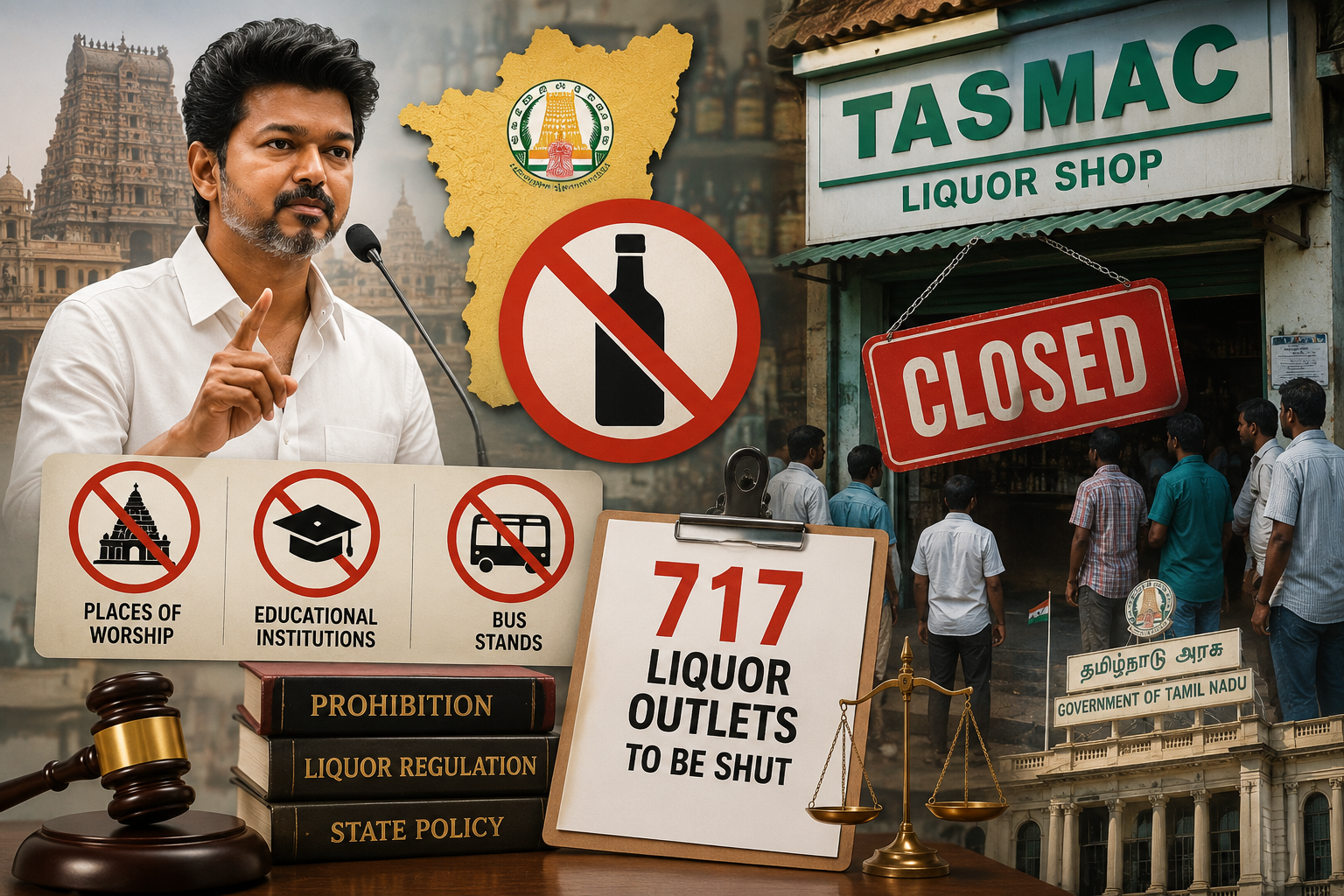
Tamil Nadu Chief Minister C Joseph Vijay has reignited the state’s decades-old political and social debate surrounding prohibition and liquor regulation after ordering the closure of 717 state-run liquor outlets across the state.
The decision, announced within two days of Vijay assuming office, targets liquor shops operating within a 500-metre radius of places of worship, educational institutions and major bus stations.
The move has once again placed the spotlight on Tamil Nadu’s complex relationship with prohibition policies, public welfare concerns and the state’s heavy dependence on liquor revenue.
717 TASMAC Shops to Be Shut Within Two Weeks
The affected outlets are operated by Tamil Nadu State Marketing Corporation (TASMAC), which controls liquor retail sales across the state.
According to government data, Tamil Nadu currently has around 4,765 TASMAC outlets functioning across urban and rural regions.
Shops Marked for Closure
- 276 shops near places of worship
- 186 shops near educational institutions
- 255 shops near bus stations
The government has reportedly instructed authorities to complete the closure process within two weeks.
Public Welfare and Social Concerns Drive Decision
The latest order is being viewed as an attempt by the new government to address growing public concerns regarding the social impact of liquor consumption, especially in sensitive public areas.
Critics of TASMAC outlets have long argued that liquor shops near schools, temples, churches, mosques and transport hubs contribute to:
- Public nuisance
- Safety concerns
- Alcohol addiction
- Domestic violence
- Youth exposure to alcohol
- Law and order issues
Several political parties and social organisations in Tamil Nadu have repeatedly demanded stricter regulation of liquor sales over the years.
Liquor Revenue Remains Crucial for Tamil Nadu
Despite recurring calls for prohibition, liquor sales continue to remain one of the Tamil Nadu government’s largest revenue sources.
TASMAC reportedly generates annual revenues exceeding ₹50,000 crore, making it a critical contributor to the state’s finances.
This dependence has created a long-standing political dilemma:
The Core Policy Challenge
- Public demand for prohibition
- Massive dependence on liquor revenue
- Employment linked to liquor retail
- Risk of illegal liquor trade
- Fiscal pressure on government finances
Successive governments have attempted to balance these competing priorities through phased restrictions rather than complete prohibition.
Tamil Nadu’s Long History of Prohibition
1937: Rajagopalachari Introduces Prohibition
Tamil Nadu’s prohibition history dates back to 1937 when C Rajagopalachari introduced a liquor ban after the Congress formed the government in the then Madras Presidency.
The prohibition policy was initially implemented in Salem before being gradually extended across the state by 1948.
To offset revenue losses from liquor sales, the government introduced sales tax measures.
The prohibition policy during this period received strong public support and became one of the longest liquor bans in the state’s history.
1971: Karunanidhi Ends Statewide Prohibition
The prohibition era ended in 1971 when the Dravida Munnetra Kazhagam government led by M Karunanidhi lifted the ban on liquor sales.
Karunanidhi argued that prohibition would not succeed unless implemented nationwide because neighboring states continued to profit from liquor sales while Tamil Nadu lost significant revenue.
The government allowed the sale of:
- Arrack
- Toddy
- Indian-made foreign liquor (IMFL)
However, the move soon attracted criticism and allegations related to corruption in liquor licensing.
1974: Prohibition Reintroduced
Facing political pressure and public criticism, the Karunanidhi government later reintroduced prohibition in 1974.
However, the policy shift once again highlighted the recurring conflict between public sentiment and fiscal realities.
MGR Era: Liquor Controls Relaxed Again
After coming to power in 1977, M G Ramachandran initially imposed permit-based controls on alcohol consumption.
Over time, however, liquor sales gradually expanded again.
By 1981:
- Ban on arrack and toddy was lifted
- Low-cost liquor sachets emerged
- State monitoring increased significantly
The government also allowed private sector manufacturing of Indian-made foreign liquor in the early 1980s.
1983: TASMAC Is Created
In 1983, the Tamil Nadu government established Tamil Nadu State Marketing Corporation (TASMAC).
The corporation was initially formed to control wholesale trade in:
- Arrack
- IMFL products
Over time, TASMAC evolved into the state’s monopoly liquor retailer.
1991: Jayalalithaa Reimposes Prohibition
After returning to power in 1991, J Jayalalithaa reintroduced prohibition as part of her election promise.
The AIADMK government banned:
- Arrack
- Toddy sales
The prohibition phase lasted for nearly a decade before policy changes re-emerged.
2003: Tamil Nadu Government Takes Full Retail Control
A major transformation occurred in 2003 when the Tamil Nadu government amended the Prohibition Act and granted TASMAC exclusive rights over liquor procurement and retail sales.
This effectively created a state-controlled liquor retail monopoly.
Since then, TASMAC has grown into one of Tamil Nadu’s largest revenue-generating public sector entities.
2016: Jayalalithaa Begins “Phased Prohibition”
In 2016, Jayalalithaa once again attempted gradual liquor restriction measures after returning to power.
Measures Introduced
- Closure of 500 TASMAC outlets
- Reduced operating hours
- Phased prohibition approach
The subsequent government led by Edappadi K Palaniswami continued the policy by shutting:
- 500 additional liquor outlets
- 169 bars
Stalin Government Also Closed Shops
In 2023, the Dravida Munnetra Kazhagam government led by M K Stalin ordered the closure of 500 liquor shops as part of its electoral promise of gradual prohibition.
The move reflected continuing public pressure on successive governments to regulate alcohol availability.
Vijay’s Decision Seen as Politically Significant
Political analysts believe Vijay’s latest order carries both symbolic and strategic significance.
The move allows the new government to:
- Position itself as socially responsible
- Address public concerns
- Signal administrative action quickly
- Build political goodwill early in tenure
At the same time, analysts note that the closures stop short of broader prohibition measures that could significantly impact state finances.
Complete Prohibition Remains Difficult
Despite periodic closures and phased restrictions, experts believe complete prohibition remains difficult in Tamil Nadu due to several factors.
Major Challenges
- Dependence on liquor revenue
- Risk of illicit liquor trade
- Smuggling concerns
- Employment impact
- Fiscal deficit pressures
Economists warn that sudden prohibition could create unintended consequences unless supported by strong rehabilitation, enforcement and alternative revenue strategies.
Public Opinion Remains Divided
Tamil Nadu’s public opinion on prohibition continues to remain deeply divided.
Supporters of Prohibition Argue
- Alcohol harms families and communities
- Liquor addiction increases social problems
- Shops near public spaces affect safety
Opponents Argue
- Prohibition encourages illegal liquor trade
- State revenue loss could hurt welfare spending
- Controlled regulation is more practical
The debate has remained politically sensitive for decades and continues to influence electoral narratives in the state.
Outlook: Vijay’s Move May Be Beginning of Broader Policy Shift
Analysts believe Vijay’s decision could potentially mark the beginning of a broader effort toward tighter liquor regulation rather than immediate statewide prohibition.
Future policy measures may include:
- Additional outlet closures
- Reduced operating hours
- Stricter licensing norms
- Expansion of phased prohibition policies
However, balancing public sentiment with economic realities will remain one of the biggest challenges for the Tamil Nadu government in the years ahead.