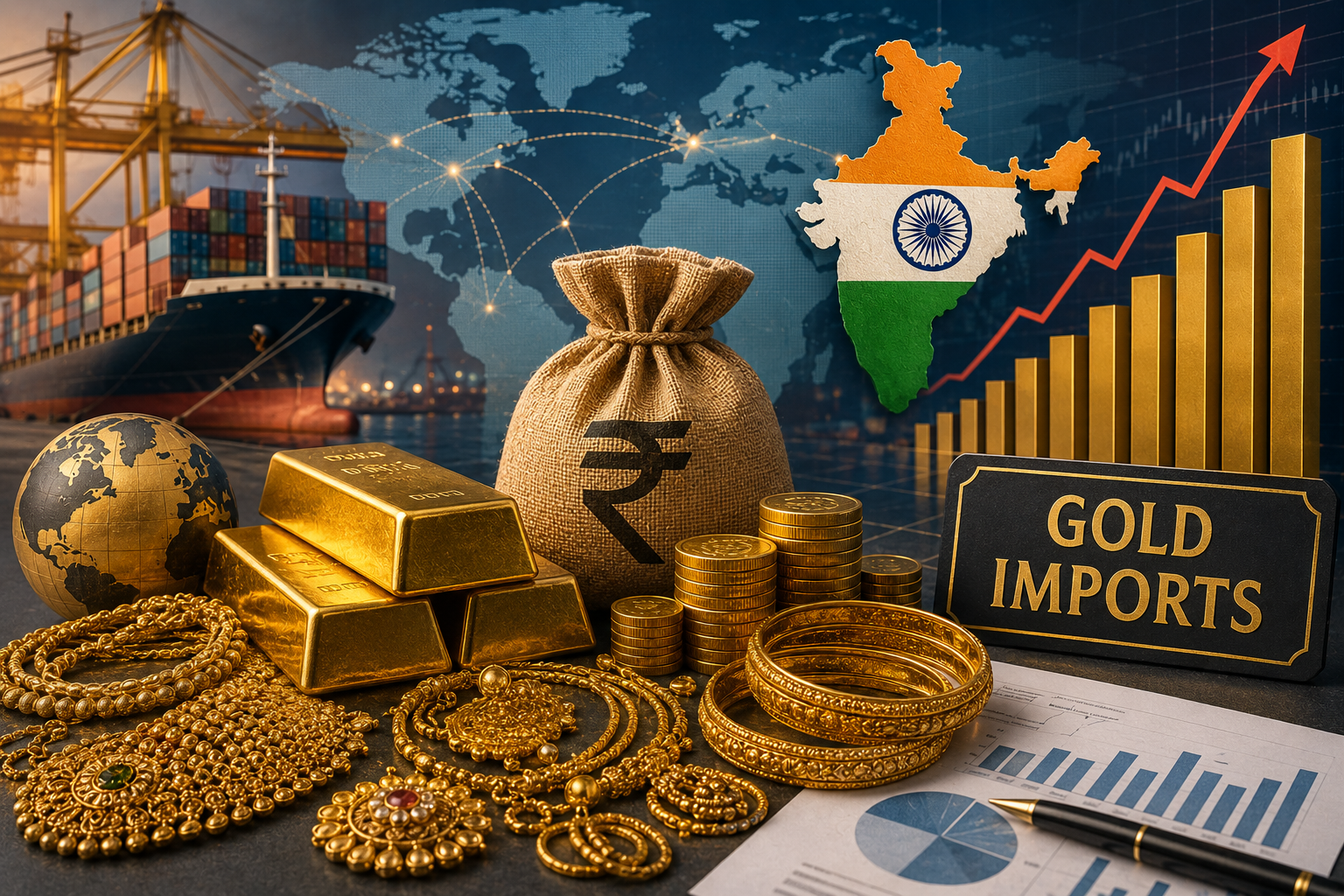
Rising Gold Demand Raises Concerns Over India’s Trade and Fiscal Stability
India’s soaring gold imports have once again come into sharp focus after Prime Minister Narendra Modi urged citizens to adopt austerity measures amid escalating geopolitical tensions in West Asia and rising pressure on the economy from elevated energy prices.
In a recent public appeal, the Prime Minister called for judicious fuel usage, postponement of unnecessary foreign travel and restraint in gold purchases as the government attempts to shield the economy from the impact of the ongoing US-Iran conflict and disruptions in global energy markets.
The appeal comes at a time when India’s gold imports have surged to record levels, intensifying concerns over the country’s trade deficit, current account balance and foreign exchange outflows.
India’s Gold Imports Hit All-Time High in FY26
India imported gold worth a record $71.98 billion during FY2025-26, marking a sharp increase of more than 24% compared to the previous financial year.
Gold Import Value Trend
- FY26: $71.98 billion
- FY25: $58 billion
- FY24: $45.54 billion
- FY23: $35 billion
- FY22: $46.14 billion
- FY21: $34.62 billion
- FY20: $28.2 billion
The sharp rise reflects a combination of elevated global gold prices and sustained domestic demand despite economic uncertainty.
Import Volumes Decline Despite Higher Spending
Interestingly, while the overall import bill surged sharply, the physical quantity of gold imported into India actually declined during FY26.
Gold Import Volumes
- FY26: 721.03 tonnes
- FY25: 757.09 tonnes
- FY24: 795.2 tonnes
- FY23: 678.3 tonnes
Analysts say the increase in import value was primarily driven by soaring international gold prices rather than a proportional increase in actual consumption.
Gold Prices Surge to Historic Levels
According to data from the Commerce Ministry, international gold prices increased significantly during FY26.
Average Gold Price Increase
- FY25: $76,617 per kg
- FY26: $99,825 per kg
Domestically, gold prices in India have surged close to ₹1.5 lakh per 10 grams after crossing the ₹1 lakh milestone for the first time in April last year.
Safe-haven demand amid geopolitical tensions, inflation concerns and global market uncertainty have continued to support bullish momentum in gold prices.
Why Gold Demand Surges During Crises
India remains the world’s second-largest gold consumer after China, with demand deeply rooted in cultural, investment and wedding-related consumption.
Major Drivers of Gold Demand
- Jewellery purchases
- Wedding and festive demand
- Inflation hedge
- Safe-haven investing
- Wealth preservation during uncertainty
Historically, gold demand in India tends to rise during periods of geopolitical stress and financial market volatility.
High Gold Imports Widen Trade Deficit
Economists warn that excessive gold imports create significant pressure on India’s external balances.
Key Economic Concerns
- Gold accounts for over 9% of India’s total imports
- Total imports during FY26 stood at $775 billion
- Trade deficit widened to $333.2 billion
Higher imports increase dollar outflows and can weaken the country’s current account position, particularly when crude oil prices are also elevated.
Current Account Deficit Remains Under Pressure
According to the Reserve Bank of India, India’s current account deficit (CAD) widened to $13.2 billion during the December quarter compared to $11.3 billion a year earlier.
The widening gap was attributed to:
- Rising gold imports
- Higher crude oil costs
- Weak export growth
- Increased import bills
Analysts believe sustained geopolitical tensions could further increase pressure on India’s balance of payments.
Switzerland Continues to Dominate Gold Supply
Switzerland remains India’s largest source of gold imports.
Major Gold Supplier Countries
- Switzerland: Around 40% share
- UAE: Over 16%
- South Africa: About 10%
India’s imports from Switzerland rose over 11% during FY26 to approximately $24.27 billion.
UAE Gold Imports Surge Under Trade Agreement
A major shift in India’s gold trade pattern has emerged following the implementation of the India-UAE CEPA agreement.
The United Arab Emirates has rapidly increased its share in India’s gold imports after receiving tariff benefits under the Comprehensive Economic Partnership Agreement (CEPA), which came into force in May 2022.
UAE Gold Import Growth
- 2022: $2.9 billion
- 2023: $6.7 billion
- 2025: $16.5 billion
Dubai’s share in India’s gold imports reportedly rose from 7.9% before the agreement to nearly 28% in 2025.
Experts Warn of Potential FTA Misuse
Trade policy experts have raised concerns that some imports routed through Dubai may primarily be benefiting from tariff arbitrage rather than genuine value addition.
Global Trade Research Initiative (GTRI) has urged the government to review tariff concessions offered on precious metals under free trade agreements.
According to Ajay Srivastava, much of the imported gold may actually originate from third countries and simply transit through Dubai to benefit from lower Indian import duties.
Government Has Already Tightened Import Rules
To curb misuse of tariff structures and excessive imports, the government has already implemented several corrective measures.
Steps Taken by Government
- Restrictions on certain gold and precious metal imports
- Increased scrutiny under FTAs
- Action against misuse of India-ASEAN duty benefits
- Monitoring of unstudded jewellery imports
The measures aim to reduce tariff circumvention and protect India’s trade balance.
Gold Import Duty Has Seen Major Changes
India has repeatedly adjusted gold import duties in response to changing macroeconomic conditions.
Gold Duty Timeline
- 2022: Duty raised from 10.75% to 15%
- FY25 Budget: Duty reduced to 6%
The reduction was intended to:
- Support the domestic jewellery industry
- Reduce smuggling
- Lower local gold prices
However, analysts believe lower duties may also have contributed to the sharp increase in imports.
Rising Oil Prices Add to Economic Pressure
The concern around gold imports has intensified because India is simultaneously dealing with elevated crude oil prices linked to geopolitical tensions in West Asia.
Higher oil and gold imports together could:
- Increase current account deficit
- Pressure the Indian rupee
- Raise imported inflation
- Worsen fiscal pressures
Economists believe this combination could become a significant macroeconomic challenge if global tensions persist.
Markets Closely Watching Possible Policy Response
Following the Prime Minister’s austerity appeal, market participants are closely monitoring whether the government may introduce additional policy measures in the coming weeks.
Possible Measures Analysts Expect
- Higher import duties on precious metals
- Tighter remittance rules
- Additional curbs on non-essential imports
- Enhanced FTA monitoring
However, analysts expect the government to adopt a gradual approach to avoid disrupting domestic demand sharply.
Gold Demand Likely to Remain Strong Despite Warnings
Despite rising prices and government caution, analysts believe gold demand in India could remain structurally strong due to:
- Cultural significance
- Wedding-related demand
- Inflation concerns
- Safe-haven investing
- Geopolitical uncertainty
As global uncertainty continues, policymakers may increasingly focus on balancing consumer demand with the need to protect India’s macroeconomic stability.
Outlook: Gold Imports Could Stay at Centre of Economic Debate
India’s record gold imports have once again highlighted the delicate balance between consumer demand, trade stability and economic resilience.
With rising geopolitical tensions, elevated oil prices and pressure on India’s external balances, policymakers are likely to closely monitor gold imports in the coming months.
The broader challenge for the government will be to protect economic stability without significantly disrupting domestic demand and the jewellery industry, which remains an important contributor to employment and exports.