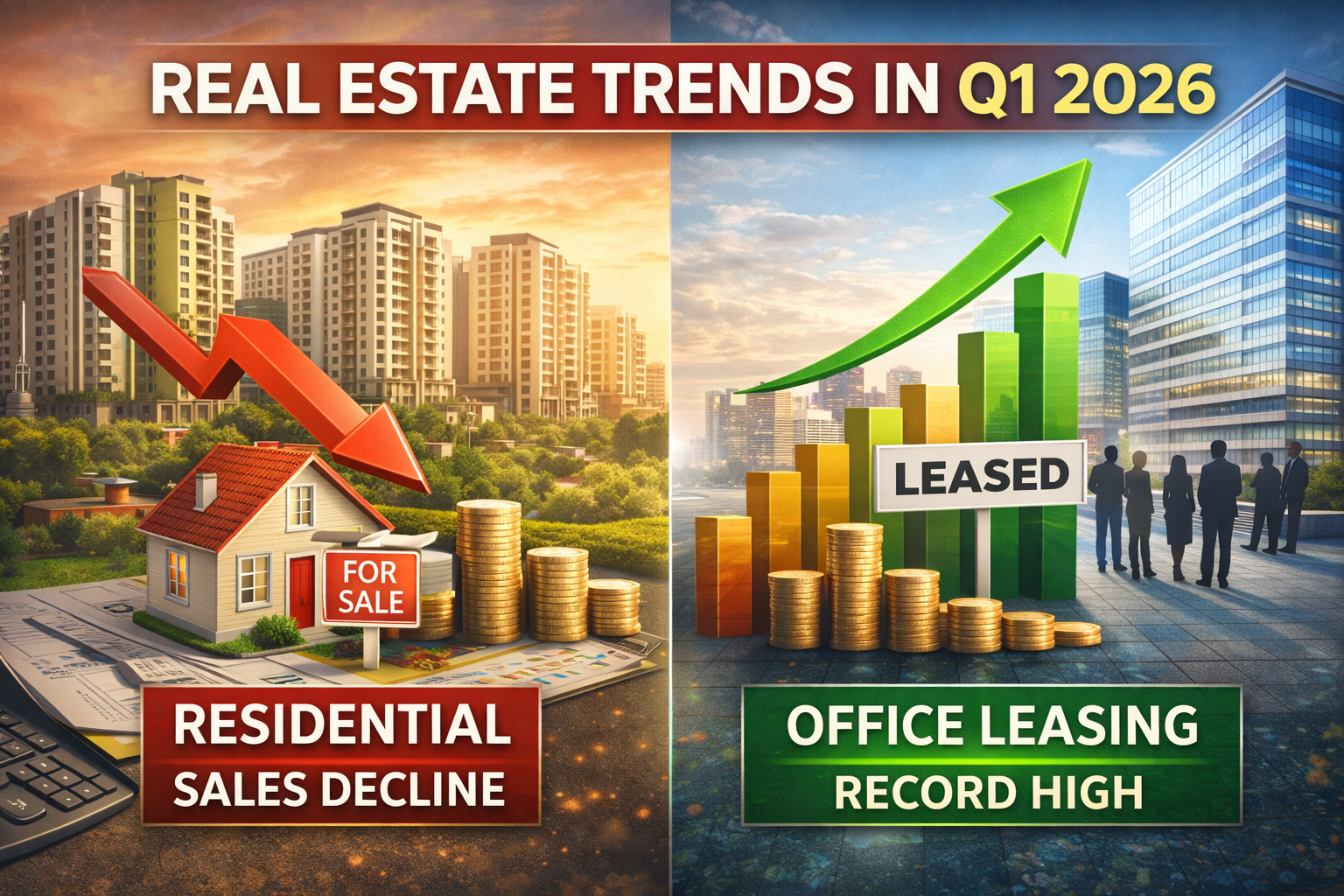
Rising property prices impact affordability as residential demand softens, while strong corporate demand drives record office leasing activity
India’s real estate sector showed contrasting trends in the first quarter of 2026, with residential sales witnessing a modest decline even as office leasing activity surged to a record high. The shift reflects changing market dynamics, where affordability pressures are beginning to weigh on homebuyers, while commercial demand remains robust.
Residential Sales See Mild Decline
Housing sales across the top eight cities fell 4% year-on-year to around 84,800 units in Q1 2026. Major markets such as Mumbai, NCR, and Pune led the decline, indicating a slowdown after a strong growth cycle in previous years.
The moderation is seen as an early phase of market consolidation. However, rising property prices and global uncertainties have made buyers more cautious, impacting transaction volumes.
Affordability Pressures Impact Demand
One of the key reasons behind the slowdown is the growing affordability challenge. As property prices continue to rise, especially in urban centers, a large segment of buyers is finding it difficult to enter the market.
Additionally, volatility in global markets and geopolitical tensions have further dampened sentiment, delaying purchase decisions among potential homebuyers.
Premium Housing Continues to Dominate
Despite the overall slowdown, demand for premium housing remains strong. Properties priced above ₹1 crore recorded double-digit growth, with the ₹1–2 crore segment contributing significantly to total sales.
On the other hand, affordable housing segments saw sharp declines, highlighting a clear shift in buyer preference toward higher-value homes.
Prices Rise Across Key Cities
Interestingly, property prices continued to increase across all major cities, even as sales slowed. NCR led the surge, with strong price appreciation seen in Ghaziabad and Greater Noida.
This trend indicates that developers are maintaining pricing power, although it may further impact affordability in the near term.
Inventory Levels and Supply Trends
Unsold inventory rose slightly during the quarter, crossing 5.19 lakh units. The quarters-to-sell (QTS) metric also edged up to 6 quarters, suggesting a gradual slowdown in absorption.
Although new launches declined marginally, they continued to exceed sales, marking the 14th consecutive quarter of higher supply than demand.
Office Leasing Touches Record High
In contrast, the office real estate segment delivered a strong performance, with leasing activity rising 6% year-on-year to nearly 30 million square feet.
Bengaluru remained the top market, driven by strong demand from Global Capability Centres (GCCs), which accounted for nearly half of total leasing activity.
Vacancy Rates Decline, Rentals Strengthen
The sustained demand for office spaces has led to a steady decline in vacancy rates, which dropped to 13.9% in Q1 2026. Tight supply conditions have also supported rental growth across major cities.
NCR and Kolkata witnessed the highest rental increases, while cities like Hyderabad, Chennai, Mumbai, and Bengaluru recorded stable gains.
Outlook: Diverging Momentum in Realty Sector
The real estate sector is currently witnessing a divergence in performance. While residential demand is stabilizing amid affordability challenges, the commercial segment continues to grow on the back of strong corporate expansion and global outsourcing trends.
Going forward, the residential market may see gradual recovery if price pressures ease, while office leasing is expected to remain strong, supported by India’s growing role as a global business hub.