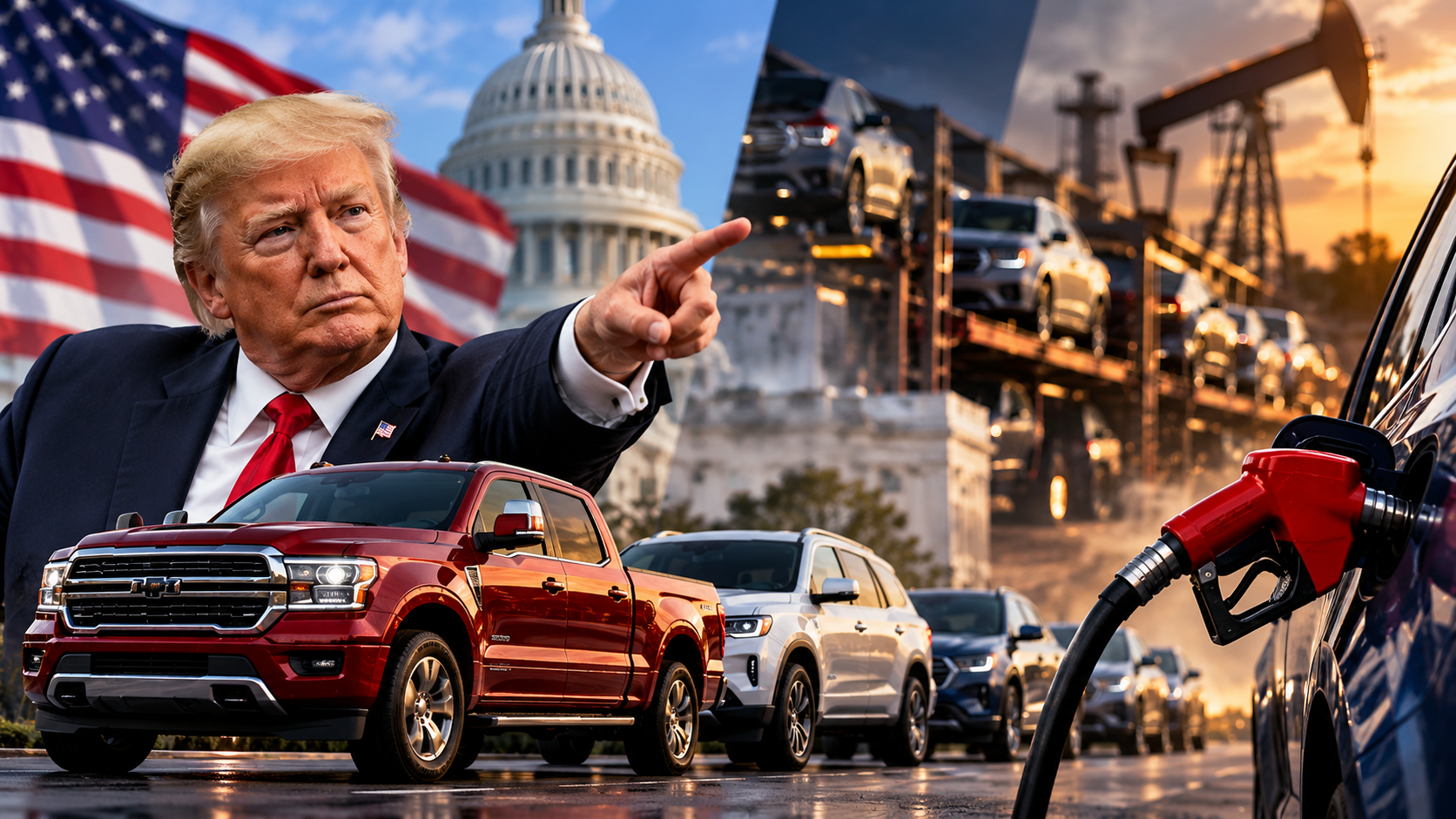
Proposed Rollback Could Reduce 2031 Fleetwide Target to 34.5 MPG From 50.4 MPG Under Biden-Era Rules
The Trump administration is moving to lower federal fuel economy requirements for new passenger cars and light trucks in the United States, marking another major shift in the country's automobile and energy policy.
The revised standards are intended to give automakers greater flexibility in producing gasoline-powered vehicles. President Donald Trump has argued that less stringent mileage requirements would reduce the cost of manufacturing vehicles and give consumers access to a wider range of gasoline-powered cars and trucks.
The administration's move would reverse much of the tightening of fuel economy requirements introduced during the previous administration. The National Highway Traffic Safety Administration (NHTSA) had earlier projected that its proposed revised framework would result in an industry fleetwide average of roughly 34.5 miles per gallon for light-duty vehicles in model year 2031. Under the 2024 standards finalized during the Biden administration, the corresponding projected figure was about 50.4 mpg.
What Are Fuel Economy Standards?
Fuel economy standards determine how efficiently new vehicles must use gasoline. They are primarily measured through miles per gallon, or MPG, and apply to manufacturers' vehicle fleets.
The US Corporate Average Fuel Economy, or CAFE, programme dates back to the energy crisis of the 1970s. Over subsequent decades, the standards have been progressively adjusted as policymakers sought to address fuel consumption, energy security, vehicle costs and emissions.
Under the 2024 rules, NHTSA had required fuel economy improvements of 2 per cent annually for passenger cars for model years 2027 through 2031, while light trucks were subject to 2 per cent annual increases for model years 2029 through 2031. The agency projected an overall light-duty fleet average of approximately 50.4 mpg by 2031.
Trump Administration Says Lower Standards Will Cut Vehicle Costs
The Trump administration has presented the rollback primarily as an affordability and manufacturing measure.
Trump has argued that automakers face unnecessary costs when required to develop increasingly fuel-efficient vehicles and that relaxing the standards would allow manufacturers to offer more gasoline-powered models.
Transportation Secretary Sean Duffy has also supported changes to the CAFE framework as part of the administration's broader effort to reduce regulatory requirements affecting the automobile industry.
NHTSA previously said that its new approach would reset fuel economy requirements based on what the agency considers the maximum feasible level under federal law. The agency's current CAFE framework projects an industrywide average of about 34.5 mpg for model year 2031 under the revised approach.
Automobile Industry Faces a Changing Regulatory Landscape
The proposed changes could have significant implications for US automakers, particularly manufacturers with large portfolios of gasoline-powered pickup trucks, SUVs and light trucks.
Companies such as Ford, General Motors and Stellantis have substantial exposure to the US light-truck market. Lower fuel economy requirements could reduce the engineering and technology costs associated with meeting increasingly stringent efficiency targets.
The change could also influence product planning. Automakers would have greater flexibility in deciding the balance between gasoline-powered vehicles, hybrids and electric vehicles based on consumer demand and regulatory requirements.
However, the ultimate impact on vehicle prices will depend on several factors, including manufacturing costs, competition, commodity prices, financing costs and consumer demand. A reduction in regulatory compliance costs does not automatically translate into an equivalent reduction in showroom prices.
EV Policy Also Being Reshaped
The fuel economy rollback forms part of a wider change in the Trump administration's approach to electric vehicles.
The administration has sought to reverse policies that it argues encouraged consumers and manufacturers to move toward EVs. Trump has repeatedly described previous federal policies as an "EV mandate", although there was no federal requirement that automakers make half of their new vehicle sales electric by 2030.
The distinction is important because the Biden administration's 2030 target was a policy goal rather than a federal requirement that manufacturers sell a specified percentage of EVs.
NHTSA has separately taken steps to revise the CAFE programme and has said the current administration is seeking to bring the system into compliance with its interpretation of federal statutory requirements.
Consumers Face a Mixed Impact
For consumers, the impact of lower fuel economy standards could develop in different ways.
Supporters of the rollback argue that manufacturers could reduce vehicle production costs and offer a wider selection of gasoline-powered models. The administration has therefore linked the policy to vehicle affordability and consumer choice.
At the same time, vehicles with lower fuel efficiency generally consume more gasoline for the same distance travelled. This means the lifetime cost of ownership could depend heavily on gasoline prices and how many miles a vehicle is driven.
The issue is particularly relevant as US gasoline prices remain elevated. Higher fuel prices can increase the long-term operating cost of less-efficient vehicles, potentially offsetting some of the savings associated with lower vehicle production costs.
Environmental Groups Raise Emissions Concerns
Environmental organisations have criticised the proposed changes, arguing that weaker efficiency requirements could increase fuel consumption and vehicle emissions.
Their argument is that reducing the required efficiency of new vehicles could result in greater gasoline consumption over the life of those vehicles, potentially increasing carbon dioxide and other pollution.
NHTSA's earlier analysis of the stricter 2024 standards projected substantial fuel savings over the lifetime of affected vehicles. The agency estimated that the rules would save more than 14 billion gallons of gasoline over time and reduce fuel costs for vehicle owners.
Environmental groups have therefore argued that reversing those standards could reduce some of the expected fuel and emissions benefits.
Fuel Prices Could Become a Bigger Factor
The debate over fuel economy is particularly relevant when gasoline prices are high.
A more fuel-efficient vehicle can reduce a consumer's exposure to fluctuations in gasoline prices, while a less-efficient vehicle can increase fuel expenditure when prices rise.
This creates a trade-off between upfront vehicle costs and longer-term running costs. The economic impact will vary depending on the purchase price of the vehicle, annual mileage, fuel efficiency and prevailing gasoline prices.
For automakers, the calculation is similarly complex. Lower compliance costs could provide more flexibility in vehicle design, but consumer demand for fuel efficiency and electrified vehicles could continue to influence product strategies independently of federal regulations.
What the Policy Means for the Auto Industry
The revised standards could reshape investment priorities across the US automobile sector.
Automakers may gain additional flexibility to allocate capital between traditional internal-combustion engines, hybrids and electric vehicles. Suppliers involved in engines, transmissions and conventional vehicle components could benefit from continued demand for gasoline-powered models, while companies focused primarily on EV-related technologies could face a different regulatory and demand environment.
However, global automotive trends will remain important. Automakers selling vehicles outside the US still have to comply with different efficiency and emissions regimes in other major markets.
As a result, US regulatory changes alone are unlikely to determine the industry's long-term technology direction.
Market and Investment Implications
The policy could have implications across several parts of the automotive value chain.
Traditional automakers with substantial US gasoline and light-truck businesses could see changes in their regulatory compliance costs and product-development requirements. Oil and gasoline demand could also be affected over the longer term if the vehicle fleet becomes less fuel efficient.
On the other hand, the environmental and efficiency implications could increase scrutiny from policymakers, consumer groups and investors focused on emissions and energy-transition risks.
For investors, the key variables will include the final structure of the standards, implementation timelines, automaker responses, vehicle pricing, gasoline demand and the pace of EV and hybrid adoption.
Market Outlook
The proposed US fuel economy rollback represents a significant change in the regulatory environment for automakers and the broader transportation sector. The administration says the policy is designed to reduce manufacturing constraints and expand consumer choice, while environmental groups argue that weaker efficiency requirements could increase fuel consumption and emissions.
The immediate market impact will depend on the final rules and how manufacturers adjust their product strategies. Over the longer term, the interaction between fuel prices, consumer preferences, EV adoption, regulatory requirements and automaker investment decisions will determine the broader economic effect.
For the global automobile industry, the development also highlights a widening divergence between US vehicle policy and efficiency regulations in other major markets. Investors will therefore be watching not only the final US standards but also how automakers balance their US product portfolios with their global electrification and efficiency strategies.