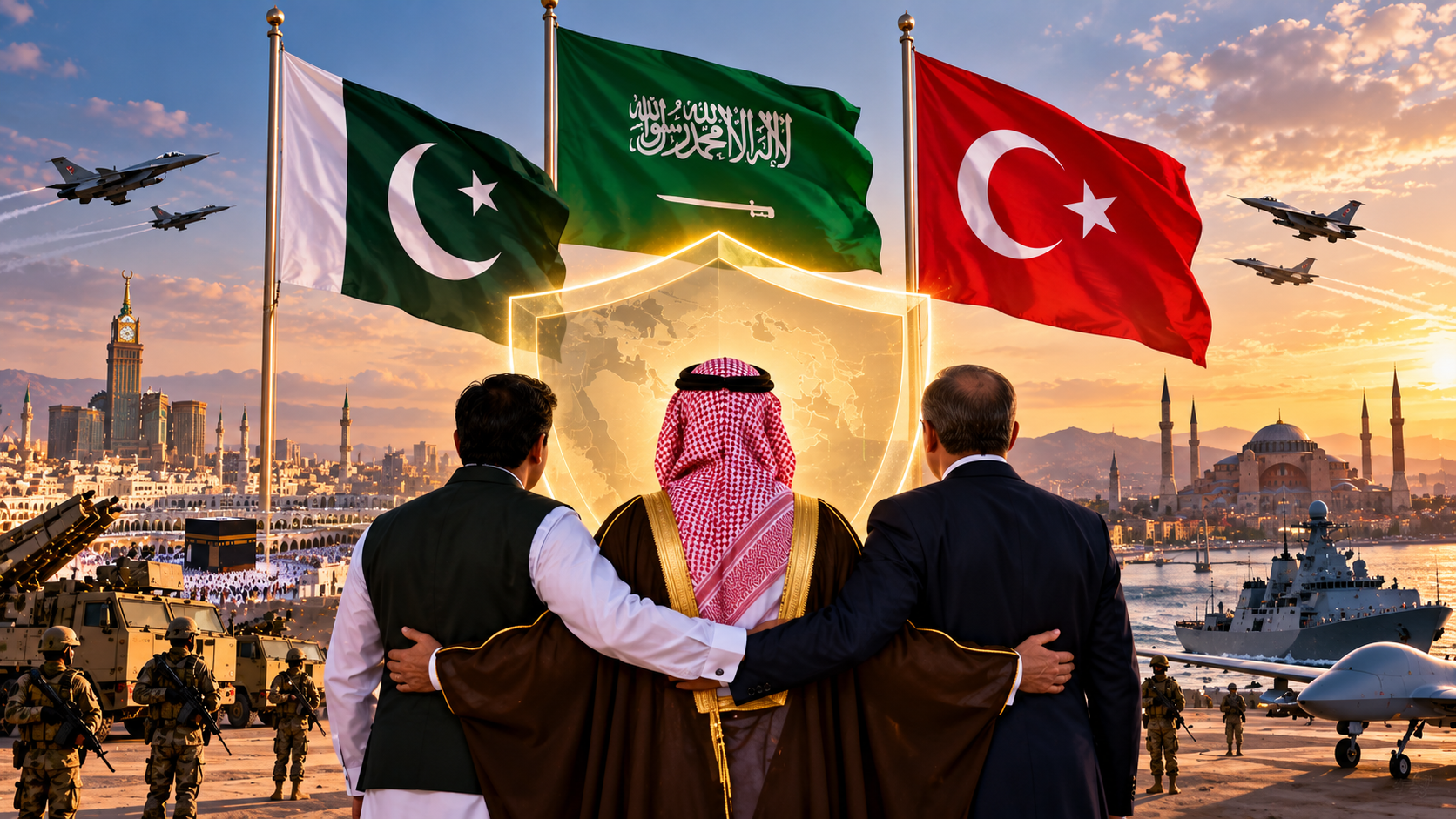
Trilateral agreement establishes a long-term framework for collective defence, intelligence sharing and military cooperation, with withdrawal permitted only after the first decade and subject to advance diplomatic notice
Pakistan, Saudi Arabia and Türkiye have committed themselves to a long-term defence partnership under the Mecca Joint Defence Agreement, which bars any signatory from withdrawing during the first 10 years after the pact enters into force. The agreement establishes a framework for collective security, military assistance and defence cooperation among the three countries, potentially reshaping security coordination across parts of the Middle East and South Asia.
The agreement was signed in Mecca on August 7 by Turkish President Recep Tayyip Erdoğan, Saudi Crown Prince Mohammed bin Salman and Pakistan Prime Minister Shehbaz Sharif. Its full text was submitted to Türkiye’s parliament for consideration, bringing renewed attention to the pact’s withdrawal provisions, mutual defence commitments and institutional structure.
The agreement does not have a fixed expiry date. It will enter into force once the final instrument of ratification is deposited with the alliance’s secretariat.
Why the Pact Has a 10-Year Withdrawal Restriction
Under the agreement’s withdrawal clause, a signatory cannot leave during the first 10 years after the pact comes into force. Once that period has elapsed, a member may withdraw by notifying the other two countries in writing through diplomatic channels at least three months in advance.
The restriction is designed to provide continuity to the partnership and reduce the risk of an early withdrawal undermining joint military planning, defence investments and intelligence-sharing arrangements.
Because the 10-year period begins when the agreement enters into force, rather than simply on the date it was signed, the precise withdrawal timeline depends on the completion of the ratification process.
The arrangement also has no stated automatic termination date. This means the agreement is intended to remain in place unless a permitted withdrawal or another applicable legal process changes the membership or status of the pact.
Collective Defence: An Attack on One Is Treated as an Attack on All
One of the agreement’s central provisions concerns collective defence. Under Article 1, the three signatories commit to protecting one another’s independence, sovereignty, territorial integrity and internationally recognised borders.
The text states that an externally originating armed attack against any one of the three countries will be considered an attack against all three. The other members are required to provide immediate assistance using the mutual assistance measures available to them.
This creates a formal basis for coordinated responses to external military threats. However, the agreement does not identify a specific country or region as the target of the alliance, and its precise implementation will depend on the circumstances of a crisis and the measures available to the signatories.
The pact also allows additional countries to join, subject to approval by the founding members.
Defence Production, Intelligence and Military Training
The agreement extends beyond a commitment to mutual defence. It outlines cooperation across several areas intended to strengthen the military capabilities of all three countries.
Key areas include:
-
Intelligence sharing and counter-terrorism cooperation.
-
Military training, logistics and operational readiness.
-
Cooperation in defence production and related industries.
-
Joint research, development and innovation in advanced technologies.
-
Coordination of military assistance and deterrence measures.
Such arrangements could help the countries coordinate procurement, share technical expertise and improve the interoperability of their armed forces. Defence-industry cooperation may also create opportunities for joint development projects and closer links between manufacturers.
The extent of these benefits will depend on the projects undertaken, the resources committed by each country and the practical implementation of the agreement.
A New Institutional Structure for Coordination
To oversee cooperation, the agreement establishes a Strategic Political and Defence Committee comprising representatives of Pakistan, Saudi Arabia and Türkiye. The committee is intended to coordinate political and defence engagement and support the implementation of the pact.
A secretariat headquartered in Saudi Arabia will assist the committee. The secretary-general will serve a three-year term, with the position rotating among the three countries. The first appointment is allocated to a Pakistani national.
The agreement also establishes rules for protecting classified information. Sensitive material cannot be shared with countries, companies or individuals outside the three signatories, and access is restricted to authorised personnel with a legitimate need to know.
These provisions are intended to provide an organisational foundation for cooperation while protecting military and intelligence information.
Regional Security Concerns Put the Agreement in Focus
The pact has attracted attention amid continuing security concerns in the Middle East, including attacks affecting Saudi Arabia and wider instability around regional shipping routes and strategic infrastructure.
According to the supplied report, defence and foreign ministers from the three countries held an emergency meeting in Riyadh earlier in October following escalating Houthi attacks on Saudi Arabia. The meeting was described as the alliance’s first activation since the agreement was signed.
The countries reportedly agreed to activate collective deterrence measures and rapidly deploy military forces to Saudi Arabia in response to the attacks. Türkiye was also reported to be providing technical and defensive military support, including air-defence systems, intelligence and logistical assistance.
These developments indicate the potential operational significance of the partnership. However, the scope of any deployment, the forces involved and the precise legal basis for particular actions require confirmation through official statements.
What the Agreement Means for Pakistan, Saudi Arabia and Türkiye
For Saudi Arabia, the pact provides a framework for strengthening security cooperation with two strategically significant partners as it seeks to protect its territory and critical infrastructure.
Pakistan brings established military capabilities and long-standing security ties with Saudi Arabia. Türkiye contributes defence-industrial expertise and military capabilities, including experience in developing defence technologies and systems.
For Türkiye, the arrangement could deepen its strategic engagement with the Gulf region. For Pakistan, it provides another formal channel for defence cooperation with partners that have significant regional interests.
Despite their shared security objectives, the three countries have distinct foreign-policy priorities, economic circumstances and strategic relationships. The durability of the partnership will therefore depend on their ability to coordinate responses when their interests or assessments of a crisis differ.
Potential Implications for Defence Industries and Investment
The pact could have implications for defence manufacturers, military technology providers and companies involved in logistics, communications, surveillance and air-defence systems.
If the agreement leads to joint procurement, technology development or manufacturing partnerships, businesses operating in these areas could see new opportunities. Cooperation on research and development could also support the exchange of technical expertise and the development of more integrated defence capabilities.
However, the agreement itself does not establish specific procurement contracts, investment amounts or production targets. Any commercial benefit will depend on subsequent government decisions, budgets, contracts and implementation arrangements.
Investors should distinguish between the strategic commitments contained in the pact and confirmed commercial orders. Defence-related opportunities may emerge over time, but the financial implications cannot be determined solely from the agreement’s signing.
Market Outlook
The Mecca Joint Defence Agreement represents a long-term commitment to closer security coordination among Pakistan, Saudi Arabia and Türkiye. Its 10-year restriction on withdrawal after entry into force, collective-defence provision and cooperation mechanisms provide a framework for sustained military engagement.
The most important developments to monitor will be the completion of ratification, the formal activation of joint mechanisms, any confirmed military deployments and the emergence of concrete defence-production or procurement agreements.
For defence-sector businesses, the pact could create opportunities if political commitments translate into funded projects and contracts. For regional security, its significance will depend on how consistently the three countries coordinate their responses to future threats. Until more implementation details are available, the agreement should be viewed as a major strategic framework rather than evidence of a fully integrated military alliance with all operational arrangements already established.