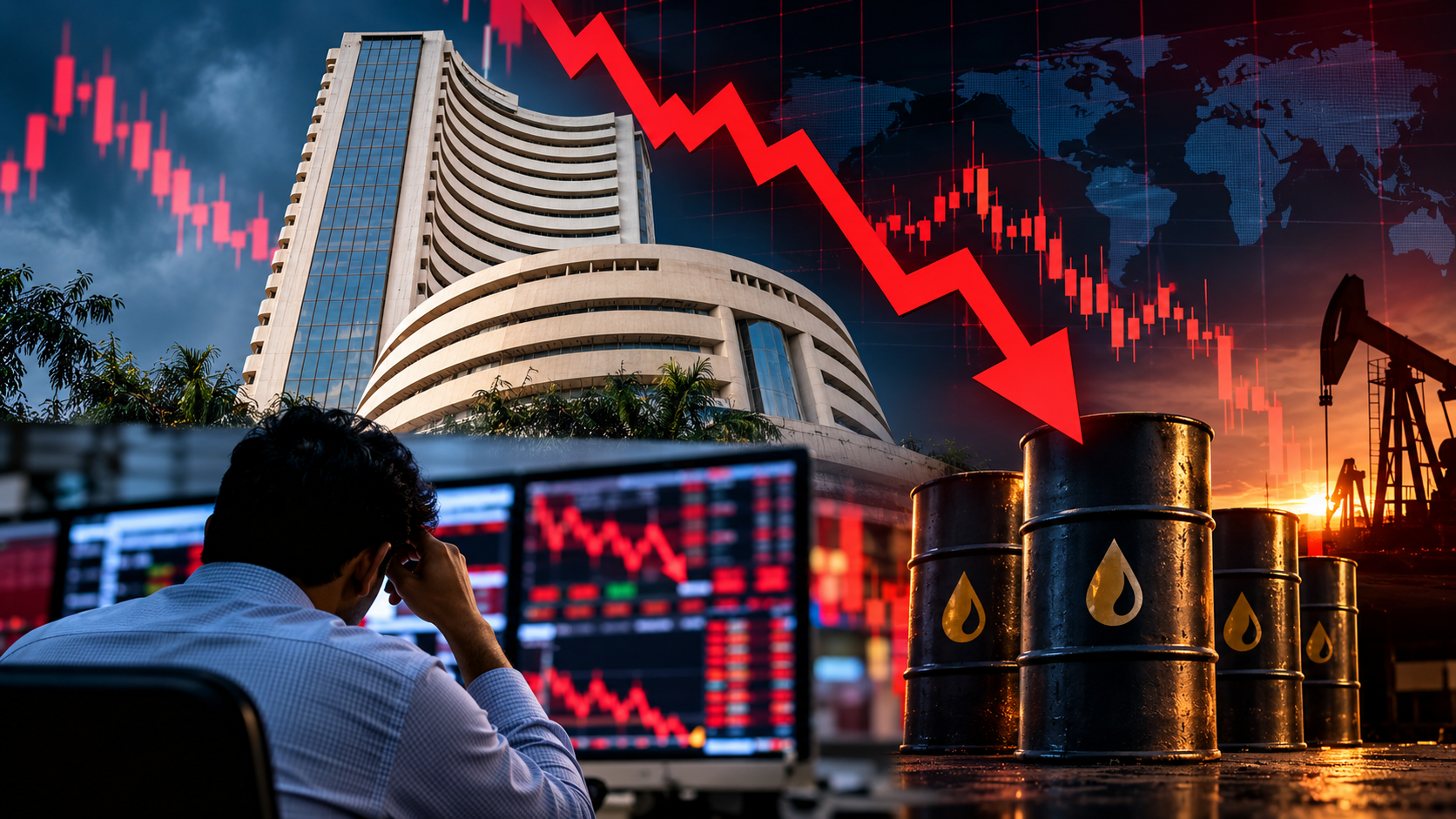
India VIX Surges 15%; Broad-Based Selling Hits Banks, Metals, Auto and Realty Stocks
Indian equity markets came under renewed selling pressure on Monday, September 28, as rising crude oil prices, elevated global bond yields and geopolitical uncertainty weighed heavily on investor sentiment. The benchmark indices opened lower and extended their losses through the morning session, with the Sensex falling more than 850 points and the Nifty 50 slipping below the psychologically important 23,000 mark.
At around 10:00 AM, the Sensex was down 858.51 points, or 1.16 per cent, at 73,037.23, while the Nifty 50 declined 258.35 points, or 1.12 per cent, to 22,882.15. Moneycontrol also reported the Sensex down nearly 900 points and the Nifty around 22,850 earlier in the session, highlighting the intensity of the morning sell-off.
The weakness came after Indian markets had already endured a prolonged period of pressure. The Nifty 50 had ended the previous week with its seventh consecutive weekly decline, its longest losing streak in six years, with elevated crude prices, higher bond yields and inflation concerns remaining key pressure points.
Nifty Slips Below 23,000; Broader Market Also Under Pressure
The Nifty 50 fell below 23,000 shortly after the opening bell. At around 9:25 AM, the index was trading near 22,966 after falling more than 200 points.
The broader market also witnessed selling pressure. The Nifty MidCap 100 and Nifty SmallCap 100 declined more than 1 per cent in early trade, while the broader market subsequently remained in negative territory.
Most sectoral indices were trading lower, indicating that the selling was not restricted to a single segment. Auto, FMCG, Metal, Realty and several other sectoral indices were down more than 1 per cent during the early session.
The Nifty Private Bank index emerged as one of the weakest pockets of the market, while the Nifty IT index relatively outperformed, although it too remained in negative territory.
Sensex Stocks: Banks and Financials Lead the Decline
Selling was particularly visible across large-cap banking and financial stocks.
Kotak Mahindra Bank, Bajaj Finance, HDFC Bank, Bharat Electronics, Hindustan Unilever and Bajaj Finserv were among the Sensex constituents declining more than 1 per cent during early trade.
TCS was the lone stock in the Sensex pack showing a gain at the time of the early update, rising around 0.25 per cent.
In the Nifty 50, Hindalco Industries, Max Healthcare Institute and Kotak Mahindra Bank featured among the major losers.
The weakness in financial stocks is significant because banks and other rate-sensitive sectors can remain vulnerable when investors reassess the interest-rate outlook amid higher commodity prices and inflation risks.
India VIX Jumps Nearly 15%
Market volatility increased sharply on Monday.
The India VIX, which measures expected volatility in the Indian equity market, surged 14.97 per cent to 13.98 during the morning session.
The sharp increase in volatility came after India VIX had already experienced a major rise in the previous week. Moneycontrol noted that the index had closed at 12.16 on Friday after declining 4.16 per cent, following a nearly 23 per cent jump in the previous session.
A sustained increase in India VIX generally indicates that traders are pricing in greater uncertainty and wider potential market swings. For investors, this can translate into sharper intraday movements and greater sensitivity to global news, crude prices and institutional flows.
Crude Oil Becomes the Biggest Market Concern
The renewed rise in crude oil prices has emerged as one of the principal triggers for Monday's sell-off.
Brent crude moved above $106 a barrel in early trading, with the rise linked to renewed uncertainty surrounding US-Iran diplomatic developments. Moneycontrol identified crude oil, US Treasury yields, geopolitical developments and foreign institutional flows as key factors likely to influence Indian equities.
Higher crude prices are particularly important for India because the country remains heavily dependent on imported oil. A prolonged period of expensive crude can increase the import bill, put pressure on the rupee, influence inflation expectations and complicate the interest-rate outlook.
Markets are therefore closely watching whether the current rise in oil prices proves temporary or develops into a sustained trend.
Rate-Hike Concerns Add to Investor Nervousness
The rise in energy prices has also revived concerns about monetary policy.
Higher crude prices can feed into inflation and potentially delay expectations of monetary easing. At the global level, higher inflation expectations can keep bond yields elevated, creating additional pressure on equity valuations.
Moneycontrol's latest market outlook highlighted crude oil and rising US Treasury yields as important factors behind the recent weakness in Indian equities.
The combination of expensive oil, elevated yields and geopolitical uncertainty is therefore creating a challenging backdrop for risk assets.
FII Flows and Global Cues Remain Important
Foreign institutional flows remain another important factor for Dalal Street.
Global investors are simultaneously assessing crude prices, US monetary policy, Treasury yields and geopolitical developments. When US yields remain elevated, emerging-market equities can face additional pressure as the relative attractiveness of dollar-denominated assets changes.
Indian markets are also entering a holiday-shortened trading week. According to Moneycontrol, domestic equity markets will remain closed on Friday, October 2, on account of Mahatma Gandhi Jayanti.
This could result in heightened sensitivity to global developments during the available trading sessions.
23,000 Becomes a Crucial Technical Level
The Nifty's move below 23,000 has placed the psychological level firmly in focus.
According to Moneycontrol's September 28 trade setup, 23,000 was identified as a crucial support zone. A sustained break below this level could expose the index to the 22,800–22,700 area, while on the upside, 23,300–23,500 remains an important zone to watch.
The early-session decline therefore makes the market's ability to reclaim and sustain levels above 23,000 important for near-term trading sentiment.
At the same time, the broader technical structure remains weak, with the Nifty continuing to form lower highs and lower lows, according to the cited technical assessment.
Clean Max Enviro Gains 6% After Large Trades
Amid the broader market sell-off, Clean Max Enviro Energy Solutions bucked the trend.
The stock gained around 6 per cent in early trade after approximately 8.6 million shares, representing around 3.7 per cent of the company's equity, changed hands through multiple large trades.
The move stood out against the broader weakness across the market and highlighted continued stock-specific activity even as benchmark indices remained under pressure.
What Investors Will Watch Next
The immediate market focus is likely to remain on crude oil prices, developments surrounding US-Iran diplomatic efforts, US Treasury yields, foreign institutional flows and movements in the rupee.
Investors will also track whether the Nifty can regain the 23,000 mark or whether selling pressure pushes the index towards the next technical support zone around 22,800–22,700.
The broader market's response will also be important. Continued weakness in MidCap and SmallCap stocks alongside large-cap selling would indicate that risk aversion is spreading across market segments.
Market Outlook
Monday's sharp decline reflects a combination of global and domestic concerns rather than a single company-specific trigger. Rising crude oil prices have once again become a key source of uncertainty for India, while elevated global yields and geopolitical developments are adding to volatility.
For the Nifty 50, 23,000 remains an important near-term reference point, with 22,800–22,700 emerging as the next zone to monitor if the decline continues. On the recovery side, the 23,300–23,500 area could remain important for assessing whether buying interest is returning.
With India VIX rising sharply and selling visible across multiple sectors, investors are likely to remain sensitive to every major move in crude oil, global bond yields and geopolitical headlines during the sessions ahead.