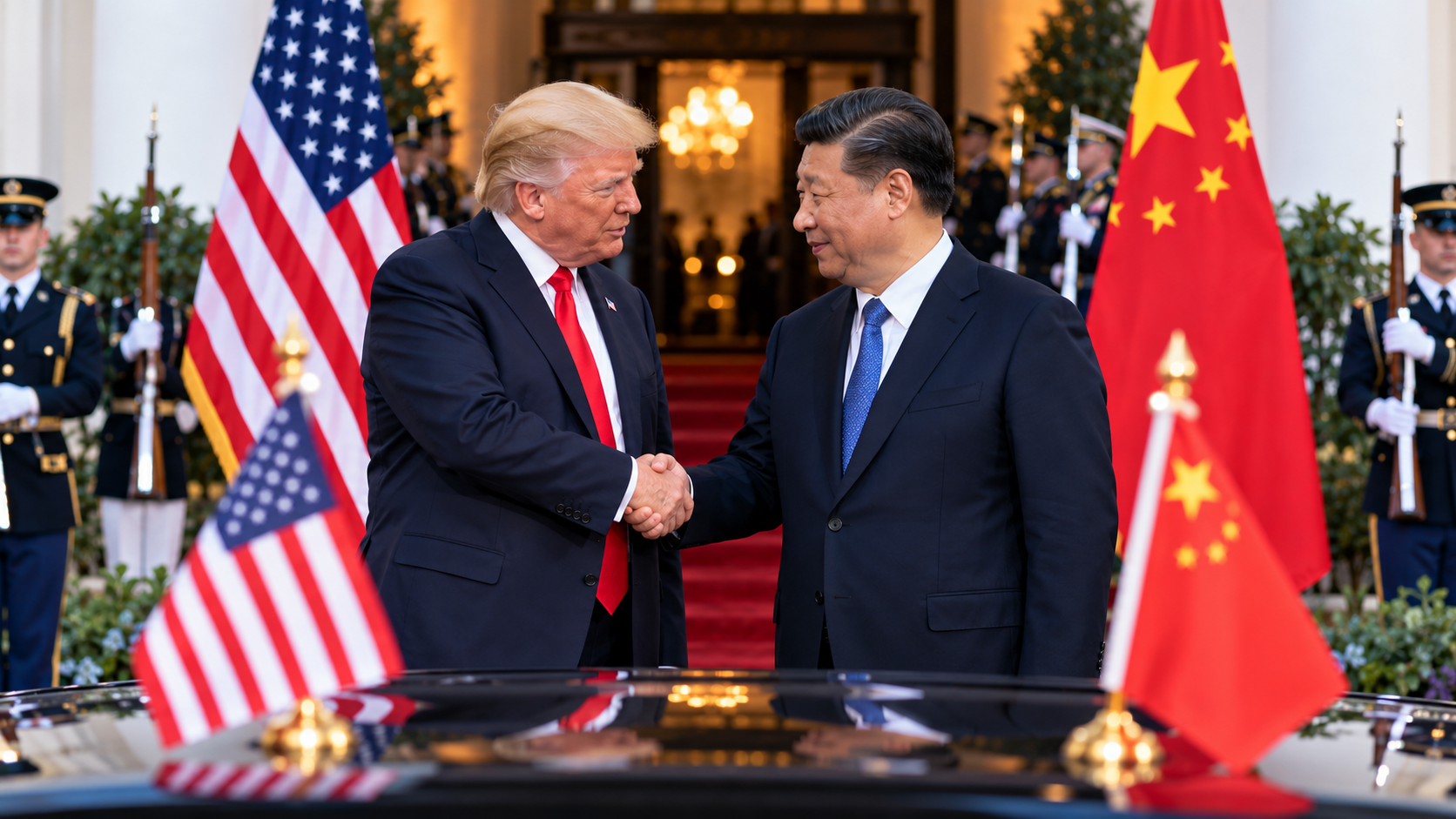
Trump and Xi Jinping strike a warmer tone at the White House, but trade, tariffs, artificial intelligence, Taiwan and technology remain unresolved as the two sides extend their trade truce
US President Donald Trump and Chinese President Xi Jinping held a closely watched summit in Washington against the backdrop of an increasingly complex economic and geopolitical relationship between the world's two largest economies.
The meeting was accompanied by an elaborate state welcome and a high-profile dinner at the White House, with both leaders adopting notably warmer rhetoric than might have been expected given the strategic competition between Washington and Beijing.
However, the summit produced limited immediate evidence of breakthroughs on several of the most difficult issues dividing the two countries.
The most significant economic development linked to the gathering was the extension of the existing US-China trade truce. US Treasury Secretary Scott Bessent said the two sides had agreed to extend the truce for another two months, giving negotiators additional time to work on unresolved trade issues.
Beyond the extension, expectations for major agreements on tariffs, artificial intelligence and other strategic areas remained largely unfulfilled.
Trade Truce Extended as Broader Tariff Questions Remain
The extension of the trade truce emerged as the clearest tangible outcome surrounding the summit.
The arrangement provides Washington and Beijing with additional time to negotiate rather than immediately returning to a more confrontational tariff environment.
The development is particularly important for businesses because US-China trade policy has implications for global supply chains, manufacturing costs, commodity demand and corporate investment decisions.
However, the extension does not resolve the underlying disagreements between the two countries.
Tariffs, market access, industrial policy, technology restrictions and China's role in global supply chains remain major points of contention.
The temporary nature of the truce also means companies cannot assume that the current trade environment will remain unchanged once the extension expires.
Trump Highlights Personal Relationship With Xi
Trump adopted a notably positive tone during the summit, describing his relationship with Xi as a strong friendship and emphasising the potential for cooperation between Washington and Beijing.
The US president's approach contrasted with the more confrontational rhetoric that characterised significant periods of the US-China trade relationship during his first term.
Trump has previously imposed and threatened substantial tariffs on Chinese goods, while Washington has also introduced restrictions targeting advanced technologies and strategic sectors.
During the latest summit, however, Trump focused more heavily on maintaining a working relationship with Xi and finding areas where the two governments could cooperate.
The warmer rhetoric does not necessarily mean the strategic rivalry has disappeared. Instead, it suggests that both governments are attempting to manage competition while keeping channels for economic and diplomatic engagement open.
Xi Pushes Economic and Technology Priorities
Xi's messaging focused more heavily on policy objectives and the broader structure of US-China relations.
The Chinese president emphasised the importance of continued economic engagement and called for Chinese companies to receive fair treatment in the United States.
He also said China remained open to American companies seeking to invest and operate in the Chinese market.
Artificial intelligence was another important area of discussion.
Xi called for greater international cooperation to ensure that AI development remains subject to human control. The issue is particularly significant because Washington and Beijing are competing for leadership in advanced computing, semiconductor technology and artificial intelligence.
The two countries have increasingly treated AI as both an economic opportunity and a strategic technology, making cooperation difficult even when both sides acknowledge the need for dialogue.
Taiwan Remains a Major Strategic Fault Line
Taiwan remains one of the most sensitive issues in the US-China relationship.
According to Beijing's account of the discussions, Xi urged Trump to oppose moves towards Taiwanese independence.
China regards Taiwan as part of its territory and has repeatedly opposed any steps that could formalise Taiwanese independence. The United States maintains a long-standing policy of strategic ambiguity regarding Taiwan while maintaining unofficial relations and providing defensive support.
The issue has the potential to complicate progress on economic matters because it involves core national-security interests for Beijing and significant strategic interests for Washington.
No broad resolution on Taiwan emerged from the summit.
Artificial Intelligence Becomes a New Area of Competition
AI has emerged as one of the most important areas of US-China competition.
The two countries are competing over advanced chips, computing infrastructure, data, AI models and the industrial applications of the technology.
Washington has introduced technology restrictions aimed at limiting China's access to certain advanced semiconductor capabilities, while Beijing has sought to strengthen domestic technological self-reliance.
At the same time, both governments recognise that uncontrolled AI development could create risks that cross national borders.
The summit therefore highlighted an unusual combination of competition and potential cooperation: Washington and Beijing remain rivals in advanced technology while exploring mechanisms for dialogue on AI safety and emergency communication.
US and Chinese officials had already been discussing a dedicated AI-safety dialogue, with another meeting expected within two months in Shenzhen, according to Reuters reporting.
Rare Earths and Supply Chains Remain Important
Critical minerals and rare-earth supply chains remain another important component of the economic relationship.
China occupies a major position in global rare-earth mining, processing and refining, while the United States and other economies have been attempting to diversify their supply chains.
Earlier US-China agreements had included commitments related to rare-earth materials and processing equipment. However, implementation has remained a work in progress.
The issue is important for industries ranging from electric vehicles and renewable energy to defence, electronics and advanced manufacturing.
Any renewed restrictions could therefore have consequences extending well beyond the bilateral trade relationship.
Earlier Trade Commitments Have Not Been Fully Realised
The latest summit also comes after months of uneven progress in fulfilling earlier US-China economic commitments.
Previous arrangements included discussions around US agricultural exports, aircraft purchases, investment mechanisms and reductions in certain trade barriers.
Some commitments have progressed, while others have taken longer than initially expected.
The gap between announced agreements and actual implementation remains one of the central challenges in the bilateral relationship.
Businesses therefore have an additional reason to focus not only on what Washington and Beijing announce at political meetings, but also on how those commitments are translated into measurable trade and investment flows.
State Dinner Adds Pomp to the Summit
The diplomatic engagement was accompanied by a high-profile state dinner at the White House.
Trump presented Xi with a bald eagle statue, while the dinner brought together senior government officials, business leaders and prominent figures from the American technology and financial sectors.
The White House said the dinner was designed around American ingredients with Chinese influences and included entertainment by military musicians and other performers.
The elaborate ceremony underscored the diplomatic importance Washington attached to Xi's visit, which was the Chinese leader's first visit to the White House in more than a decade.
However, the pageantry was accompanied by relatively limited public detail on major new economic agreements.
Pomp Versus Policy
The contrast between the ceremony and the limited number of immediately visible breakthroughs became a defining feature of the summit.
Trump and Xi demonstrated a willingness to maintain direct communication, while the extension of the trade truce reduced the immediate risk of a renewed escalation in tariffs.
At the same time, major structural disagreements remain.
These include the future of tariffs, technology controls, semiconductor access, Taiwan, rare-earth supply chains, AI governance and China's relationship with countries such as Iran.
The summit therefore appears to have focused as much on managing tensions as resolving them.
Markets Closely Watching the Outcome
The US-China relationship remains particularly important for global financial markets.
A deterioration in relations could increase uncertainty for multinational companies, disrupt supply chains and raise the cost of imported goods.
Conversely, a more stable trade environment could provide greater visibility for businesses that depend heavily on cross-border manufacturing and exports.
Asian markets have also responded to expectations surrounding the summit. Before the meeting, the Chinese yuan had strengthened to its highest level against the US dollar in more than three years, while investors were watching whether the summit would produce concrete economic progress.
The extension of the trade truce provides some additional breathing room, but markets are likely to remain sensitive to future announcements.
Implications for Global Businesses
For multinational companies, the most important takeaway is that US-China economic competition remains a long-term issue rather than a temporary trade dispute.
Companies operating across both markets must continue to account for tariff risks, technology restrictions, supply-chain diversification and geopolitical uncertainty.
Industries such as semiconductors, electric vehicles, telecommunications, renewable energy, artificial intelligence and advanced manufacturing are particularly exposed to changes in US-China policy.
The trade truce can provide short-term stability, but businesses are likely to continue building alternative supply chains and reducing excessive dependence on either market.
What Comes Next
The two countries now have additional time to negotiate before the extended trade truce expires.
The next phase of discussions will be closely watched for progress on tariff reductions, market access, rare-earth supplies, agricultural purchases, technology restrictions and investment flows.
AI cooperation could also become an increasingly important diplomatic channel as both countries attempt to establish mechanisms for dealing with emerging technological risks without giving up their competitive advantages.
Meanwhile, Taiwan and broader geopolitical disagreements are likely to remain outside the scope of any simple trade agreement.
Global Outlook
The Trump-Xi summit has demonstrated that Washington and Beijing are willing to maintain dialogue even while their strategic rivalry continues.
The extension of the trade truce reduces the immediate possibility of another sharp escalation in tariffs, but it does not resolve the deeper economic and geopolitical differences between the two countries.
For global markets, the key question now is whether the additional negotiating window produces concrete agreements or simply postpones the underlying disputes.
Investors and businesses will therefore continue to track US-China trade policy, technology restrictions, critical-mineral supply chains and developments around Taiwan. The direction of these negotiations could influence global trade flows, corporate investment decisions, commodity markets and risk sentiment well beyond the two countries.