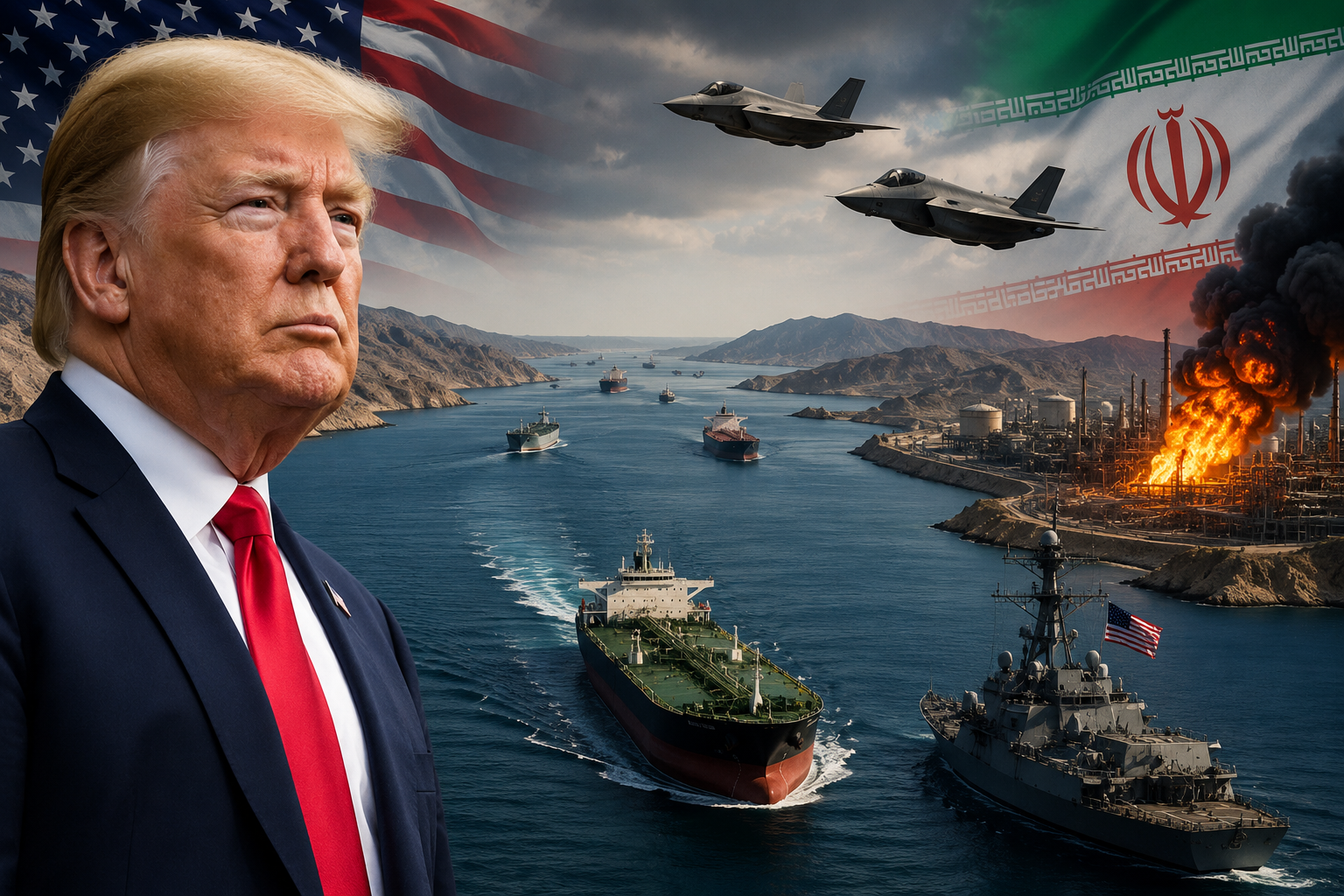
US President Says Strategic Waterway Is Under American Control As Military Tensions Escalate
US President Donald Trump has suggested renaming the strategically vital Strait of Hormuz as “Trump Strait”, as military tensions between the United States and Iran intensify and concerns over global energy supplies remain elevated.
Trump made the proposal in a social media post on Wednesday, arguing that the waterway is now under US control. The statement came less than a day after US forces conducted another round of strikes against Iranian military targets.
While the proposed name change is largely symbolic, the remarks come at a critical time for global energy and financial markets. The Strait of Hormuz is one of the world's most important maritime routes for crude oil and petroleum products, and any prolonged disruption could have significant consequences for oil prices, inflation, shipping costs and global economic growth.
US-Iran Conflict Enters Another Dangerous Phase
The latest developments mark another escalation in the conflict between Washington and Tehran.
According to the US Central Command (Centcom), American forces targeted Iranian air-defence systems, radar installations, maritime assets, mine-laying capabilities and communications facilities linked to Iran's Islamic Revolutionary Guard Corps (IRGC).
The operations followed a roughly month-long pause in active fighting.
The US military had also previously reported attacks on two Iranian launchers on Larak Island, which it said were preparing to launch rockets carrying naval mines into the Strait of Hormuz.
The renewed military activity has increased uncertainty for commercial vessels operating in and around the waterway.
Why Strait of Hormuz Matters To The World
The Strait of Hormuz connects the Persian Gulf with the Gulf of Oman and the Arabian Sea, making it a critical gateway for energy exports from the Middle East.
Before the conflict, approximately one-fifth of global oil trade moved through the strait.
The route is particularly important for major oil-producing countries in the Gulf region because it provides a maritime link between their export terminals and international markets.
Any disruption could therefore affect not only crude oil supplies but also refined petroleum products and global shipping schedules.
Oil Prices Jump As Markets Price In Geopolitical Risk
Crude oil prices rose by around 4% following the latest military developments as traders assessed the possibility of further disruption to regional energy supplies.
The increase highlights the sensitivity of oil markets to developments around the Strait of Hormuz.
Even without a complete closure, increased security risks can cause shipping companies and energy traders to demand higher risk premiums.
Higher crude prices can then spread through the global economy by increasing fuel, transportation and manufacturing costs.
US Says Hormuz Remains Under Its Control
Trump and his administration have repeatedly maintained that Iran no longer controls the Strait of Hormuz.
The US administration has also pointed to alternative oil-export routes through pipelines operated by Saudi Arabia and the United Arab Emirates.
These routes can allow some crude shipments to bypass the strait and reach international markets without travelling through the contested waterway.
US officials have argued that total regional oil exports, including pipeline shipments, remain higher than before the conflict.
US Energy Secretary Chris Wright said that more than 17 million barrels of oil passed through the Strait of Hormuz on Monday, describing the figure as a wartime record.
Before the conflict began on February 28, approximately 20 million barrels per day of crude oil and petroleum products moved through the waterway.
Iran Rejects Washington's Claims
Iran has rejected the US administration's claims that the Strait of Hormuz is fully open and under American control.
Iran's Foreign Ministry has alleged that US military strikes hit civilian areas and infrastructure in several provinces.
Iran has also said that a wedding ceremony in Sirik County was among the locations affected by the latest military operations.
The United States has denied intentionally targeting civilians. Centcom spokesperson Navy Captain Tim Hawkins said the US military does not target civilians and accused the IRGC of operating differently.
The conflicting claims add another layer of uncertainty as international governments attempt to assess the situation on the ground.
Iran Retaliates With Missile Strikes
Iran responded to the US attacks by launching missile strikes against American military facilities in the region.
The IRGC said it targeted US bases in Jordan, Kuwait and Bahrain, as well as another US facility in Iraq.
The retaliatory attacks raise concerns that the conflict could expand beyond the immediate US-Iran confrontation.
Several countries across the Middle East host US military assets, increasing the potential geographic scope of the conflict if retaliatory attacks continue.
A wider regional conflict could create additional risks for energy infrastructure, shipping lanes and global commodity markets.
Commercial Shipping Faces Rising Risks
The Strait of Hormuz is not only important for oil producers but also for the international shipping industry.
The resumption of hostilities has already contributed to a reduction in commercial shipping through the region compared with pre-war levels.
The situation has become more difficult for shipping operators as military strikes have resumed after the earlier pause.
The United Kingdom Maritime Trade Operations (UKMTO) has reported attacks involving vessels travelling through the Strait of Hormuz almost daily.
For shipping companies, increased risks can result in:
-
Higher insurance premiums
-
Additional security expenses
-
Longer shipping routes
-
Higher freight costs
-
Delays in cargo deliveries
-
Increased fuel consumption
These additional costs can ultimately be passed through to consumers and businesses.
Saudi Arabia Reports Oil Tanker Attack
Saudi Arabia has also accused Iran of attacking an oil tanker, with two people reportedly killed in the incident.
Any increase in attacks against commercial vessels could make shipping companies more reluctant to operate through the Strait of Hormuz.
If more vessels are diverted to alternative routes, shipping times and transportation costs could increase significantly.
Such developments would add further upward pressure to the price of delivered energy and other commodities.
Alternative Pipelines Offer Some Protection
The existence of alternative export infrastructure provides some protection against a complete interruption of oil supplies.
Saudi Arabia and the UAE have pipelines capable of moving part of their oil exports without using the Strait of Hormuz.
However, these alternatives cannot fully replace the volume normally transported through the waterway.
Consequently, even if the strait remains partially operational, a prolonged reduction in tanker traffic could tighten global oil markets.
Trump Has A History Of Geographic Renaming Proposals
The “Trump Strait” proposal follows several other geographical renaming initiatives associated with the US president.
Trump previously announced the renaming of the Gulf of Mexico as the Gulf of America, although Mexico and other countries have rejected the change.
He also proposed referring to Lake Ontario as “Lake America” during an ongoing trade dispute with Canada.
The latest proposal is more politically charged because the Strait of Hormuz is internationally recognised by a long-established name and is located between Iran and Oman.
A unilateral proposal from one country would not automatically change the internationally recognised geographical name.
Global Markets Remain Sensitive To Oil Prices
For investors, the proposed name change is considerably less important than the military and economic developments surrounding the strait.
The primary market concern is whether the conflict results in a sustained reduction in energy shipments.
A prolonged supply disruption could push crude prices significantly higher and increase inflationary pressures globally.
Higher oil prices can also complicate the monetary-policy outlook because central banks may become more cautious about cutting interest rates if energy-driven inflation accelerates.
This could affect equity valuations, bond yields and currency markets.
India Could Face Higher Economic Pressure
India is particularly sensitive to crude oil prices because of its substantial dependence on imported energy.
A sustained increase in crude prices could raise the country's import bill and put pressure on the trade deficit.
It could also influence the Indian rupee and domestic inflation.
Higher fuel and transportation costs may increase expenses for airlines, logistics companies, automobile operators, chemicals manufacturers and other fuel-intensive industries.
For the broader Indian equity market, a sharp and sustained rise in crude oil could therefore become a headwind for corporate earnings.
Indian Aviation And Transport Sectors In Focus
Airlines are among the industries most directly exposed to higher fuel prices.
A sustained increase in crude prices can eventually feed into aviation turbine fuel prices, increasing operating expenses for carriers.
Transport and logistics companies could also experience higher fuel costs.
If companies are unable to fully pass these costs to customers, margins could come under pressure.
Conversely, upstream oil producers and selected energy companies could benefit from stronger crude prices, creating a divergent impact across sectors.
Inflation And Interest Rates Could Become A Concern
A prolonged oil-price shock could complicate the inflation outlook for major economies.
Energy costs have a broad impact on the cost of transportation, manufacturing, food distribution and other services.
For India, higher crude prices could make it more difficult to maintain a benign inflation environment if the increase persists.
Investors will therefore monitor not only crude prices but also how long elevated prices remain above normal levels.
A temporary spike may have a limited impact, while a prolonged energy shock could have broader consequences for monetary policy and economic growth.
Renaming Proposal Overshadowed By Strategic Importance
Although Trump's “Trump Strait” proposal has attracted significant attention, the more consequential issue remains the security of the waterway.
The Strait of Hormuz is critical to the global economy because of the volume of energy that normally passes through it.
Any sustained disruption could create a chain reaction:
Military escalation → shipping disruption → tighter oil supply → higher crude prices → higher inflation → pressure on economic growth and financial markets
The longer the disruption continues, the greater the potential economic impact.
Investors Watch For De-Escalation Signals
Global investors will closely monitor diplomatic developments between Washington and Tehran.
A reduction in military activity could quickly lower the geopolitical risk premium embedded in crude oil prices.
An agreement that ensures safe commercial passage through the Strait of Hormuz could provide relief to energy markets and risk assets.
On the other hand, further attacks on tankers, oil infrastructure or military facilities could trigger another sharp increase in market volatility.
Key Factors To Watch
Strait Of Hormuz Shipping Traffic
The number of commercial vessels passing through the waterway will provide an important indication of whether the disruption is worsening or easing.
Crude Oil Prices
Brent and WTI prices will remain the most immediate market indicators of geopolitical risk.
Military Escalation
Further US or Iranian attacks could increase the probability of a broader regional conflict.
Alternative Oil Routes
Pipeline volumes from Saudi Arabia and the UAE could determine how much of the supply disruption can be absorbed.
Shipping Insurance And Freight Rates
Rising insurance and transportation costs would signal increasing commercial risks even if oil supplies remain available.
Diplomatic Developments
Any renewed negotiations could significantly reduce geopolitical risk premiums.
Market Outlook
The proposed renaming of the Strait of Hormuz as “Trump Strait” is primarily a political and symbolic statement, but the circumstances surrounding the announcement carry significant implications for global markets.
The key issue for investors is whether the renewed US-Iran conflict causes a prolonged disruption to one of the world's most important energy corridors.
For India, the biggest risks would arise from a sustained increase in crude oil prices, higher freight and transportation costs, pressure on the rupee and a potential increase in inflationary pressures. Energy-intensive sectors such as aviation, logistics, chemicals and transportation could face margin pressure.
In the near term, crude oil prices, tanker movements through the Strait of Hormuz, US-Iran military developments and diplomatic efforts will remain the most important market indicators.
A credible de-escalation could bring relief to global equities and commodities, while further attacks on commercial shipping or energy infrastructure could trigger another wave of volatility and keep investors defensive.