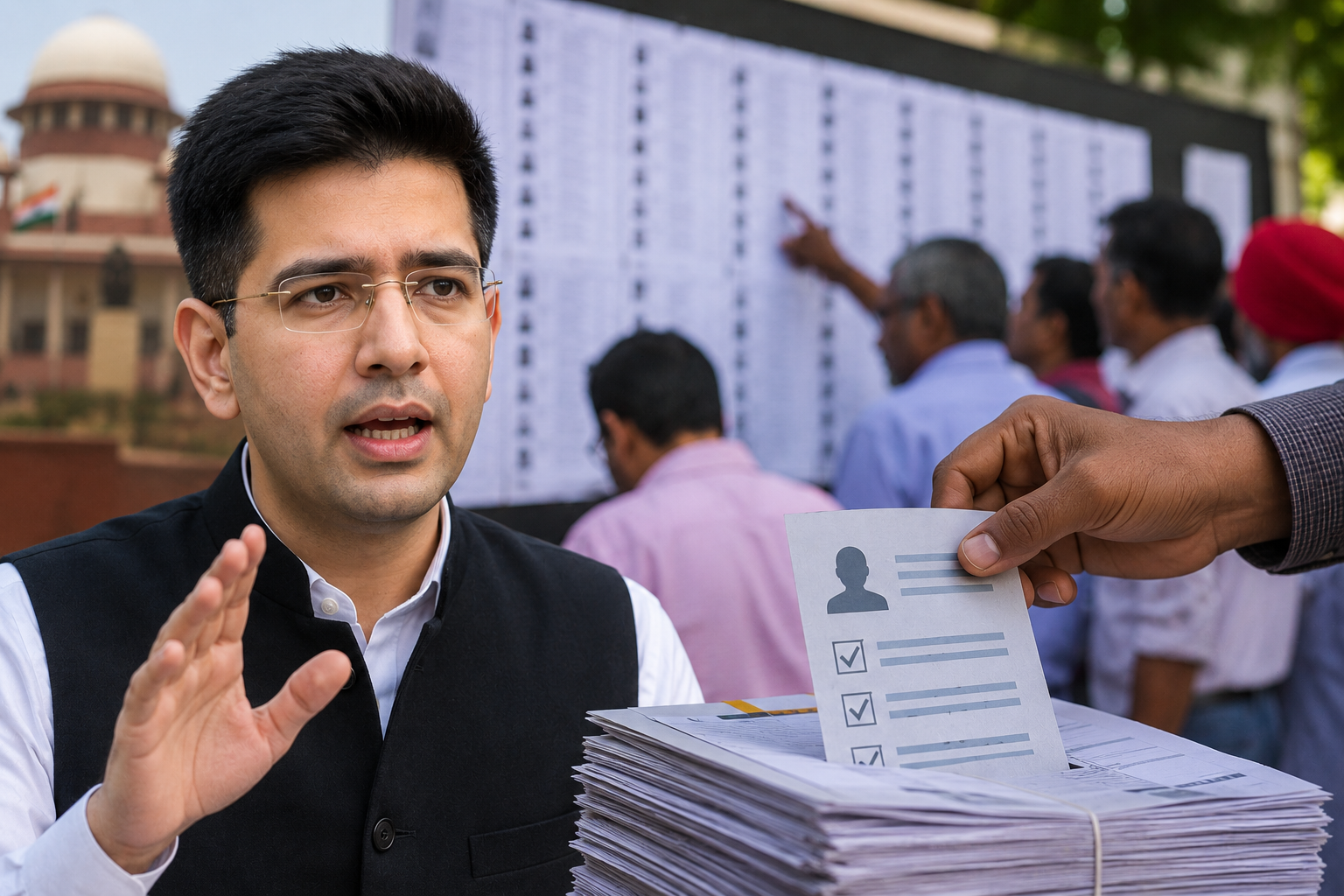
Rajya Sabha MP Says Voter ID Is Registered In Mohali; Plans To Challenge ‘Permanently Shifted’ Status
Rajya Sabha MP Raghav Chadha has alleged political vendetta after his name was marked as “permanently shifted” in Punjab's draft electoral roll prepared under the Election Commission of India's Special Intensive Revision (SIR).
Chadha, who joined the Bharatiya Janata Party (BJP) in April 2026 after previously representing the Aam Aadmi Party (AAP) in the Rajya Sabha, has questioned why his name was classified as shifted when, according to him, his voter identification is registered in Mohali.
The development has triggered a political dispute over the electoral-roll revision process in Punjab, with Chadha alleging that the action against him is connected to his decision to leave AAP.
The matter is currently at the draft stage, and the claims-and-objections process remains open for voters seeking correction or restoration of their names.
Chadha Calls Electoral Roll Classification Political Vendetta
Chadha has strongly objected to the classification of his name in the draft electoral roll.
He alleged that the Punjab government had taken what he described as its “politics of revenge” into the electoral-roll revision exercise.
According to Chadha, his name being classified as “permanently shifted” cannot be treated simply as a clerical mistake because his voter ID remains registered in Mohali.
He has further alleged that the administrative machinery of the Punjab government and police has been used against former AAP leaders who subsequently left the party and joined the BJP.
These statements represent Chadha's allegations. The electoral-roll verification and correction process is still underway.
Chadha Joined BJP After Representing AAP In Rajya Sabha
The controversy follows a major political shift in Chadha's career.
Chadha was elected to the Rajya Sabha from Punjab in 2022 as an AAP nominee. He subsequently joined the BJP in April 2026.
His departure from AAP has been followed by political exchanges between Chadha and his former party.
The latest electoral-roll dispute has therefore acquired an additional political dimension, with Chadha directly linking his classification in the draft roll to the political fallout following his departure.
Name Listed Under ASDD Category
According to the draft electoral roll, Chadha's name has been categorised under the “Absent, Shifted, Deceased and Duplicate” (ASDD) classification.
His specific status has been recorded as “permanently shifted.”
The classification is significant because electoral-roll revisions are intended to identify entries that require verification and correction, including voters who may have moved from their registered address.
Chadha has disputed the classification and intends to use the formal claims-and-objections mechanism to seek correction.
Around 20.6 Lakh Names Excluded From Punjab Draft Roll
Chadha's case is part of a much larger electoral-roll revision exercise in Punjab.
Around 2.06 million names, or approximately 9.7% of Punjab's pre-SIR electorate, were not included in the draft electoral roll.
The excluded entries include names classified under categories such as absent, shifted, deceased and duplicate.
The scale of the exclusions has made the claims-and-objections stage particularly important because affected voters have an opportunity to establish their eligibility and seek restoration of their names.
Draft Electoral Roll Is Not The Final List
A key point in the controversy is that the current electoral roll is a draft and not the final electoral register.
Exclusion from the draft does not automatically mean that an individual has permanently lost their place on the electoral roll.
Voters whose names have been omitted or incorrectly classified can submit claims and supporting documents during the designated period.
The electoral authorities will subsequently examine these submissions before preparing the final roll.
Chadha himself has acknowledged that his current classification can be challenged through this process.
Claims And Objections Window Remains Important
The claims-and-objections period for Punjab is scheduled to continue until September 12.
During this period, affected voters can approach the relevant authorities with documents and other information supporting their claim.
The process is intended to provide an opportunity to correct errors and ensure that eligible voters are not inadvertently excluded.
The final electoral roll is scheduled to be published on October 12.
Therefore, the ultimate status of Chadha's name will depend on the outcome of the verification and claims process.
Chadha Invokes ECI Guidelines For Public Representatives
Chadha has also raised a specific objection concerning the treatment of public representatives during the SIR exercise.
He has referred to Paragraph 4(d) of the Election Commission's Detailed Guidelines for SIR, which he says provides for a protected list covering certain categories of individuals, including public representatives.
According to Chadha, the provision requires the names of members of the judiciary, public representatives, holders of declared offices and certain personalities from fields such as arts, culture, journalism, sports and public services to be included in the draft electoral rolls where their names have been flagged in the electoral database.
The purpose, as Chadha interprets it, is to allow the relevant documents to be collected during the claims-and-objections period.
MP Questions Why His Name Was Excluded
Chadha has argued that he is a sitting Member of Parliament from Punjab and therefore believes his name should have been included in the draft electoral roll under the provision he cited.
He has alleged that the relevant provision was “wilfully violated” in his case.
He has also argued that electoral rolls cannot be treated as the property of any political party or state government.
The allegation is now part of a broader political debate over how the SIR exercise is being implemented in Punjab.
Electoral Authorities' Verification Process Will Be Crucial
The next stage of the process will determine whether Chadha's name is restored to the electoral roll.
The authorities are expected to examine the available electoral records and documents submitted during the claims-and-objections period.
If the authorities determine that the “permanently shifted” classification was incorrect, the entry could be corrected before publication of the final roll.
Conversely, if the authorities uphold the classification after verification, the existing status could remain in the final electoral roll, subject to applicable legal remedies.
Large-Scale SIR Exercise Across India
The Punjab exercise forms part of a wider Special Intensive Revision being conducted by the Election Commission across multiple states and Union territories.
The exercise has generated significant attention because of the number of electoral entries being reviewed.
According to figures cited in the report, approximately 133.7 million names across 30 states and Union territories covered by the exercise had not been included in draft electoral rolls, representing around 14.1% of the pre-SIR electorate.
The large numbers have intensified political and public discussion over electoral verification, documentation and voter rights.
Accuracy Of Electoral Rolls Versus Voter Accessibility
Electoral-roll revision serves an important administrative purpose by helping identify outdated, duplicate or otherwise problematic entries.
Maintaining accurate electoral rolls can reduce the possibility of duplicate registrations and ensure that voter records reflect genuine eligible electors.
However, the process also needs to ensure that eligible voters have a straightforward mechanism to challenge incorrect exclusions.
The claims-and-objections process therefore becomes an important safeguard during a large-scale revision.
Political Parties Likely To Monitor Final Roll
The final outcome of the SIR process could have political significance in Punjab.
Political parties are likely to monitor the number of names restored following claims and objections, the geographic distribution of exclusions and the reasons for changes to electoral records.
If substantial numbers of voters remain excluded from the final roll, the issue could become a major political point of contention.
At the same time, successful correction of genuine errors could reduce some of the concerns surrounding the draft list.
Chadha's Allegations Could Intensify Political Debate
Chadha's case has the potential to become a larger political issue because he is a sitting Rajya Sabha MP and a recent political entrant into the BJP after leaving AAP.
His allegation that the electoral-roll classification represents political retaliation places the focus not only on his individual voter record but also on the transparency and implementation of the SIR process.
However, the final assessment of his electoral status remains pending.
The distinction between a political allegation and an administrative determination will remain important until the authorities complete the claims-and-objections process.
What Happens Next
The immediate next step for Chadha is to submit his claim seeking correction of his electoral-roll status.
The relevant authorities will examine his submission along with the applicable electoral records and documents.
The claims-and-objections window is scheduled to close on September 12, after which the electoral authorities will process the submissions.
The final electoral roll is expected on October 12.
The outcome will establish whether Chadha's name is restored, corrected or continues to remain excluded from the final list.
Broader Implications For Voters
The controversy also highlights the importance of voters checking their electoral status during a revision exercise.
Individuals whose names have been excluded or incorrectly classified have an opportunity to use the prescribed correction mechanism.
For political parties, candidates and public representatives, accurate electoral records are particularly important because voter-list changes can have wider political implications.
The Punjab SIR exercise will therefore remain under close observation until the final roll is published.
Market Outlook
The controversy surrounding Raghav Chadha's name in Punjab's draft electoral roll is primarily a political and electoral-administration development and is unlikely to have a direct immediate impact on financial markets.
The near-term focus will remain on the completion of the claims-and-objections process and the publication of the final electoral roll.
A broader political escalation around the SIR exercise could increase political uncertainty, but unless it begins affecting state-level governance, policy implementation, public spending or investor confidence, the direct market impact is expected to remain limited.
For investors, the key developments to watch are the outcome of the claims process, the final Punjab electoral roll and whether the wider SIR exercise becomes a significant political issue.