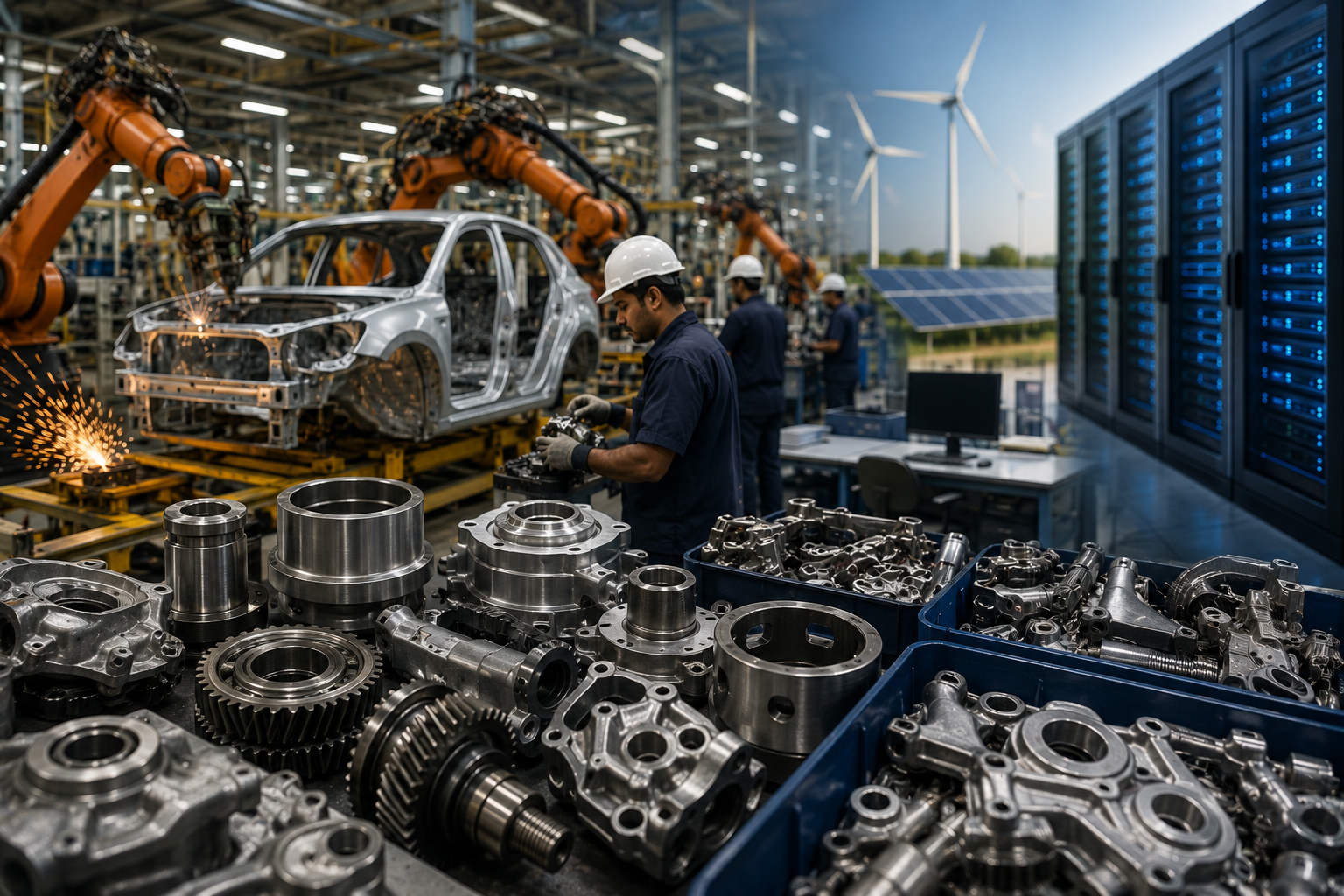
Strong vehicle demand offers growth support, but competition for skilled manpower and common industrial inputs is creating fresh challenges for India's auto-component industry
India's auto-component industry is entering a period of strong structural opportunity but also increasing operational complexity, as fast-growing sectors such as data centres and renewable energy compete with automotive manufacturers for skilled manpower, raw materials and industrial capacity.
The industry's underlying demand remains robust, with original equipment manufacturers (OEMs) maintaining healthy production schedules and expectations of another strong financial year. However, component manufacturers are increasingly required to manage a more competitive resource environment while meeting higher standards for quality, delivery, technology and cost.
A report by the Automotive Component Manufacturers Association of India (ACMA) and Boston Consulting Group (BCG) highlighted the emerging resource squeeze at the 66th annual ACMA event.
The report pointed to growing competition for manpower and common raw materials from industries that are themselves experiencing rapid investment and expansion.
Data centres and renewable energy create additional resource demand
India's investment cycle is no longer being driven only by traditional manufacturing and infrastructure.
Data centres, renewable-energy projects, electronics manufacturing and other technology-intensive industries are expanding rapidly. These sectors require large quantities of electrical equipment, metals, power-management systems, engineering services and specialised manpower.
Several of these requirements overlap with the automotive ecosystem.
As a result, auto-component manufacturers could face greater competition for both materials and workers, particularly in manufacturing clusters where multiple industries are expanding simultaneously.
BCG partner and managing director Saurabh Chhajer highlighted the issue, noting that auto-component clusters increasingly compete with industries experiencing their own strong growth cycles.
Auto demand remains strong despite operating challenges
The resource constraints have not translated into a significant deterioration in automotive demand.
ACMA Director General Vinnie Mehta said the industry saw strong momentum in the first quarter and July, while OEM schedules indicate continued traction heading into the festive season.
The expectation of another strong financial year provides a favourable backdrop for component manufacturers.
Higher vehicle production generally translates into increased demand for components such as braking systems, transmission parts, suspension systems, electrical components, castings, forgings, tyres and a growing range of electronic and software-linked products.
The challenge for suppliers is therefore not necessarily finding demand, but fulfilling that demand efficiently and profitably.
Festive season could support production schedules
The upcoming festive season is expected to remain an important demand period for India's automobile industry.
Higher consumer activity around major festivals can support passenger-vehicle, two-wheeler and commercial-vehicle sales, encouraging OEMs to maintain production schedules.
For component manufacturers, this can create opportunities for higher capacity utilisation.
However, stronger demand can also expose supply-chain bottlenecks if manufacturers do not have sufficient inventory, labour or production capacity.
Effective planning will therefore be crucial during periods of peak demand.
Talent shortage becomes a growing industry concern
Competition for skilled manpower is emerging as a major challenge for auto-component manufacturers.
The automotive industry is undergoing a technology transformation, increasing demand for engineers, electronics specialists, automation professionals, software talent, maintenance technicians and other skilled workers.
At the same time, data centres, renewable-energy companies and other technology-driven industries are competing for similar talent pools.
This can increase recruitment costs and employee attrition while making it harder for smaller component manufacturers to retain specialised workers.
Workforce reskilling becomes essential
The changing nature of vehicle technology means that the industry's manpower requirements are also evolving.
Electric vehicles, connected vehicles, advanced driver-assistance systems, vehicle electronics and software-defined vehicles require capabilities that were less important in conventional automotive manufacturing.
Component manufacturers will therefore need to invest in workforce training and reskilling.
Rather than relying exclusively on external recruitment, companies may increasingly develop internal talent pipelines through technical training, apprenticeships and partnerships with educational institutions.
Raw-material competition could intensify
The pressure is not limited to labour.
As multiple industries expand simultaneously, demand for common raw materials and industrial inputs could rise.
Renewable-energy projects require large quantities of metals, electrical components and power-management equipment. Data centres similarly require extensive electrical infrastructure and cooling systems.
Auto-component manufacturers could consequently face higher procurement costs or longer lead times for certain materials.
This could become particularly challenging for smaller suppliers with limited bargaining power.
Input-cost volatility can affect margins
Raw-material costs are a major component of the cost structure for many auto-component manufacturers.
If input prices rise faster than companies can pass them on to customers, operating margins may come under pressure.
Long-term agreements with OEMs can provide revenue visibility, but they can also limit the speed at which suppliers adjust prices.
Companies with stronger procurement capabilities, diversified suppliers and better inventory management could therefore have a competitive advantage.
Smart factories emerge as a solution
The industry is increasingly turning towards automation and digital manufacturing to address resource constraints.
According to the ACMA-BCG report, more than two-thirds of surveyed auto-component manufacturers have adopted smart-factory initiatives at the pilot, scale-up or fully integrated stage.
These initiatives are aimed at improving productivity and reducing the impact of manpower shortages.
Smart-factory technologies can include:
-
Automated production systems
-
Industrial robotics
-
Real-time machine monitoring
-
Predictive maintenance
-
Digital quality-control systems
-
Production analytics
-
Automated inventory management
-
Connected manufacturing equipment
-
Data-driven production planning
The objective is to produce more efficiently while reducing dependence on manual processes.
Automation could improve productivity
Automation can help manufacturers address several challenges simultaneously.
Robotic systems can perform repetitive operations with consistent precision, while digital monitoring can identify production inefficiencies and potential equipment failures.
Predictive maintenance can also reduce unexpected downtime, improving overall equipment utilisation.
For component manufacturers operating in high-volume production environments, even modest improvements in productivity can have a meaningful impact on profitability.
However, automation requires upfront capital investment, making financing and return-on-investment calculations important considerations.
Technology investment may widen the gap between suppliers
The shift towards smart manufacturing could also create a greater divide between large and small component manufacturers.
Larger suppliers generally have greater financial resources to invest in automation, digital systems, research and development and global manufacturing facilities.
Smaller suppliers may find it more difficult to finance such investments.
This could encourage smaller manufacturers to specialise in niche products, form technology partnerships or become part of larger supplier ecosystems.
EV transition reshapes the component industry
The electric-vehicle transition represents another major structural change.
Electric vehicles have different architectures and component requirements compared with conventional internal-combustion-engine vehicles.
The shift creates opportunities in areas such as:
-
Electric motors
-
Battery systems
-
Power electronics
-
Charging equipment
-
Thermal management
-
Electronic control systems
-
Vehicle software
-
Advanced sensors
-
Lightweight materials
At the same time, traditional suppliers exposed heavily to components associated with internal-combustion engines may need to diversify.
Domestic value addition becomes increasingly important
The expansion of the EV ecosystem is also increasing attention on domestic manufacturing capabilities.
Greater localisation of components can reduce dependence on imports, improve supply-chain resilience and create opportunities for Indian manufacturers.
For component companies, developing local capabilities in advanced electronics, power electronics and other emerging technologies could become an important source of long-term growth.
Export ambitions add another growth avenue
India's auto-component industry is also targeting a significant expansion in exports.
BCG values the sector at around $80 billion, with exports of approximately $23 billion. The industry is targeting $100 billion in exports by FY30.
This target reflects the growing opportunity for Indian manufacturers to become important suppliers to global automobile companies.
Global automakers are increasingly focused on supply-chain diversification and resilience, potentially creating opportunities for Indian companies with competitive manufacturing capabilities.
Global supply-chain integration could accelerate
Indian component manufacturers are seeking deeper integration into international supply chains.
Export expansion can help companies diversify their customer base and reduce dependence on domestic demand.
However, global customers generally have stringent requirements relating to product quality, delivery timelines, traceability, reliability and cost.
Manufacturers will therefore need to invest in technology and process improvements to compete internationally.
Quality and reliability remain critical
The increasing complexity of vehicles is raising the importance of component quality.
A failure in a critical automotive component can affect vehicle safety, production schedules and a manufacturer's reputation.
OEMs are therefore demanding greater reliability from suppliers.
This is likely to increase the importance of digital quality monitoring, automated inspection and advanced manufacturing processes.
Multi-tier supply chains remain vulnerable
Automotive supply chains are highly interconnected.
A vehicle manufacturer may directly source components from Tier-1 suppliers, which themselves depend on Tier-2 and Tier-3 manufacturers.
A disruption at a lower level of the supply chain can therefore eventually affect OEM production.
The recent resource competition makes multi-tier supply-chain visibility increasingly important.
Component manufacturers may need to diversify suppliers and maintain better visibility into their upstream networks.
Working-capital management will be important
Higher input costs and longer supply chains can increase working-capital requirements.
Manufacturers may need to hold additional inventory to protect against supply disruptions, while simultaneously managing receivables from customers.
Efficient working-capital management could therefore become an important differentiator.
Companies that can maintain high inventory turns while ensuring reliable supply may have an advantage over less efficient competitors.
Data-centre boom creates both competition and opportunity
The rapid development of data centres is not necessarily only a threat to the automotive ecosystem.
Some auto-component manufacturers with capabilities in electrical systems, precision engineering, thermal management, power electronics or specialised manufacturing could potentially diversify into adjacent industrial markets.
Such diversification could provide an additional revenue stream while reducing dependence on the automotive cycle.
However, moving into new industries requires appropriate certifications, customer relationships and technical capabilities.
Renewable-energy expansion creates adjacent opportunities
The renewable-energy sector could similarly offer opportunities for engineering and manufacturing companies.
Component manufacturers with capabilities in electrical equipment, metal fabrication, precision manufacturing and power-management systems could explore applications beyond automotive.
This could help companies utilise their existing manufacturing expertise across multiple industries.
Industry faces a balancing act
The Indian auto-component sector is therefore facing a complex balancing act.
On one side, vehicle demand remains strong and exports are expanding. On the other, manufacturers are dealing with rising resource competition and rapidly changing technology requirements.
The winners are likely to be companies capable of combining:
Scale + technology + productivity + supply-chain resilience + global competitiveness.
Companies that fail to adapt could face rising costs and increasing competitive pressure.
Key factors to monitor for the auto-component sector
Investors and industry participants should monitor several structural indicators:
Vehicle production
Continued growth in OEM production would support component demand and capacity utilisation.
Raw-material prices
Changes in metal and other industrial input prices could directly influence margins.
Labour costs
Increasing competition for skilled workers could push up employee costs.
Smart-factory adoption
Higher automation could improve productivity and reduce dependence on labour.
EV penetration
The pace of EV adoption will determine how quickly component portfolios need to evolve.
Export growth
Expansion in exports could provide a major long-term growth opportunity for Indian suppliers.
OEM sourcing strategies
Greater localisation and supply-chain diversification could create opportunities for domestic manufacturers.
Capital expenditure
Investments in capacity, automation and new technologies will indicate the industry's readiness for future demand.
What this means for India's automotive ecosystem
The evolving environment could ultimately accelerate the transformation of India's auto-component industry.
Competition for talent and raw materials is forcing manufacturers to become more efficient. At the same time, strong vehicle demand is providing the revenue base needed to invest in new technologies.
The industry's export ambitions could further encourage companies to upgrade manufacturing capabilities and meet global standards.
The result could be a more technologically advanced and globally integrated Indian component sector.
Long-term opportunity remains significant
Despite the near-term operational challenges, the long-term opportunity for India's auto-component industry remains substantial.
India's large domestic vehicle market, growing EV ecosystem, expanding manufacturing base and increasing participation in global supply chains provide multiple avenues for growth.
The next phase of expansion, however, is likely to be driven less by capacity alone and more by productivity, technology, localisation and global competitiveness.
Market Outlook
The outlook for India's auto-component industry remains structurally positive, supported by robust vehicle demand, increasing OEM production schedules, export opportunities and the country's growing role in global automotive supply chains.
However, the competitive environment is becoming more demanding. Data centres, renewable energy and other fast-growing sectors are competing for the same skilled workforce and selected industrial inputs, potentially increasing costs for component manufacturers.
The industry's response will be critical. Greater adoption of smart factories, automation, workforce reskilling, supplier diversification and advanced manufacturing technologies can help offset resource constraints.
Companies with strong balance sheets, technological capabilities, diversified customer bases, export exposure and efficient supply chains could be better positioned for the next phase of growth.
For investors, the key factors to track will be OEM production volumes, EV transition, export growth, raw-material costs, operating margins, automation spending and capacity utilisation. The ability of individual companies to convert strong industry demand into sustainable margin and cash-flow growth will ultimately determine the quality of the investment opportunity.