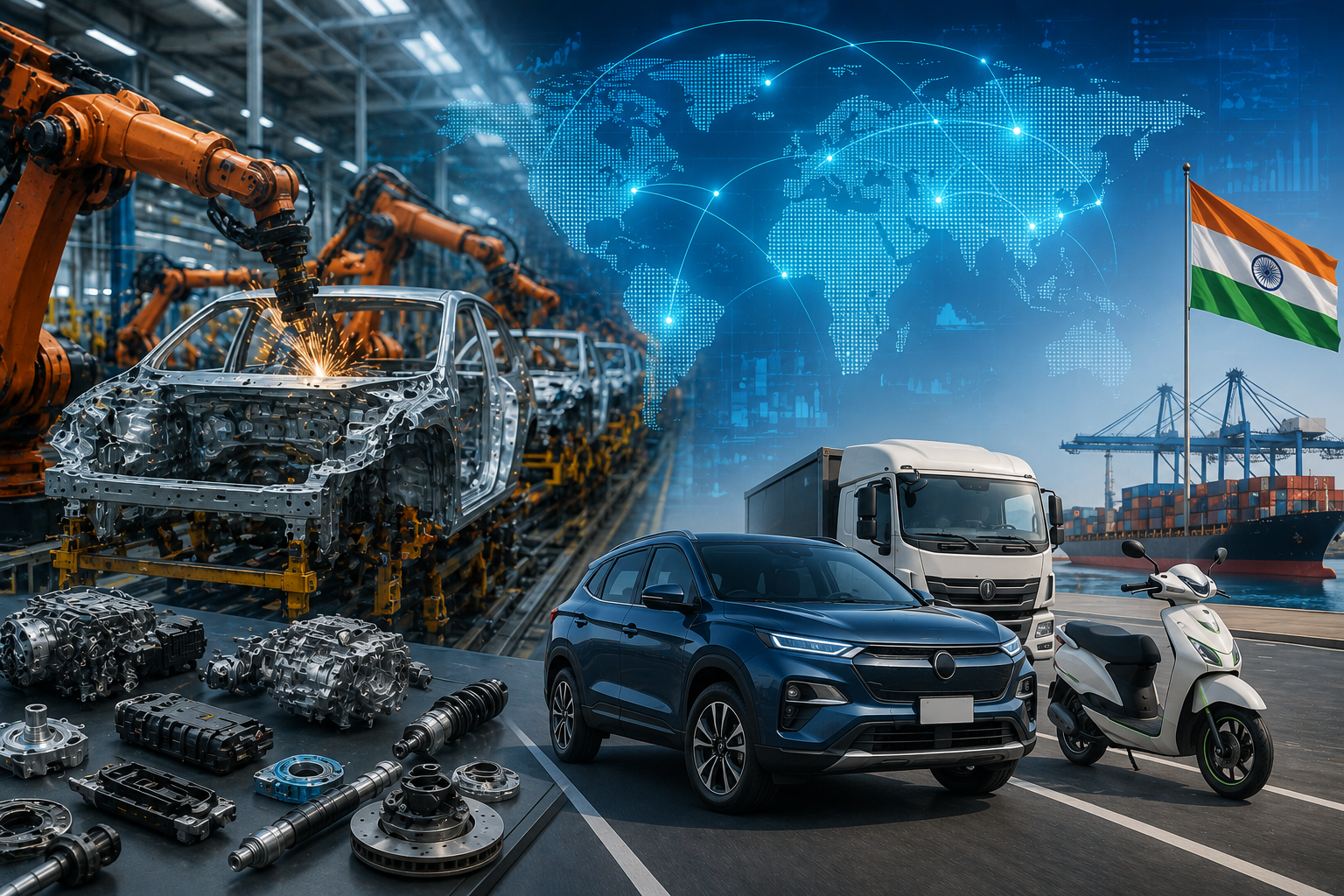
India's automobile industry needs to move beyond resilience and build globally competitive, technology-rich and sustainable value chains
India's automobile industry needs to move beyond its focus on resilience and accelerate efforts to build global scale, technology leadership and internationally competitive value chains, industry leaders said on Wednesday.
Speaking at the Annual Session of the Automotive Component Manufacturers Association of India (ACMA) in New Delhi, Society of Indian Automobile Manufacturers (SIAM) President Shailesh Chandra said India's automobile sector remains a strong pillar of the economy and has significant potential to emerge as a global manufacturing and technology leader.
Chandra said the industry's next phase should focus on converting the resilience developed over the past few years into global competitiveness, technology leadership, scale and global leadership.
The message comes at an important juncture for the Indian automobile ecosystem. The sector is simultaneously dealing with the transition from internal-combustion engines to electric vehicles, rapid advances in vehicle electronics and software, changing global supply chains, rising localisation requirements and intensifying competition for skilled talent and raw materials.
From resilience to global leadership
The automotive industry has spent the past several years strengthening supply-chain resilience.
The Covid-era disruptions, semiconductor shortages, geopolitical tensions and logistics bottlenecks highlighted the vulnerability of globally interconnected manufacturing networks.
Indian manufacturers responded by diversifying suppliers, increasing localisation and building greater visibility across their supply chains.
Industry leaders now believe the focus needs to shift from simply managing disruptions to using this stronger foundation to create globally competitive businesses.
The next phase is therefore expected to centre on:
-
Manufacturing scale
-
Product innovation
-
Technology development
-
Higher domestic value addition
-
Export competitiveness
-
Supply-chain efficiency
-
Sustainable manufacturing
-
Skilled workforce development
Scale could become India's biggest competitive advantage
Scale is critical in an industry where manufacturers need to make large investments in technology, research, tooling and production facilities.
Higher volumes allow companies to spread fixed costs across a larger production base while improving purchasing power and manufacturing efficiency.
For India's auto-component manufacturers, achieving greater scale could also improve their ability to compete for global OEM contracts.
Larger suppliers can potentially offer customers a wider product portfolio, stronger engineering support and greater capacity across multiple geographies.
Global customers are looking for reliable supply chains
Global automobile manufacturers are increasingly looking for suppliers capable of delivering consistent quality and reliable volumes across markets.
This presents an opportunity for Indian companies.
India's large domestic market can provide the initial scale required to develop competitive manufacturing capabilities. Successful companies can then use those capabilities to expand into global markets.
The combination of domestic scale and export expansion could therefore become a powerful growth model for Indian automotive companies.
Technology leadership is the next challenge
Cost competitiveness has traditionally been one of India's major advantages.
However, the global automotive industry is becoming increasingly technology-driven.
Modern vehicles contain significantly more electronics, sensors, software and computing capabilities than earlier generations.
Technology leadership will therefore become increasingly important in determining which countries capture the highest-value portions of the automotive supply chain.
Vehicles are becoming technology platforms
The definition of an automobile is changing rapidly.
Vehicles are increasingly becoming connected technology platforms incorporating:
-
Advanced electronics
-
Sensors
-
Artificial intelligence
-
Cloud connectivity
-
Software
-
Digital dashboards
-
Advanced driver-assistance systems
-
Cybersecurity systems
-
Battery-management technology
This creates new opportunities for Indian engineering and technology companies.
EV transition creates a new industrial opportunity
The shift towards electric mobility could provide India with an opportunity to build new areas of manufacturing leadership.
Electric vehicles require a different component architecture compared with conventional vehicles.
The emerging ecosystem includes:
-
Batteries
-
Electric motors
-
Inverters
-
Power electronics
-
Battery-management systems
-
Charging equipment
-
Thermal-management systems
-
Vehicle software
-
Advanced sensors
Developing domestic capabilities in these areas could help India capture a greater share of the value created by the EV transition.
Localisation will remain strategically important
The push for global competitiveness also requires greater domestic value addition.
Heavy dependence on imported critical components can expose manufacturers to currency movements, shipping disruptions and geopolitical risks.
Increasing localisation can improve supply-chain resilience while creating domestic manufacturing capabilities.
The opportunity is particularly significant in advanced electronics, battery components, power electronics and other technology-intensive products.
Auto-component makers can move up the value chain
The Indian component industry has traditionally supplied a broad range of mechanical and engineering products.
The next opportunity is to move towards higher-value systems and integrated solutions.
Instead of supplying individual components, companies can increasingly develop complete systems for braking, electronics, power management, thermal management and other applications.
Moving up the value chain can potentially improve margins and strengthen relationships with global OEMs.
Export opportunity could transform the sector
Global exports could become one of the most important growth engines for India's auto-component industry.
As international manufacturers diversify their supply chains, Indian suppliers can compete for new programmes.
However, winning global contracts requires more than low production costs.
Suppliers must demonstrate:
Quality + reliability + scale + technology + delivery capability + cost competitiveness.
Companies that can meet all these requirements could potentially become strategic suppliers to global automotive manufacturers.
India can benefit from global supply-chain diversification
Global companies continue to look for alternative manufacturing locations to reduce dependence on concentrated supply chains.
India's large domestic market gives it an advantage over smaller manufacturing destinations.
A company can establish production facilities in India to serve domestic customers while simultaneously developing export capabilities.
This creates an opportunity to build large-scale manufacturing ecosystems rather than isolated export facilities.
R&D investment will determine technology leadership
Becoming a global technology leader requires sustained investment in research and development.
Indian companies will need to invest more aggressively in:
-
Battery technology
-
Power electronics
-
Vehicle software
-
Artificial intelligence
-
Autonomous-driving systems
-
Advanced materials
-
Manufacturing technology
-
Connected vehicles
The companies that successfully develop intellectual property could capture a larger share of the industry's future value.
Software is becoming as important as hardware
The emergence of software-defined vehicles is creating a fundamental change in automotive competition.
Vehicle functions can increasingly be updated or enhanced through software after the vehicle has been sold.
This creates recurring opportunities around software, connectivity and digital services.
India's established IT and software ecosystem provides a potential advantage.
Collaboration between automobile manufacturers and Indian technology companies could accelerate the development of software-defined vehicle capabilities.
Artificial intelligence enters automotive manufacturing
AI can play a role both inside vehicles and across manufacturing operations.
Manufacturers can use AI for:
-
Predictive maintenance
-
Quality inspection
-
Production planning
-
Demand forecasting
-
Supply-chain optimisation
-
Inventory management
-
Product development
AI-driven manufacturing could improve productivity and reduce waste.
For companies facing rising labour costs and shortages of specialised workers, automation and AI could become increasingly important.
Smart factories can support scale
Digital manufacturing is likely to become a major component of India's global competitiveness strategy.
Smart factories allow manufacturers to collect real-time information from machines and production lines.
This can help companies identify bottlenecks, reduce downtime and improve quality.
Robotics can also automate repetitive operations and improve consistency.
The combination of automation, data analytics and AI could allow Indian manufacturers to increase output without proportionally increasing manpower.
Talent could become a major bottleneck
Technology transformation is increasing demand for highly skilled employees.
Automotive companies increasingly require specialists in:
-
Electronics
-
Software
-
Artificial intelligence
-
Robotics
-
Battery technology
-
Data science
-
Advanced manufacturing
The competition for these professionals is intensifying as other sectors, including data centres, renewable energy and electronics manufacturing, expand rapidly.
Reskilling will be essential
The industry's workforce will need to evolve alongside technology.
Traditional mechanical and manufacturing skills will remain important, but employees will increasingly need digital and electronics-related capabilities.
Companies may therefore need to increase spending on:
-
Technical training
-
Apprenticeships
-
Digital skills
-
Engineering programmes
-
Industry-academic partnerships
A strong domestic talent pipeline could become a competitive advantage.
Sustainability becomes a global requirement
Global automotive customers are increasingly demanding more sustainable supply chains.
Environmental performance is becoming an important consideration when companies select suppliers.
Indian manufacturers will therefore need to improve:
-
Energy efficiency
-
Renewable-energy usage
-
Waste management
-
Water efficiency
-
Recycling
-
Carbon emissions
-
Sustainable sourcing
Sustainability is increasingly moving from a compliance requirement to a competitive factor.
Critical minerals are strategically important
The EV transition has also increased the importance of critical minerals.
Lithium, graphite, nickel and other materials are essential for various battery technologies.
Building reliable access to these materials and developing domestic processing capabilities will be important for India's long-term automotive ambitions.
Without secure raw-material supply chains, large-scale EV manufacturing could remain vulnerable to global commodity and geopolitical disruptions.
Battery ecosystem needs to expand
Battery technology is one of the most important areas in the EV value chain.
India will need capabilities across the battery ecosystem, including:
-
Cell manufacturing
-
Battery packs
-
Battery-management systems
-
Recycling
-
Materials processing
-
Energy storage
A competitive battery ecosystem could strengthen the country's EV manufacturing capabilities and reduce dependence on imported systems.
Charging infrastructure must expand
The growth of electric vehicles also requires a reliable charging ecosystem.
Public and private charging infrastructure needs to expand alongside EV sales.
Faster charging technology, battery swapping and improved charging networks could help address range and convenience concerns.
This creates opportunities beyond traditional automobile manufacturing.
Auto suppliers can diversify into adjacent sectors
The growth of EVs, renewable energy and data centres is creating overlapping industrial requirements.
Companies with expertise in:
-
Power electronics
-
Precision engineering
-
Thermal management
-
Electrical systems
-
Metal fabrication
-
Industrial automation
could potentially serve multiple industries.
Diversification can reduce dependence on a single end market and improve capacity utilisation.
Infrastructure will determine manufacturing competitiveness
Large-scale automotive manufacturing requires efficient infrastructure.
Ports, highways, railways, logistics networks and industrial corridors need to support rapid movement of components and finished vehicles.
Efficient logistics can reduce inventory requirements and improve delivery reliability.
For export-oriented manufacturers, port connectivity becomes particularly important.
MSMEs remain crucial to the ecosystem
Small and medium-sized enterprises form a major part of India's auto-component supply chain.
They supply specialised parts to Tier-1 suppliers and OEMs.
Supporting these companies through technology adoption, financing, quality improvement and workforce training can strengthen the entire industry.
Digitalisation could also help smaller suppliers improve their ability to meet global standards.
Consolidation could accelerate
The push towards scale and technology may encourage consolidation in the component industry.
Larger companies have greater resources to invest in:
-
R&D
-
Automation
-
Capacity expansion
-
Global acquisitions
-
Technology partnerships
-
International facilities
Smaller companies may increasingly focus on specialised products or participate in larger supplier networks.
Strategic partnerships could accelerate growth
Indian manufacturers may increasingly use joint ventures, technology partnerships and acquisitions to gain access to advanced capabilities.
Partnerships with global companies can provide:
-
Technology
-
Engineering expertise
-
Global customers
-
Manufacturing know-how
-
International distribution
Such collaborations can shorten the time required to develop new capabilities.
Capital expenditure is likely to remain high
The transition towards EVs, advanced manufacturing and global-scale production requires significant capital investment.
Companies will need to spend on:
-
New production lines
-
Automation
-
Research laboratories
-
Battery facilities
-
Electronics manufacturing
-
Digital systems
-
Export capacity
Investors will therefore need to evaluate whether planned capital expenditure is likely to generate adequate returns.
Returns on capital will separate winners from laggards
Higher capital expenditure does not automatically create value.
Companies must achieve sufficient utilisation and profitability from new investments.
The ability to generate strong returns on invested capital will therefore remain an important metric.
Companies that consistently deploy capital into high-growth businesses while maintaining balance-sheet discipline could have an advantage.
India's domestic market remains a powerful foundation
One of India's biggest advantages is the size of its domestic automobile market.
A large home market provides manufacturers with scale before they enter international markets.
It also allows companies to test products, develop supply chains and build manufacturing expertise.
This domestic foundation can support the development of globally competitive companies.
Global leadership requires globally competitive brands
India's long-term ambition should extend beyond being a manufacturing location for multinational companies.
The development of Indian automotive brands and component suppliers with global recognition could increase the value captured domestically.
Global brands can also command stronger pricing power and build long-term customer relationships.
Policy support remains important
Government policy can play an enabling role through:
-
Manufacturing incentives
-
EV policies
-
Infrastructure investment
-
Localisation programmes
-
Research support
-
Export facilitation
-
Skill-development initiatives
However, industry leaders' emphasis on competitiveness also highlights the importance of companies becoming increasingly self-sufficient and commercially sustainable.
Competition from other manufacturing hubs remains intense
India is competing with several countries for global automotive investments and supply-chain contracts.
Manufacturing destinations across Asia and other regions continue to invest heavily in infrastructure, technology and incentives.
India therefore cannot rely solely on its large domestic market.
Continuous improvement in productivity, quality, infrastructure and innovation will be necessary to maintain its competitive position.
What this means for listed auto companies
The industry's shift towards global leadership could create different opportunities across listed companies.
Manufacturers with strong domestic brands may benefit from scale and premiumisation.
Auto-component companies with global customers may benefit from supply-chain diversification.
Technology-focused suppliers may gain from EVs and software-defined vehicles.
Companies with strong export exposure could benefit from global sourcing opportunities.
Investors will therefore need to look beyond vehicle volumes and assess each company's position within the evolving value chain.
Key investment indicators to watch
Revenue from exports
A growing share of international revenue can indicate increasing global competitiveness.
R&D intensity
Higher R&D investment can signal preparation for technology-driven growth.
EV exposure
Companies positioned across batteries, electronics, motors and EV platforms may have greater long-term relevance.
Capacity utilisation
Higher utilisation can improve operating leverage and returns on capital.
Automation
Increasing automation can help companies manage labour costs and improve productivity.
Customer diversification
A diversified customer base reduces dependence on individual OEMs.
Capital expenditure
The quality and expected returns of new investments will be important.
Free cash flow
Strong cash generation can help companies fund growth without excessive leverage.
India's opportunity extends beyond automobiles
The transformation of the automobile industry could have broader implications for India's manufacturing economy.
A globally competitive automotive ecosystem can create demand for:
-
Steel
-
Aluminium
-
Electronics
-
Semiconductors
-
Chemicals
-
Batteries
-
Software
-
Logistics
-
Engineering services
This can create a wider industrial multiplier effect.
The next decade could reshape India's automotive position
The next phase of India's automotive development is likely to be fundamentally different from the previous one.
The focus will increasingly shift from volume growth to value creation.
Manufacturers will need to develop technology, improve productivity, expand exports and build sustainable supply chains.
The companies that succeed in these areas could move from being domestic suppliers to globally significant automotive businesses.
Market Outlook
The outlook for India's automobile sector remains structurally positive, but the industry's next growth phase will require a significant shift in strategy.
The emphasis from industry leaders on scale, technology leadership and global competitiveness reflects the changing nature of the global automotive industry.
India has a strong foundation in the form of a large domestic market, established auto-component ecosystem, engineering talent and competitive manufacturing costs. The next challenge is to convert these advantages into globally competitive products, technologies and brands.
The EV transition, software-defined vehicles, artificial intelligence, smart manufacturing and global supply-chain diversification could create significant opportunities for Indian companies.
At the same time, the industry faces challenges from raw-material competition, skilled talent shortages, critical-mineral dependence, high capital requirements and intense international competition.
For investors, the most important companies to watch will be those that combine scale, technology, strong balance sheets, high returns on capital, export capabilities and exposure to emerging automotive technologies.
If India can successfully transition from being primarily a cost-competitive manufacturing destination to a global automotive technology and engineering hub, the opportunity for both automobile manufacturers and component suppliers could be significantly larger over the next decade.