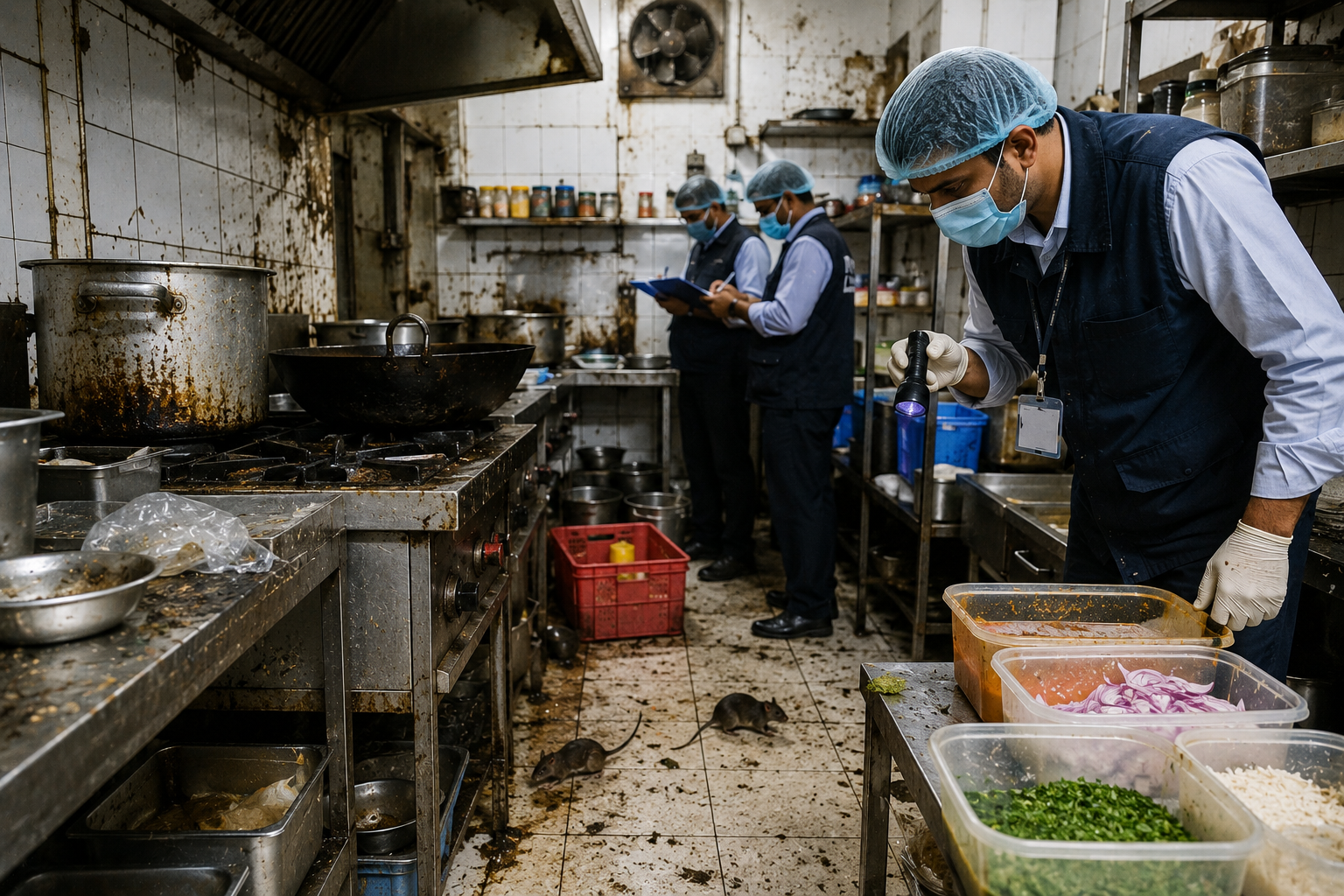
Regulators step up inspections across restaurants, cloud kitchens and food warehouses as consumers demand greater transparency and hygiene standards
India's food-services industry is entering a new phase of regulatory scrutiny as authorities across the country intensify inspections of restaurants, commercial kitchens, food warehouses and other food establishments following a surge in consumer complaints and viral social-media posts.
The crackdown comes amid growing awareness about food hygiene among Indian consumers, particularly in urban centres where eating out and ordering food online have become an increasingly regular part of daily life.
Recent inspections have reportedly uncovered violations including flies, rats and cockroaches, expired or adulterated ingredients, improper storage and inadequate hygiene practices.
The increasing enforcement activity is creating a new operating environment for India's rapidly expanding food-services sector, with restaurants, cloud kitchens, packaged-food companies, quick-commerce operators and food-delivery platforms facing greater pressure to demonstrate compliance.
Social media becomes a powerful accountability mechanism
Social media has emerged as an important catalyst behind the renewed focus on food safety.
Photographs and videos showing allegedly unhygienic kitchens can reach thousands or even millions of consumers within a short period.
Platforms such as Instagram and X have become channels through which consumers can publicly highlight concerns about food preparation, storage and hygiene.
In some cases, complaints raised online have also been followed by formal regulatory inspections.
This has effectively created an informal layer of consumer-led monitoring alongside the official regulatory framework.
Young consumers driving greater scrutiny
Younger consumers are increasingly willing to research restaurants before making purchases and share their experiences online.
Food reviews are no longer restricted to taste, price and presentation.
Consumers are increasingly interested in:
-
Kitchen cleanliness
-
Ingredient quality
-
Food preparation practices
-
Hygiene standards
-
Storage conditions
-
Restaurant ratings
-
Regulatory compliance
This shift is particularly relevant for restaurants targeting urban millennials and Gen Z consumers, for whom digital reputation can significantly influence purchasing decisions.
India's food-services market continues to expand
The food-services industry has benefited from urbanisation, rising disposable incomes, changing lifestyles, digital payments and the rapid expansion of food-delivery platforms.
Consumers are eating outside the home more frequently than previous generations.
The expansion of restaurants, cloud kitchens, food-delivery services and quick-commerce platforms has also increased the number of businesses involved in preparing, storing and distributing food.
With the sector expanding rapidly, regulators face the challenge of ensuring that growth does not come at the expense of food safety.
Maharashtra becomes a major enforcement hub
Maharashtra has emerged as one of the most active states in the latest enforcement campaign.
The Maharashtra Food and Drug Administration has reportedly conducted more than 3,000 spot checks since May.
The inspections have covered a broad range of establishments, including restaurants, fast-food outlets and premium hospitality venues.
The increased activity follows the appointment of Tukaram Mundhe as commissioner of the Maharashtra FDA, whose approach to enforcement has attracted significant public attention.
Crackdown expands beyond major cities
The enforcement drive is not confined to India's largest metropolitan areas.
Authorities in states including Karnataka and Jammu and Kashmir have also stepped up action against food businesses and products.
This suggests that food safety is increasingly becoming a nationwide regulatory priority.
According to the Food Safety and Standards Authority of India's online database, regulators have conducted more than 24,000 raids since April, highlighting the scale of the current enforcement activity.
Premium restaurants and hotels also under scrutiny
The latest inspections demonstrate that food-safety concerns are not limited to smaller establishments.
Several premium and well-known establishments have also faced regulatory scrutiny.
The report noted that establishments including JW Marriott in New Delhi and the Cricket Club of India in Mumbai were among those flagged during inspections.
The development highlights an important point for the industry: brand reputation or premium positioning does not eliminate food-safety risk.
Food safety becomes a reputational issue
For restaurants and food businesses, regulatory violations can create consequences far beyond financial penalties.
A single viral video can trigger widespread negative publicity.
Consumers may quickly share photographs and reviews, potentially causing a significant decline in footfall or online orders.
This makes food safety an increasingly important component of reputation management, customer retention and brand value.
Businesses therefore have an incentive to identify and correct hygiene problems before they become regulatory or social-media crises.
Quick-commerce ecosystem faces new scrutiny
The regulatory focus is also extending into India's rapidly growing quick-commerce industry.
Food-safety authorities have reportedly taken action involving warehouses associated with Blinkit and Swiggy Instamart over alleged hygiene-related issues.
Quick-commerce businesses operate through networks of warehouses and dark stores that hold food and grocery products close to consumers.
The model depends on speed, but speed must be supported by disciplined inventory management.
Dark stores create unique food-safety challenges
Quick-commerce warehouses can handle large numbers of products in relatively compact spaces.
Food products may include:
-
Fresh produce
-
Dairy products
-
Packaged foods
-
Frozen foods
-
Beverages
-
Ready-to-eat products
Maintaining appropriate storage conditions becomes essential.
Businesses need effective systems to monitor expiry dates, temperatures, pest control and product rotation.
Technology can improve quick-commerce compliance
Technology can help operators manage food-safety requirements at scale.
Digital systems can automatically track:
-
Expiry dates
-
Inventory movement
-
Temperature conditions
-
Product batches
-
Supplier information
-
Storage locations
Automated alerts can help operators remove products approaching expiry.
This could reduce both regulatory risk and food wastage.
Packaged-food manufacturers also face greater scrutiny
The regulatory focus is not restricted to food preparation.
Packaged-food manufacturers are also facing scrutiny over issues such as labelling and product claims.
Accurate labelling is particularly important because consumers rely on packaging information when deciding what to buy.
Claims relating to health, ingredients, nutritional value and product characteristics must meet regulatory requirements.
Companies that fail to do so could face both regulatory action and reputational damage.
Adulteration remains a critical concern
Food adulteration remains one of the most serious risks in the food ecosystem.
Substandard or adulterated raw materials can potentially enter multiple stages of the supply chain before reaching consumers.
This makes supplier verification and traceability particularly important.
Food companies increasingly need to know not only what ingredients they are purchasing but also where those ingredients originate and how they have been handled.
Storage standards are equally important
Food safety is not limited to ingredient quality.
Even safe ingredients can become unsafe if they are stored incorrectly.
Problems can arise from:
-
Excessive temperature
-
Moisture
-
Poor ventilation
-
Pest infestation
-
Cross-contamination
-
Improper packaging
-
Inadequate refrigeration
Restaurants and warehouses therefore need comprehensive storage protocols rather than relying solely on visual inspections.
Festive season increases regulatory importance
The latest enforcement drive comes just before India's major festive period.
The period from September through Diwali typically sees increased spending on:
-
Restaurants
-
Sweets
-
Snacks
-
Packaged foods
-
Food delivery
-
Grocery products
-
Corporate and household gifting
Higher consumption volumes increase the importance of maintaining food-safety standards throughout the supply chain.
Authorities are likely to face additional pressure to prevent unsafe products from reaching consumers during the high-demand period.
Restaurants could face higher operating costs
Stricter enforcement is likely to increase compliance expenses for food businesses.
Restaurants may need to spend more on:
-
Kitchen upgrades
-
Pest control
-
Employee training
-
Food-safety audits
-
Refrigeration
-
Storage infrastructure
-
Cleaning equipment
-
Monitoring systems
-
Waste management
For large restaurant chains, these costs may be absorbed through scale.
For smaller independent restaurants, however, compliance investment could put pressure on already thin operating margins.
Compliance could become a competitive advantage
Higher compliance costs do not necessarily represent only a burden.
Restaurants that consistently maintain high hygiene standards may be able to differentiate themselves from competitors.
As consumers become more conscious about food safety, visible compliance can strengthen trust.
Businesses may increasingly use:
-
Open kitchens
-
Digital hygiene records
-
Certified suppliers
-
Regular audits
-
Transparent sourcing
as part of their brand proposition.
Organised players could benefit
The regulatory environment may accelerate the shift towards organised food-service businesses.
Large chains generally have greater resources to implement standard operating procedures across multiple locations.
They can centralise procurement, conduct regular audits and maintain dedicated quality-control teams.
This could give organised operators an advantage as regulatory standards become more stringent.
Smaller restaurants face a tougher transition
Independent restaurants may have less financial capacity to upgrade their facilities.
Many operate with limited margins and relatively small teams.
The challenge will be to improve hygiene without making food significantly more expensive for consumers.
Industry associations are therefore calling for enforcement that combines accountability with education and corrective opportunities.
Restaurant industry seeks balanced regulation
The National Restaurants Association of India has called for a balanced regulatory approach.
The industry body has argued that businesses should be given opportunities to address deficiencies rather than facing unnecessary reputational damage.
The association is also conducting awareness programmes focused on food-safety best practices.
The debate highlights the challenge of balancing three objectives:
Consumer safety + effective enforcement + business viability.
Public naming versus corrective action
One of the biggest questions emerging from the crackdown is how regulators should communicate violations to the public.
Consumers need access to credible information about food-safety risks.
Businesses, meanwhile, need a fair opportunity to correct deficiencies.
A transparent framework could include:
-
Clear inspection criteria
-
Documented violations
-
Defined correction timelines
-
Follow-up inspections
-
Proportionate penalties
-
Public disclosure of serious violations
Such a system could improve confidence in the regulatory process.
Gujarat increases focus on kitchen surveillance
Gujarat is also strengthening food-safety monitoring.
The state capital has reportedly asked more than 11,000 food establishments to install cameras inside their kitchens.
The initiative illustrates how technology could increasingly become part of food-safety enforcement.
Kitchen surveillance can provide regulators and businesses with greater visibility into food-preparation practices.
However, CCTV should ideally complement rather than replace regular inspections and hygiene management.
Karnataka intensifies product enforcement
Authorities in Karnataka have been seizing and destroying food products considered unfit for consumption.
Such action can prevent unsafe products from reaching consumers.
It can also encourage businesses to strengthen quality-control procedures before products enter distribution channels.
Jammu and Kashmir takes action on ghee
Authorities in Jammu and Kashmir have also acted against certain batches of ghee, restricting their sale, storage and distribution.
Ghee is widely used in Indian households and food businesses, making quality assurance particularly important.
Such interventions highlight the breadth of the current food-safety campaign.
Food-delivery platforms may face increasing pressure
Food-delivery platforms occupy an important position in the ecosystem because they connect consumers with thousands of restaurants.
While platforms may not directly operate restaurant kitchens, customers often associate the overall food-delivery experience with the platform.
This could encourage platforms to strengthen restaurant onboarding and monitoring.
Potential areas of greater scrutiny could include:
-
Food licences
-
Restaurant documentation
-
Consumer complaints
-
Hygiene records
-
Periodic inspections
-
Repeat violations
Cloud kitchens need stronger controls
Cloud kitchens face a unique challenge because customers cannot physically observe the food-preparation environment.
The kitchen itself is effectively invisible to the consumer.
As a result, digital reputation becomes especially important.
Operators may need to invest in internal audits, staff training, documented procedures and transparent sourcing to maintain consumer confidence.
Food-safety technology market could grow
The increased regulatory focus could create new opportunities for companies providing food-safety and compliance technology.
Potential growth areas include:
-
Temperature sensors
-
Digital inventory management
-
Food traceability
-
Kitchen monitoring
-
Pest-control technology
-
Automated compliance systems
-
Supplier verification
-
Laboratory testing
As regulations become more technology-driven, businesses may increasingly use digital tools to demonstrate compliance.
Data could improve regulatory targeting
Regulators can also potentially use data to improve inspection efficiency.
Instead of relying entirely on random inspections, authorities could identify businesses with:
-
Repeated complaints
-
Previous violations
-
Poor inspection history
-
High-risk food categories
-
Irregular compliance records
Risk-based inspections could help authorities focus resources where they are most needed.
AI could play a future role
Artificial intelligence could eventually support food-safety enforcement through analysis of large datasets.
Potential applications include identifying patterns in consumer complaints, analysing inspection records and detecting high-risk businesses.
Computer vision could also potentially help monitor certain hygiene parameters.
However, technology should remain an additional tool rather than a substitute for qualified inspectors and laboratory testing.
Food safety is becoming an ESG issue
For larger food companies and listed businesses, food safety can increasingly be viewed through an ESG and governance lens.
A serious food-safety incident can affect:
-
Brand reputation
-
Revenue
-
Customer retention
-
Regulatory relationships
-
Employee confidence
-
Investor perception
Strong food-safety governance can therefore become part of broader operational risk management.
Export businesses face additional pressure
Food exporters face even stricter requirements because international markets often have highly detailed food-safety standards.
Issues involving pesticide residues, contamination or traceability can result in shipment rejections or import restrictions.
Improving domestic compliance can therefore help Indian food exporters strengthen their credibility in international markets.
India's global food reputation matters
India is a major producer and exporter of agricultural and processed food products.
Repeated food-safety controversies can potentially affect the perception of Indian products internationally.
Stronger domestic enforcement could help improve confidence among overseas buyers.
The challenge is to ensure that enforcement translates into consistent improvements in actual quality rather than short-term inspection campaigns.
Consumer behaviour could change
The crackdown could have a lasting impact on how consumers choose food businesses.
Consumers may increasingly prefer restaurants that demonstrate:
-
Clean kitchens
-
Strong ratings
-
Transparent sourcing
-
Quality certifications
-
Consistent hygiene
-
Reliable food-safety records
This could make food safety a meaningful factor in restaurant competition.
Restaurant ratings may increasingly include hygiene
Food-delivery and restaurant-review platforms could eventually see greater demand for hygiene-related information.
Customers may increasingly look for reviews mentioning kitchen cleanliness and food handling.
This could create a feedback loop:
Better hygiene → stronger reviews → higher trust → more orders.
Conversely:
Poor hygiene → viral complaints → reputational damage → lower demand.
Formalisation of the food industry could accelerate
India's food-services industry is gradually moving towards greater formalisation.
Standardised operating procedures, digital payments, online ordering, centralised procurement and technology-enabled inventory management are already transforming the sector.
Food-safety regulation could accelerate this process.
Businesses that cannot adapt to higher standards may find it increasingly difficult to compete.
Long-term impact on organised restaurant chains
Organised restaurant chains could emerge as relative beneficiaries if compliance becomes a more important purchasing criterion.
Their advantages can include:
-
Standardised kitchens
-
Centralised procurement
-
Employee training
-
Dedicated quality teams
-
Better documentation
-
Greater ability to invest in technology
However, large chains must also maintain consistency across thousands of outlets.
Long-term impact on food manufacturers
Food manufacturers with strong quality-control systems may benefit as consumers become more cautious about product quality.
Companies with robust supplier networks, traceability and laboratory testing could potentially gain market share.
On the other hand, businesses relying heavily on low-cost sourcing without adequate quality controls could face increasing regulatory risk.
What investors should watch
Investors tracking India's food and consumer sectors should monitor several trends.
Regulatory enforcement
A sustained increase in inspections could raise compliance costs.
Organised sector growth
Higher standards could favour professionally managed businesses.
Consumer preferences
Growing hygiene awareness could influence purchasing decisions.
Quick-commerce compliance
Dark-store and warehouse regulations could affect operating costs.
Technology adoption
Demand for traceability and monitoring systems could increase.
Festive demand
Higher food consumption will test supply-chain capacity and compliance.
Export restrictions
International food-safety issues could affect export-oriented businesses.
Brand reputation
Companies with strong consumer trust may gain an advantage.
What businesses should do next
Food businesses can reduce regulatory and reputational risks by adopting a preventive approach.
Key measures include:
-
Conducting regular kitchen audits
-
Maintaining strict pest-control programmes
-
Verifying suppliers
-
Monitoring ingredient expiry dates
-
Maintaining appropriate storage temperatures
-
Training employees regularly
-
Keeping documented cleaning schedules
-
Improving ingredient traceability
-
Installing monitoring systems where appropriate
-
Establishing formal complaint-response mechanisms
The objective should be to identify problems internally before they become regulatory violations or viral social-media incidents.
Food safety could become a differentiator
The current crackdown could ultimately reshape competition within India's food-services industry.
For years, businesses have competed primarily on price, location, menu, convenience and delivery speed.
Food safety could increasingly become another major differentiating factor.
Restaurants that can demonstrate consistent hygiene and transparent operating practices may gain stronger consumer trust.
The challenge is balancing enforcement and growth
India needs a food-safety framework that protects consumers while allowing legitimate businesses to grow.
Excessively weak enforcement can expose consumers to health risks.
At the same time, unpredictable or disproportionate enforcement can increase uncertainty for businesses.
A transparent, consistent and risk-based regulatory system can potentially deliver better outcomes for both sides.
Market Outlook
The latest food-safety crackdown represents more than a short-term inspection campaign. It reflects a broader transformation in India's food ecosystem, where consumer awareness, social-media accountability and regulatory enforcement are converging.
The immediate impact is likely to be higher compliance costs for restaurants, cloud kitchens, food warehouses and food manufacturers. Smaller operators could face greater pressure, while organised businesses with established quality-control systems may be better positioned to absorb the additional requirements.
Over the longer term, stricter enforcement could accelerate formalisation, technology adoption and professionalisation across India's food-services industry.
The rapid expansion of quick commerce and food delivery adds another dimension to the issue, making digital inventory management, traceability and warehouse hygiene increasingly important.
For investors, the key areas to watch are organised restaurant chains, food manufacturers with strong quality systems, food-safety technology providers, quick-commerce infrastructure and businesses with strong consumer trust.
The festive season will be an important test as restaurants, sweet shops, packaged-food companies and delivery platforms prepare for a significant increase in demand.
The broader direction, however, is becoming increasingly clear: food safety is moving from a compliance issue to a strategic business issue. Companies that combine growth with strong hygiene standards, transparent operations and technology-enabled quality control could be better placed to build sustainable brands in India's expanding food economy.