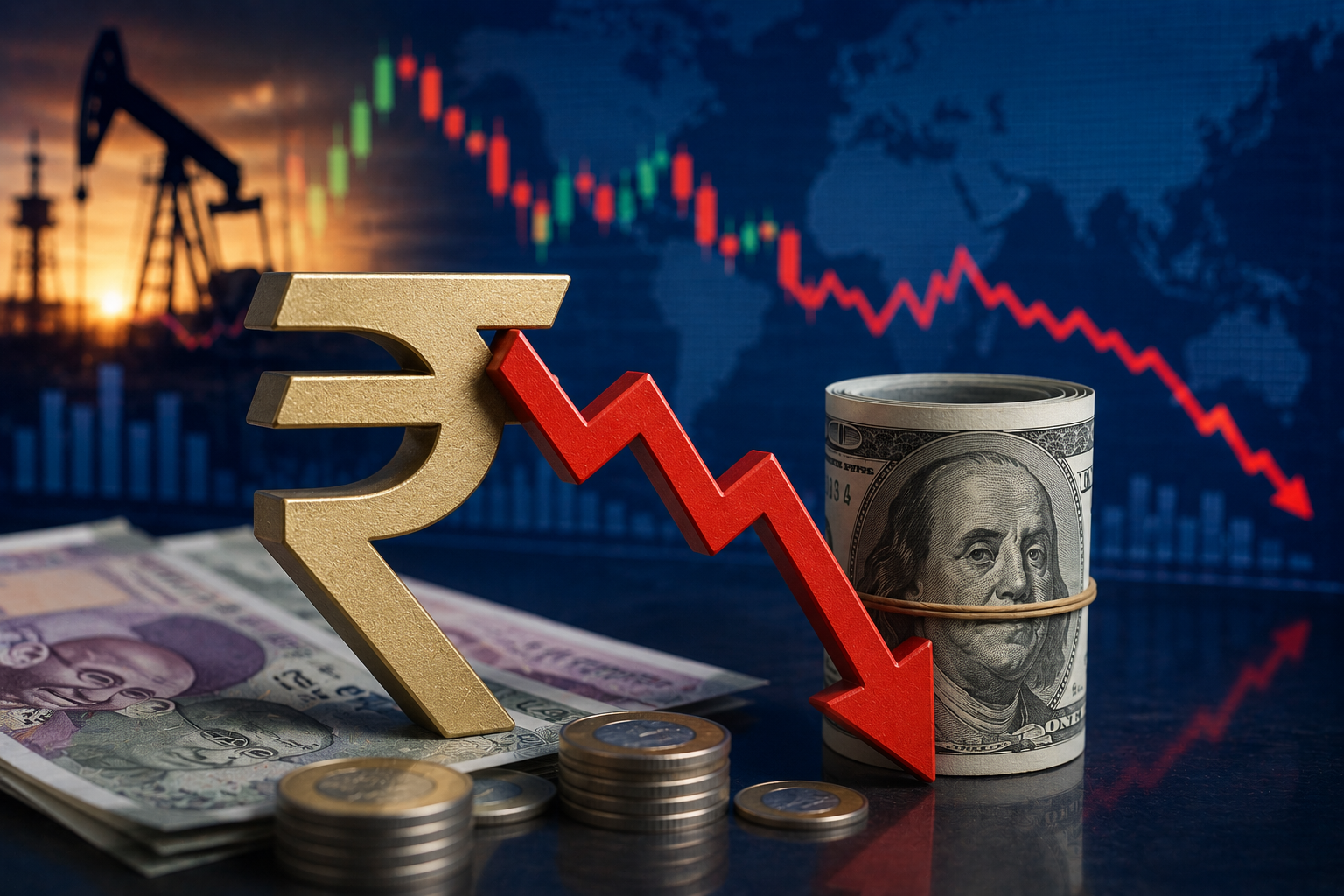
Indian currency remains under pressure as Brent crude approaches $96 and geopolitical tensions trigger risk aversion
The Indian rupee slipped further against the US dollar in early trade on Wednesday, September 2, as rising crude oil prices, renewed US-Iran tensions and expectations of tighter US monetary policy weighed on sentiment across global financial markets.
The rupee opened at 94.97 against the US dollar, down 2 paise from its previous close of 94.95. The currency remained in a narrow trading range initially, but the broader market environment continued to remain challenging for emerging-market currencies.
Forex traders said the Reserve Bank of India (RBI) is closely monitoring the rupee's movement as Brent crude prices have moved towards $95-$96 a barrel and the Dollar Index remains close to the 100 mark.
The combination of expensive crude, a stronger dollar and higher global bond yields has increased pressure on the domestic currency.
Brent crude rises to $95.59 per barrel
Crude oil has emerged as one of the biggest concerns for the Indian currency.
Brent crude futures were trading at around $95.59 per barrel, rising nearly 1 per cent, amid concerns over possible disruptions to crude supplies through the Strait of Hormuz.
The latest increase in oil prices has significant implications for India because the country relies substantially on imported crude oil to meet its energy requirements.
When international crude prices rise, India's oil import bill increases, creating greater demand for US dollars. If this demand remains elevated, it can put additional depreciation pressure on the rupee.
A prolonged rise in crude prices could also influence India's inflation trajectory by increasing transportation, logistics and manufacturing costs.
US-Iran tensions trigger fresh risk aversion
Renewed tensions between the United States and Iran have added another layer of uncertainty to global markets.
Investors are particularly concerned about the potential impact of geopolitical developments on energy supplies from the Middle East. The Strait of Hormuz is a crucial energy transportation route, making any threat to oil flows highly sensitive for global financial markets.
The possibility of prolonged disruption has pushed crude prices higher and encouraged investors to increase exposure to traditional safe-haven assets, including the US dollar.
For India, this creates a difficult combination of higher energy costs and dollar strength, both of which can weigh on the rupee.
Dollar Index remains close to 100
The US dollar continued to strengthen against major global currencies.
The Dollar Index was trading at 99.75, up 0.08 per cent. The index measures the value of the US dollar against a basket of six major currencies.
The dollar has received support from two major factors — geopolitical uncertainty and expectations surrounding US interest rates.
Whenever global risk aversion increases, investors often move towards dollar-denominated assets. This tends to provide additional support to the US currency and creates pressure on emerging-market currencies.
Fed rate hike expectations strengthen the dollar
Market participants have also increased their expectations of a September Federal Reserve rate hike.
These expectations have pushed US Treasury yields higher, making dollar assets more attractive to international investors.
Higher US yields can have a significant impact on emerging markets because investors may shift capital towards US fixed-income assets when the return differential becomes more favourable.
A combination of higher US yields and a stronger dollar can therefore lead to greater volatility in currencies such as the rupee.
US Treasury yields emerge as another pressure point
The rise in US Treasury yields is being closely monitored by Indian currency and equity traders.
Higher yields reflect expectations that US monetary policy could remain tighter than previously anticipated. If the Federal Reserve raises interest rates or signals a more hawkish policy stance, the dollar could receive further support.
For the rupee, this could mean increased pressure from both the commodity and financial-market channels.
The market will therefore closely track upcoming US economic data, inflation indicators and Federal Reserve commentary for clues about the direction of monetary policy.
RBI keeps a close watch on rupee movement
Market participants said the RBI is keeping a close watch on the currency market as the rupee faces pressure from rising crude prices and dollar strength.
The central bank has historically intervened in the foreign exchange market to prevent excessive volatility and disorderly movements.
The objective is generally not to defend a specific exchange-rate level but to ensure that sudden movements do not destabilise financial markets.
With crude oil prices rising and geopolitical uncertainty increasing, traders will watch for signs of RBI intervention in the spot and forward markets.
Rupee movement reflects broader global pressures
The latest depreciation of 2 paise may appear limited, but the underlying factors remain important.
The rupee is currently facing pressure from:
-
Rising Brent crude prices
-
A stronger US dollar
-
Higher US Treasury yields
-
Expectations of a September Fed rate hike
-
Renewed US-Iran tensions
-
Risk aversion across global markets
-
Potential volatility in foreign portfolio flows
These factors could continue to influence currency trading in the coming sessions.
Indian stock market also hit by global risk-off sentiment
The weakness in the rupee came alongside a sharp sell-off in Indian equities.
The Sensex plunged 788.52 points to 76,155.76 during early trade, while the Nifty declined 269 points to 23,786.80.
The equity-market decline highlights the broader impact of the global risk-off environment.
Higher crude prices are negative for oil-importing economies, while rising US yields can reduce the relative attractiveness of emerging-market equities.
At the same time, geopolitical uncertainty can encourage investors to reduce risk exposure.
FII flows remain an important factor
Foreign institutional investors remained net buyers of Indian equities on Tuesday, providing some support to domestic markets.
According to exchange data, FIIs purchased Indian equities worth ₹1,143.38 crore on a net basis.
However, sustained foreign buying could become more challenging if global risk appetite deteriorates.
If US yields continue to rise and the dollar strengthens, international investors could reassess allocations towards emerging-market equities and currencies.
Consequently, FII flows will remain an important indicator for both the rupee and the Indian stock market.
Impact of a weaker rupee on the Indian economy
A depreciating rupee has both positive and negative consequences for the Indian economy.
Importers face higher costs
Companies dependent on imported raw materials, energy products, machinery and components can face higher costs when the rupee weakens.
Oil-importing companies are particularly sensitive because crude oil is priced internationally in US dollars.
Exporters may benefit
Export-oriented companies can benefit from a weaker rupee because their overseas revenues translate into a higher rupee value.
Sectors such as IT services, pharmaceuticals and other dollar-revenue businesses can therefore receive some earnings support from currency depreciation, although the actual impact depends on hedging arrangements and the share of imported inputs.
Inflation remains a concern
If currency depreciation coincides with higher crude oil prices, the inflationary impact can become more significant.
Imported inflation can affect fuel, transportation, logistics and industrial input costs, potentially influencing corporate margins and consumer prices.
Oil prices remain the biggest near-term risk
The direction of crude oil prices will remain critical for the rupee.
If Brent crude stabilises around current levels or declines, pressure on the Indian currency could moderate.
However, a sustained move towards the $100-per-barrel level could increase concerns regarding India's import bill and external-sector stability.
Any major disruption to oil supplies from the Middle East could result in a sharp increase in crude prices and consequently intensify pressure on the rupee.
Dollar strength to remain a key market indicator
Currency traders will also closely track the Dollar Index.
A sustained move towards or above the 100 level would indicate continued dollar strength and could keep emerging-market currencies under pressure.
On the other hand, a decline in the Dollar Index, particularly if accompanied by lower US Treasury yields, could provide some relief to the rupee.
The interest-rate differential between India and the US will also remain important for global capital flows.
Geopolitical developments could drive volatility
The currency market is likely to remain highly sensitive to developments involving the US and Iran.
Any escalation that threatens crude production or transportation routes could trigger another jump in oil prices.
Conversely, signs of de-escalation could lead to a decline in the geopolitical risk premium in crude and provide some relief to global markets.
This makes geopolitical headlines an important short-term trigger for both the currency and equity markets.
What traders will watch next
Market participants are likely to monitor several indicators closely:
Crude oil: Any sustained move above $95-$100 could increase pressure on the rupee.
Dollar Index: A move towards or above 100 would signal continued dollar strength.
US Treasury yields: Further increases could strengthen the dollar and influence global capital flows.
Federal Reserve policy: Expectations surrounding a September rate decision will remain crucial.
RBI intervention: Traders will watch for signs of central-bank action to limit excessive volatility.
FII flows: Continued foreign buying could provide support, while renewed selling could increase pressure on domestic assets.
US-Iran tensions: Any development affecting Middle East energy supplies could have an immediate impact on crude and currency markets.
Rupee outlook remains cautious
The rupee's latest move to 94.97 per US dollar keeps the currency close to the psychologically important 95 level.
While the two-paise decline itself is modest, the combination of high crude prices, elevated US yields and geopolitical uncertainty suggests that currency volatility could remain high.
The RBI's presence in the foreign exchange market could help contain sharp movements, but sustained pressure from global factors may make it difficult for the rupee to recover quickly unless crude prices or dollar strength moderate.
Market Outlook
The near-term outlook for the rupee remains cautious to negative, with the 95-per-dollar level likely to remain a closely watched psychological threshold.
A sustained rise in Brent crude towards $100, further escalation in US-Iran tensions, stronger US Treasury yields or a more hawkish Federal Reserve could increase depreciation pressure on the rupee.
On the other hand, easing geopolitical tensions, lower crude prices, softer US yields and continued foreign capital inflows could provide support to the domestic currency.
For Indian investors, the interaction between the rupee, crude oil, Dollar Index, US bond yields and FII flows will remain crucial. A prolonged combination of expensive oil and dollar strength could also keep pressure on Indian equities, particularly import-dependent sectors, while select export-oriented companies may benefit from currency weakness.