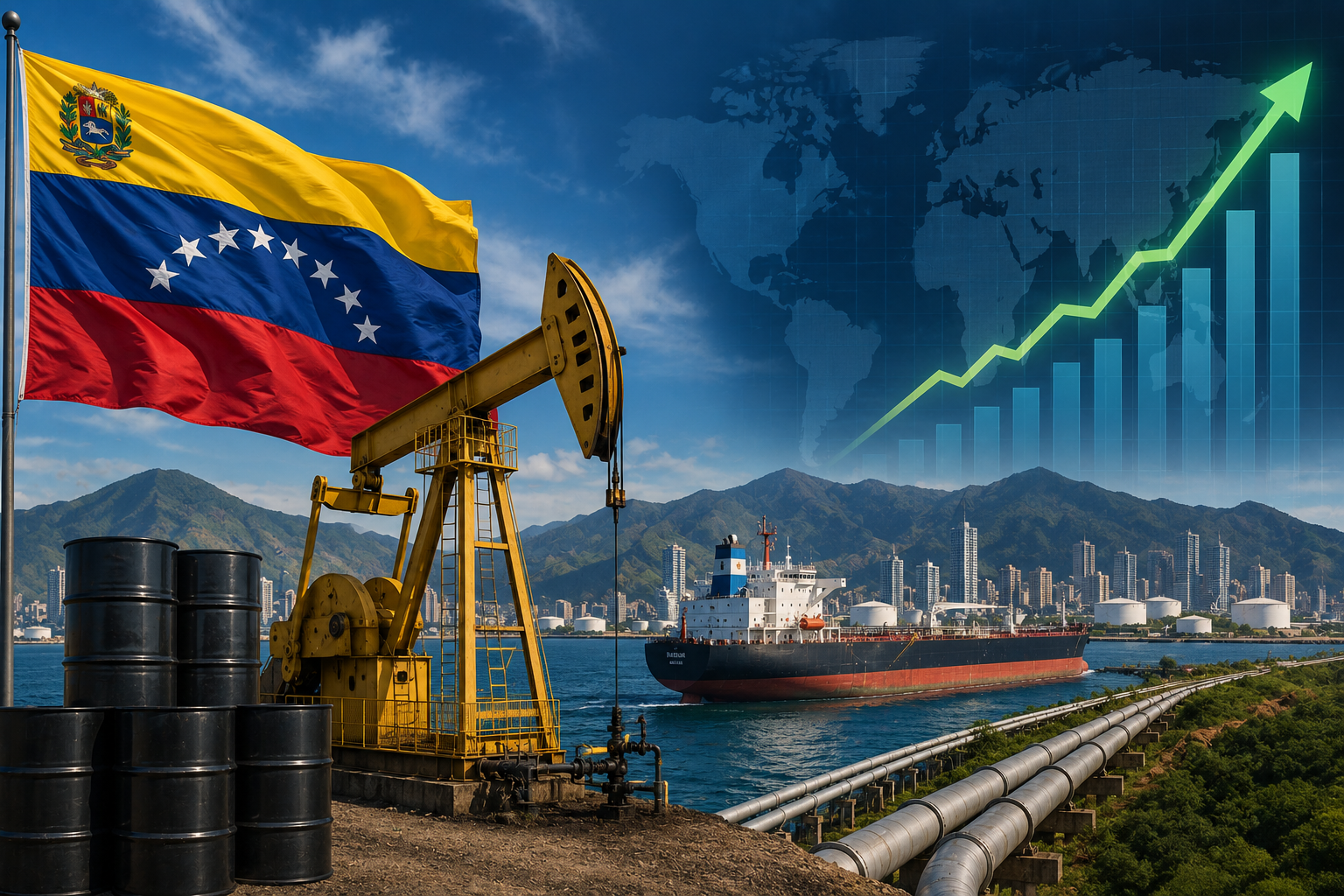
New energy deals involving US and global oil companies could revive Venezuela's battered oil industry and add significant crude supply to world markets
Venezuela's crude oil production could more than double over the next few years as fresh investment and new energy agreements bring international capital, technology and operational expertise back into the country's oil industry, according to US Energy Secretary Chris Wright.
Wright made the comments after arriving in Venezuela for a one-day visit, as Caracas and international energy companies prepare to sign a series of agreements covering oil and energy projects.
The development is attracting considerable attention across global energy markets because Venezuela holds some of the world's largest oil reserves but has experienced a prolonged decline in production due to years of underinvestment, operational difficulties, mismanagement and US sanctions.
The potential return of Venezuelan barrels to the international market could have significant implications for crude prices, refiners, oil-importing countries and energy-intensive economies such as India.
Venezuela aims to rebuild its oil production capacity
Venezuela's oil industry has undergone a dramatic decline from its historic production levels.
Crude output peaked at more than 3 million barrels per day during the late 1990s. Production subsequently fell sharply as the country's oil infrastructure deteriorated and investment declined.
In recent months, Venezuelan production has been around 1.1 million to 1.2 million barrels per day.
Wright's comments suggest that the country could see a major production recovery if newly announced investment agreements are successfully implemented.
A more than doubling of current output would potentially take Venezuela's production well above 2 million barrels per day over the coming years, although the exact pace and scale of the increase will depend on investment, infrastructure rehabilitation, field performance and regulatory conditions.
International companies return to Venezuela
One of the most important developments is the expected involvement of several international energy companies.
Chevron, Italy's Eni, India's ONGC, Colombia's GeoPark and US-based GE Vernova are among the companies expected to sign agreements or participate in energy projects in Venezuela.
The return of international companies could provide Venezuela with access to:
-
New drilling technology
-
Oilfield redevelopment expertise
-
Capital investment
-
Modern production equipment
-
Infrastructure development
-
Refining and processing technology
-
Power and energy-sector equipment
-
International marketing and logistics networks
For a country whose oil infrastructure has suffered from years of limited investment, these factors could be critical to restoring production.
Why Venezuela's oil reserves matter
Venezuela has an exceptionally large hydrocarbon resource base, making it strategically important to global energy markets.
However, reserves alone do not translate into immediate production.
Heavy investment is required to develop oilfields, maintain wells, upgrade pipelines, improve processing infrastructure and transport crude to export terminals.
The challenge for Venezuela is therefore not simply finding oil. It is rebuilding the industrial ecosystem required to extract, process and export it consistently at commercial scale.
That is where international companies could play a critical role.
US-backed investment could accelerate production growth
Wright said the investment associated with the new agreements could "massively grow" available oil production and eventually place downward pressure on crude prices.
The expected production increase comes as Washington seeks deeper involvement in Venezuela's energy sector.
The United States has historically imposed sanctions on Venezuela's oil industry, significantly affecting the country's ability to attract international capital and conduct unrestricted oil trade.
A greater role for US companies would therefore represent an important shift in the country's energy landscape.
For Washington, increased Venezuelan production could potentially improve global oil supply and reduce upward pressure on energy prices.
For Caracas, international investment could provide additional export revenues and support economic reconstruction.
Long-term access to Venezuelan oil becomes strategic issue
The developments follow a separate arrangement under which the United States is expected to gain long-term access to a portion of Venezuela's proven oil reserves.
According to the report, US-backed private oil company North American Blue Energy Partners, or NABEP, would receive a long-term lease covering 17 oilfields containing an estimated 65 billion barrels of oil reserves.
The reported arrangement has attracted attention because of its scale and the strategic importance of the assets.
However, the structure has also raised questions among some oil companies and observers regarding the process through which the agreement was reached and the background of the parties involved.
These issues could influence the willingness of international investors to commit additional capital to Venezuela.
Geopolitical competition adds another dimension
Venezuela's oil industry has historically attracted interest from countries including Russia and China.
US officials said some of the oilfields involved in the emerging arrangements had until recently been associated with Chinese and Russian control or participation.
A greater US presence could therefore change the geopolitical balance surrounding Venezuela's energy resources.
The development is particularly significant because oil remains one of the most strategically important commodities in the global economy.
Control over production capacity, export infrastructure and long-term supply contracts can influence not only energy prices but also trade relationships and geopolitical alliances.
Chevron remains an important player
Chevron is among the most prominent international energy companies with operations in Venezuela.
The company's continued participation could be important for the country's production recovery because of its existing operational knowledge, infrastructure and experience in Venezuelan oilfields.
A successful expansion of international oil operations could encourage other companies to increase their exposure to Venezuela, provided regulatory and sanctions-related risks remain manageable.
The participation of multiple international companies could also distribute investment risk across different projects and areas of expertise.
India's ONGC could gain strategic importance
The involvement of India's ONGC is particularly important from an Indian energy-security perspective.
India is one of the world's largest oil-importing economies, making international crude prices a major factor for inflation, the current account deficit, the rupee and corporate profitability.
Greater Venezuelan production could expand the global pool of available crude and potentially create additional sourcing opportunities for Indian refiners.
Indian refiners have substantial experience processing different grades of crude, including heavier varieties. If Venezuelan supplies become commercially attractive and geopolitical restrictions allow, Indian companies could potentially increase purchases from the country.
The participation of ONGC in Venezuelan projects could also strengthen India's long-term energy relationship with the South American producer.
More Venezuelan crude could put pressure on global oil prices
The biggest potential consequence for financial markets is the possibility of additional global oil supply.
If Venezuelan output rises materially from current levels, the additional barrels could increase supply in international markets.
All else being equal, higher supply tends to put downward pressure on crude prices.
However, the impact would depend on the timing of the production increase and developments elsewhere in the global oil market.
OPEC+ production decisions, US shale output, global economic growth, Chinese demand, geopolitical tensions and disruptions in major oil-producing regions will continue to influence the overall supply-demand balance.
The production increase will not happen overnight
Despite the optimistic outlook, rebuilding Venezuela's oil production capacity will be a multi-year process.
Many oilfields require rehabilitation after years of underinvestment. Existing wells may need workovers, new drilling programmes and improved recovery techniques.
Infrastructure such as pipelines, storage facilities, processing units and export terminals also requires investment.
The availability of skilled workers, equipment and financing will be equally important.
Therefore, the headline potential of doubling production should not be interpreted as an immediate increase in global oil supply.
The market impact will become more significant as projects move from agreements to actual drilling, production and exports.
Refining capacity remains a major factor in fuel prices
Wright also pointed to refining capacity as an important factor behind elevated gasoline and diesel prices in the United States.
Crude oil is only the first stage of the fuel supply chain. It must be processed into gasoline, diesel, jet fuel and other petroleum products.
If refinery capacity is insufficient, even a well-supplied crude market can experience higher finished-fuel prices.
Wright said US gasoline prices should decline in the coming weeks following steps taken by the Trump administration to ease regulations affecting refiners.
This distinction is important for investors because a decline in crude prices does not necessarily translate into an equivalent decline in retail fuel prices.
Strait of Hormuz remains critical for global oil markets
The developments in Venezuela are unfolding alongside continued geopolitical risks affecting global energy flows.
Wright said around 17 million barrels of oil transited the Strait of Hormuz on Monday, describing it as the highest level of crude flow through the waterway since the conflict involving the US and Israel and Iran disrupted flows.
The Strait of Hormuz is one of the world's most important energy chokepoints.
Any significant disruption to the waterway can quickly push crude prices higher because large volumes of Middle Eastern oil and petroleum products move through the route.
Therefore, even if Venezuelan production increases, geopolitical disruptions elsewhere could offset some of the additional supply.
What lower crude prices could mean for India
A sustained decline in international crude prices would generally be positive for India.
India imports a substantial portion of its crude oil requirements, making the country particularly sensitive to changes in international energy prices.
Lower crude prices could help:
-
Reduce India's oil import bill
-
Improve the current account balance
-
Reduce inflationary pressure
-
Support the Indian rupee
-
Improve margins for several fuel-consuming industries
-
Reduce transportation costs
-
Benefit airlines and logistics companies
-
Support household purchasing power
The impact on Indian equities could also be positive if lower energy costs translate into improved corporate margins.
Indian refiners could benefit from increased crude availability
Indian oil refiners could potentially benefit from a larger and more competitive global crude market.
A rise in Venezuelan supply could provide additional sourcing options for refiners, particularly if Venezuelan producers offer competitive pricing to regain international market share.
Companies with sophisticated refining systems capable of processing heavier crude grades could be better positioned to take advantage of such opportunities.
However, the actual benefit will depend on crude quality, freight costs, sanctions, payment mechanisms and the commercial terms offered by Venezuelan producers.
Oil producers could face a different impact
While lower crude prices are generally positive for oil-consuming economies, the effect is different for upstream producers.
A significant increase in global supply can put pressure on crude prices and reduce revenue per barrel for oil producers.
This could affect the profitability and investment plans of producers if prices fall sharply.
The impact on state-owned oil companies and oil-exporting nations could be particularly significant because government finances in many producer economies are closely linked to hydrocarbon revenues.
OPEC+ response will be important
Any major increase in Venezuelan production will also need to be considered in the context of OPEC+ supply management.
If Venezuelan output rises significantly, the broader producer group may need to assess the impact on the global supply-demand balance.
Potential adjustments in production policies by other major producers could offset or amplify the effect of additional Venezuelan barrels.
As a result, investors should not assume that every additional barrel produced in Venezuela will automatically translate into an equivalent increase in freely available global supply.
Venezuela's economic recovery depends heavily on oil
Oil remains central to Venezuela's economy.
A successful production recovery could provide the government with greater export earnings and potentially support investment in infrastructure and other sectors.
Higher production could also create employment opportunities across drilling, engineering, logistics, transportation, construction and services.
However, the sustainability of this recovery will depend on the country's ability to establish a stable investment framework and attract long-term capital.
International investors typically require clarity on ownership, taxation, sanctions, repatriation of profits and contract enforcement before committing large amounts of capital to energy projects.
Key risks for investors
Despite the potential upside, Venezuela's oil revival carries significant risks.
Geopolitical risk
Changes in relations between Venezuela and the United States could alter investment conditions and oil-export policies.
Sanctions risk
Any changes in US sanctions or licensing arrangements could affect international companies operating in Venezuela.
Infrastructure risk
Years of underinvestment have left portions of the country's energy infrastructure in need of significant rehabilitation.
Execution risk
Production targets may take longer to achieve than initially expected because oilfield redevelopment is capital-intensive and technically complex.
Price risk
A sharp increase in Venezuelan production could put downward pressure on crude prices, affecting upstream profitability.
Political and regulatory risk
Long-term investment decisions will depend heavily on the stability and predictability of Venezuela's regulatory environment.
Global energy market: What investors should watch
The Venezuela story should be monitored alongside several other major factors influencing the global oil market.
Investors should track:
-
Venezuelan monthly crude production
-
New oilfield investment announcements
-
Chevron and other international companies' project activity
-
ONGC's involvement in Venezuelan projects
-
US sanctions and licensing policy
-
OPEC+ production decisions
-
Global crude inventories
-
US refinery utilisation
-
Chinese crude demand
-
US shale production
-
Strait of Hormuz shipping flows
-
Middle East geopolitical developments
-
Global economic growth expectations
What could change the oil market equation?
The most important question for investors is whether Venezuela can convert its enormous reserves into sustained production growth.
If new agreements translate into actual investment and production, Venezuela could gradually become a more important contributor to global supply.
A move towards 2 million barrels per day or more would represent a major recovery from current levels.
A return towards the country's historical production peak would be even more significant, although achieving such levels would require substantial investment and years of development.
The market is therefore likely to focus less on announcements alone and more on evidence of actual drilling activity, new production capacity and rising exports.
Market Outlook
Venezuela's potential oil-production revival represents a medium- to long-term supply story with potentially significant implications for global crude prices.
If international investment successfully lifts Venezuelan production from around 1.1–1.2 million barrels per day to more than 2 million barrels per day over the coming years, the additional supply could create a meaningful bearish force for crude prices, particularly if global demand growth remains moderate.
For India, increased Venezuelan output could be favourable because a larger global supply pool may help contain crude prices and reduce pressure on the country's oil import bill, inflation and current account.
However, the immediate direction of crude prices will continue to be determined by the broader global supply-demand balance, OPEC+ policy and geopolitical developments, particularly around major oil-producing regions and the Strait of Hormuz.
For investors, the key distinction is between announced investment and actual production. The next major signals will be the implementation of energy agreements, capital deployment, drilling activity and monthly Venezuelan output.
If those indicators begin showing sustained improvement, Venezuela could gradually re-emerge as one of the most important sources of incremental oil supply in the global market.