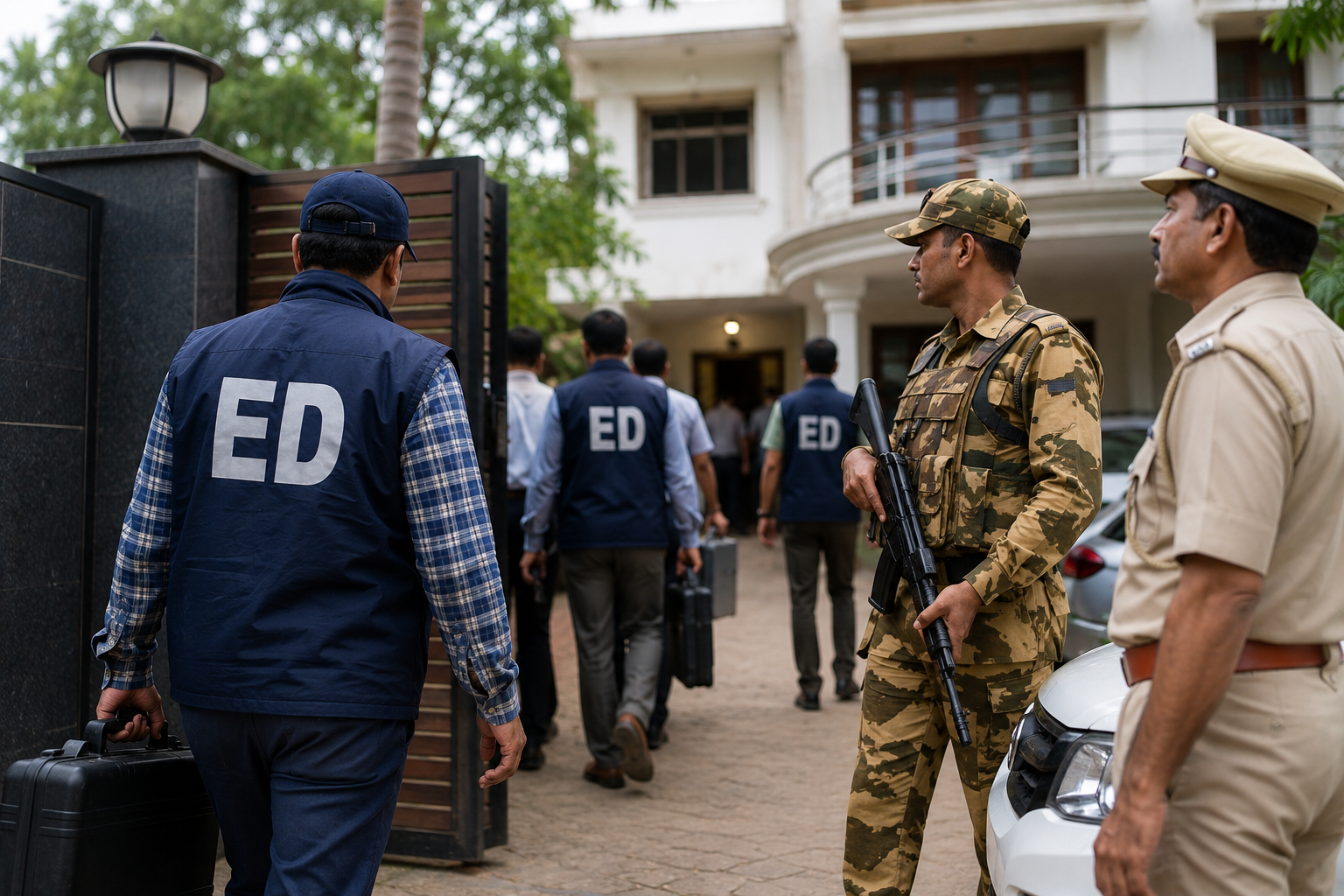
Searches at seven locations in PMLA probe; investigation widens into alleged irregularities in CGPSC recruitment
The Enforcement Directorate (ED) on Tuesday conducted searches at seven locations across Chhattisgarh as part of a money-laundering investigation linked to alleged irregularities in the Chhattisgarh Public Service Commission (CGPSC) recruitment process.
Among the premises searched was that of K K Chandrakar, who served as personal assistant to former Chhattisgarh chief minister Bhupesh Baghel. The searches are being conducted under the Prevention of Money Laundering Act (PMLA). (The New Indian Express)
The latest action marks an expansion of the ED's probe into alleged irregularities surrounding CGPSC examinations and recruitment.
ED Searches Seven Locations
According to officials, the ED's Raipur zonal office is conducting searches at seven locations in the state.
The premises linked to Chandrakar are among those being searched as part of the investigation. The operation is focused on alleged financial irregularities connected with the CGPSC case. (The New Indian Express)
As of the latest reports, the agency has not disclosed the complete details of material or documents recovered during the searches.
Probe Linked to CGPSC Recruitment Irregularities
The investigation relates to alleged irregularities in the recruitment process conducted by the Chhattisgarh Public Service Commission.
The broader case concerns allegations surrounding recruitment examinations and an alleged paper leak and manipulation of the selection process. According to reporting on the ED investigation, the allegations relate to CGPSC recruitments conducted during 2020-2022. (Moneycontrol)
The ED is examining the case from the money-laundering angle, meaning investigators are looking beyond the underlying recruitment allegations to identify any suspected financial transactions or proceeds of crime.
ED's Money-Laundering Investigation
The ED's PMLA investigation stems from an earlier case registered by the Central Bureau of Investigation (CBI), according to reports.
The agency's investigation is examining alleged financial transactions associated with the recruitment irregularities. The money-laundering angle can involve tracing the movement, concealment or use of suspected proceeds of crime.
However, an ED search is an investigative action and does not by itself establish guilt.
Any allegations against individuals must ultimately be supported by evidence and tested through the legal process.
Former CGPSC Chairman Taman Singh Sonwani in Focus
The latest searches come after the ED's earlier action against former CGPSC chairman Taman Singh Sonwani.
According to Moneycontrol, Sonwani had earlier been arrested in connection with the money-laundering investigation. The agency has been examining alleged financial transactions and other monetary aspects of the recruitment case. (Moneycontrol)
Reports have alleged that the investigation involves claims of question-paper leakage, manipulation of the selection process and alleged illegal gratification. These remain allegations under investigation.
Allegations of Recruitment Manipulation
According to details reported about the ED investigation, the agency has examined allegations that the recruitment process was manipulated to benefit certain candidates and relatives of individuals connected to the commission.
Moneycontrol reported that the agency is investigating allegations involving nepotism, financial transactions and selection of relatives of government officials and political leaders. (Moneycontrol)
These claims have not been established as judicial findings and remain part of the ongoing investigation.
Alleged Paper Leak Angle
The CGPSC case also involves allegations surrounding the leakage of examination papers.
The investigation has examined recruitment examinations conducted during the 2020 and 2021 period, with agencies looking into whether the examination process was compromised.
The paper-leak allegation is significant because any proven manipulation of competitive examinations can have consequences for the validity and credibility of the recruitment process.
Why the Case Has Political Significance
The ED's search of premises linked to a former chief minister's former aide has given the investigation an additional political dimension.
Bhupesh Baghel was chief minister of Chhattisgarh before the Congress government lost power in the 2023 Assembly elections.
However, the current searches are described as part of an investigation into alleged CGPSC-related financial irregularities. The reported search of Chandrakar's premises does not establish wrongdoing by Baghel.
Any connection between individuals and alleged offences would have to be established through evidence and due legal process.
What the ED May Examine
In a PMLA investigation, authorities can examine financial and documentary evidence relevant to the suspected offence.
Investigators may examine:
-
Bank-account transactions
-
Property records
-
Financial statements
-
Digital devices
-
Communications
-
Corporate records
-
Cash transactions
-
Documents relating to suspected payments
-
Other material relevant to the alleged financial trail
The objective is to establish whether suspected proceeds of crime were generated, transferred, concealed or used.
Financial Trail Could Become Critical
The most important aspect of the investigation from the PMLA perspective will be the alleged financial trail.
If investigators identify suspicious transactions, they may examine:
Who made the payment?
Who received the money?
How was it transferred?
Whether assets were subsequently acquired?
Whether the transactions were disguised through other entities or accounts?
Answers to these questions could determine the direction of the money-laundering investigation.
Earlier CBI Case Forms the Underlying Investigation
The ED's case is linked to an earlier CBI investigation, according to reports.
Moneycontrol reported that the ED's money-laundering case stems from a 2024 FIR registered by the CBI. The CBI case followed a complaint by Chhattisgarh Police. (Moneycontrol)
This illustrates the distinction between the underlying criminal investigation and the subsequent money-laundering investigation.
The CBI investigation focuses on the alleged underlying offences, while the ED examines whether the alleged criminal activity generated proceeds that were subsequently dealt with in a manner covered by the PMLA.
Allegations Concerning Financial Transactions
Reports on the investigation have referred to allegations of illegal gratification and financial transactions connected with the recruitment process.
Moneycontrol reported that the ED has alleged that certain payments were connected with alleged manipulation of selections. Separately, reports have cited the agency's claims concerning alleged routing of money through a family-controlled entity. (Moneycontrol)
These claims are allegations made in the course of the investigation and should not be treated as established facts unless proven through the legal process.
What Happens After the Searches?
The next phase will depend on what investigators find during the searches.
Potential developments could include:
-
Examination of seized documents and digital devices
-
Recording of statements
-
Tracing of financial transactions
-
Questioning of additional individuals
-
Further searches
-
Attachment of suspected proceeds of crime, where legally justified
-
Filing of prosecution-related documents, if the investigation supports such action
The ED has not yet publicly provided a complete account of the outcome of Tuesday's searches.
Recruitment Integrity Under Scrutiny
The case has implications beyond the individuals being investigated.
The CGPSC conducts examinations for recruitment to important positions in the state government. Any proven irregularity in such examinations can affect thousands of candidates and raise questions about the integrity of public recruitment.
A transparent examination system is critical because government recruitment directly affects public administration and the credibility of state institutions.
What Candidates and the Public Will Watch
The broader public interest in the case is likely to centre on whether the investigation establishes:
-
How the alleged irregularities occurred
-
Whether examination papers were leaked
-
Whether selections were manipulated
-
Whether money changed hands
-
Who allegedly benefited
-
Whether financial proceeds can be traced
-
Whether any appointments are ultimately affected
The answers will emerge only as the investigation and related legal proceedings progress.
Important Legal Distinction
The developments should be viewed within the context of an ongoing investigation.
An ED search is not a conviction.
Similarly, being questioned, having premises searched or being named in an investigation does not automatically establish criminal liability.
The allegations must be supported by evidence and are subject to the legal process.
Key Developments at a Glance
| Parameter | Details |
|---|---|
| Investigating agency | Enforcement Directorate |
| Case | Alleged CGPSC irregularities |
| Law | Prevention of Money Laundering Act |
| Locations searched | 7 |
| Notable premises | K K Chandrakar's premises |
| Chandrakar's association | Former PA to Bhupesh Baghel |
| Underlying issue | Alleged CGPSC recruitment irregularities |
| Financial angle | Alleged money laundering |
| Earlier agency action | Former CGPSC chairman Taman Singh Sonwani arrested, according to reports |
| Current status | Investigation underway |
What Could Happen Next
The immediate focus will be on the findings from Tuesday's searches.
If investigators identify documents or financial records that they believe establish a money trail, the agency could widen its investigation.
Additional individuals could potentially be questioned if their names emerge from the evidence.
The investigation could also result in further action concerning assets if the agency establishes a legally sustainable connection between those assets and alleged proceeds of crime.
At present, however, the complete outcome of the searches is awaited.
Broader Governance Implications
The CGPSC case highlights the importance of maintaining transparency in public-sector recruitment.
Government examinations are particularly sensitive because candidates invest significant time and resources preparing for them. Allegations of paper leaks, favouritism or manipulation can undermine confidence in the entire recruitment system.
The investigation therefore has significance not only from a political or legal perspective but also from the standpoint of institutional credibility.
Market Outlook
The ED's latest searches represent a fresh development in the ongoing investigation into alleged irregularities involving the Chhattisgarh Public Service Commission.
The search of premises linked to former chief minister Bhupesh Baghel's former personal assistant K K Chandrakar has increased the political attention surrounding the case, while the PMLA angle puts the focus on the alleged financial trail behind the recruitment-related allegations. (The New Indian Express)
The immediate monitorable will be the evidence recovered from the seven locations and whether investigators identify transactions or assets that they believe are connected to suspected proceeds of crime.
The earlier investigation involving former CGPSC chairman Taman Singh Sonwani means the latest searches are part of a broader probe rather than an isolated action. (Moneycontrol)
For now, the case remains at the investigation stage. The key developments to watch are further questioning, additional searches, financial-trail findings, possible asset-related action and subsequent court proceedings.
Importantly, the ED's searches and the allegations reported in connection with the case should not be treated as a final determination of guilt. The outcome will depend on the evidence gathered and the legal process that follows.
:::