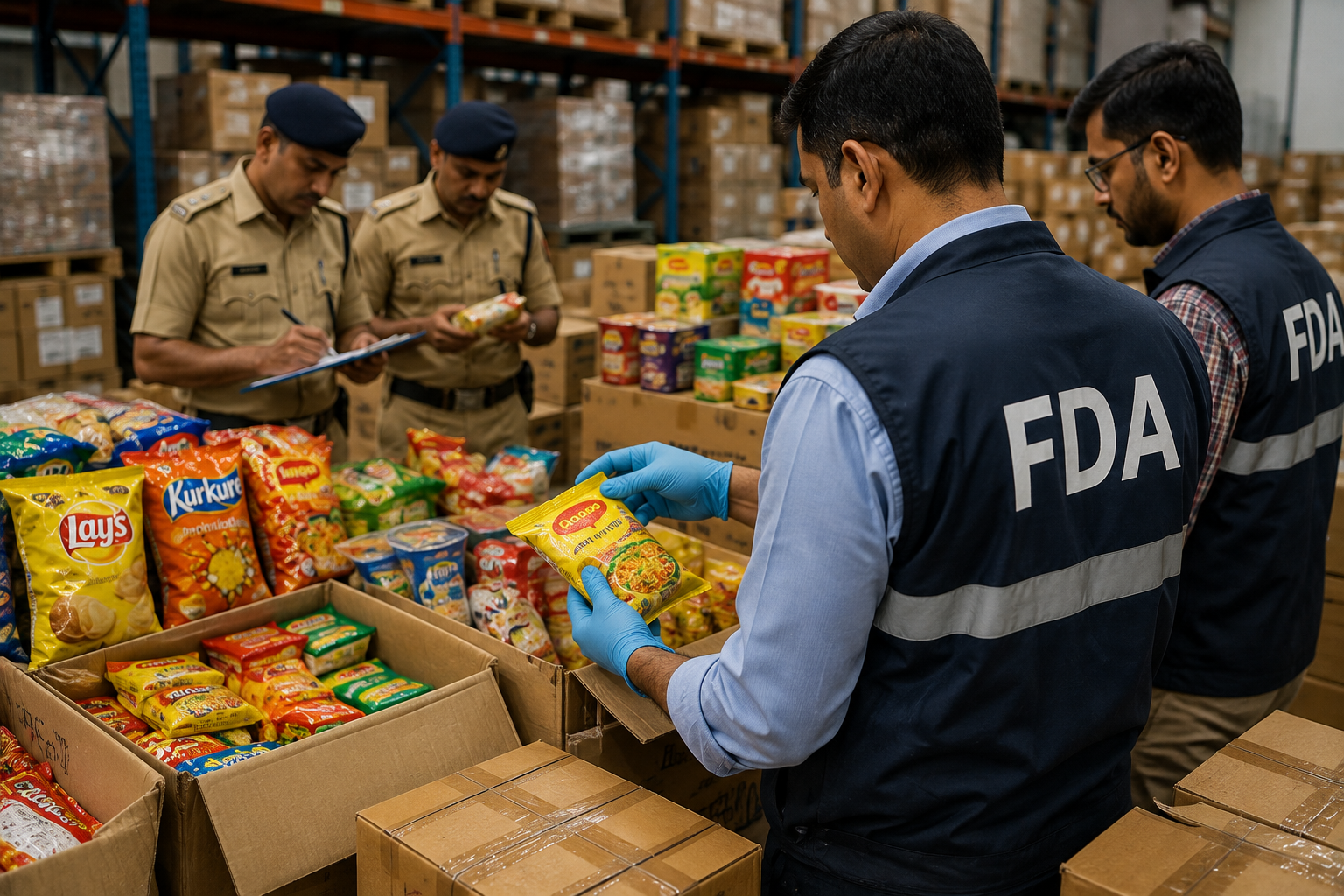
Lay’s, Kurkure and Maggi among products seized as authorities uncover alleged tampering of manufacturing and expiry dates in Navi Mumbai
The Maharashtra Food and Drug Administration (FDA), in coordination with the Navi Mumbai Police Crime Branch, has uncovered an alleged racket involving the manipulation of manufacturing and expiry dates on packaged food products in Navi Mumbai.
Authorities seized 8,442 cartons of food and beverage products during raids conducted between August 24 and August 29 at the premises of Sadhana Enterprises in the Turbhe TTC Industrial Area. The total value of the seized material has been estimated at approximately ₹75.52 lakh.
According to officials, the premises were allegedly being used to store, repack and alter labels on packaged food products before they were prepared for sale or export.
How the alleged food-label tampering was carried out
The Maharashtra FDA said its investigation uncovered an alleged process in which original manufacturing and expiry or use-by dates printed on packaged products were removed or altered.
Replacement stickers carrying different dates were allegedly applied to the products before they were repackaged.
Authorities also reportedly found that original labels containing information about ingredients and nutritional values had been removed and replaced.
The raid reportedly resulted in the recovery of equipment and materials that could be used for such operations, including inkjet printers, thinners and specially prepared stickers.
Officials are now investigating whether the alleged activity was intended to make products appear to have a longer shelf life than their original packaging indicated.
₹75.52 lakh worth of products seized
The enforcement operation resulted in the seizure of 8,442 cartons linked to exporter companies.
According to officials, the declared value of the main consignment was around ₹75.21 lakh. In addition, expired and unlabelled food products valued at approximately ₹30,600 were recovered.
The combined value of the seized material therefore stood at around ₹75.52 lakh.
The seized inventory is now part of the ongoing investigation, with authorities examining the products, labels, documentation and supply-chain records.
Lay’s, Kurkure and Maggi products found in seized stock
The seized inventory reportedly included a wide range of packaged food and beverage products carrying the names of major consumer brands.
Among the products mentioned by the FDA were:
-
Lay’s potato chips
-
Multiple Kurkure variants
-
Maggi Masala and Atta Noodles
-
Fun Flips
-
Knorr Mushroom Soup
-
Rasoi curry pastes
-
Hellmann’s mayonnaise
-
Thums Up
-
Limca
Importantly, the seizure of products carrying a particular brand name does not by itself establish involvement of the respective brand owner in the alleged racket.
The investigation will determine how the products reached the facility, who handled them and who was responsible for the alleged alteration of dates and labels.
10 exporter companies under investigation
The FDA said the seized stock was linked to 10 exporter companies based in Mumbai, Delhi and Noida.
Investigators are expected to examine the relationship between these companies and the Navi Mumbai facility, including procurement records, invoices, warehouse records and transportation documents.
Authorities could also investigate whether the products were intended for domestic consumption, export markets or both.
The movement of products through multiple intermediaries can make traceability particularly important in cases involving alleged label manipulation.
Why expiry-date tampering is a major food-safety concern
Expiry and use-by dates provide consumers with important information about the permitted shelf life of packaged food.
Food products can undergo changes in quality and safety over time depending on their ingredients, packaging, storage conditions and manufacturing process.
Altering a date on a package can potentially mislead consumers about the age and suitability of the product.
The issue becomes more serious when labels containing other mandatory information are also allegedly removed or replaced.
Such information can include ingredients, nutritional details, batch numbers and other declarations needed by consumers and regulators.
FDA suspends Sadhana Enterprises' food licence
Following the operation, the food licence of Sadhana Enterprises was suspended by the authorities.
The licence suspension prevents the concerned premises from continuing regulated food-related activities under the existing approval while enforcement proceedings and investigation continue.
The action also signals the seriousness with which regulators are treating the alleged violations.
Further regulatory measures could follow depending on the investigation and examination of the seized products.
FIR registered in Navi Mumbai
An FIR has been registered at Turbhe police station under relevant provisions of the Food Safety and Standards Act, 2006, as well as provisions of the Bharatiya Nyaya Sanhita.
The criminal investigation will seek to establish the individuals responsible for the alleged activities and determine whether additional entities were involved.
Authorities are also expected to examine the scale and duration of the alleged operation.
Investigation to focus on supply-chain trail
A key part of the investigation will be tracing the journey of the products before they reached the Navi Mumbai premises.
Officials may examine:
-
Purchase invoices
-
Stock registers
-
Warehouse records
-
Batch numbers
-
Manufacturing details
-
Transportation documents
-
Export documentation
-
Label-printing materials
-
Distributor and exporter records
Such records could help authorities determine where the products originated and where they were ultimately intended to be supplied.
Potential risks for distributors and exporters
The case highlights the regulatory risks faced by distributors, warehouses and exporters operating in the packaged-food supply chain.
Food businesses are required to maintain compliance with applicable food-safety and labelling requirements. Any deliberate manipulation of product information can expose businesses to regulatory action and potential criminal proceedings.
For companies operating large distribution networks, stronger inventory tracking and product traceability can help identify irregularities before products reach consumers.
Why brand protection is also important
The incident also highlights a separate challenge for large food and beverage companies: brand protection across the distribution chain.
When counterfeit, relabelled or improperly handled products enter the supply chain, consumers may associate the resulting quality or safety concerns with the original brand even when the brand owner was not responsible for the activity.
Companies therefore increasingly need systems that can help distributors and regulators verify product authenticity, batch information and movement through the supply chain.
Consumer awareness becomes critical
The FDA action serves as a reminder for consumers to pay attention to packaging and labelling when purchasing packaged food.
Consumers should check whether:
-
The manufacturing and expiry/use-by dates appear genuine
-
Labels are intact and securely attached
-
Packaging shows signs of tampering
-
Batch information is clearly visible
-
Product seals are intact
-
Mandatory food-safety information is present
-
The product appears properly stored
-
There are unusual stickers covering original information
Consumers should avoid products with suspiciously altered labels or damaged packaging.
What could happen to the seized products?
The seized products will remain subject to regulatory examination as authorities investigate the alleged violations.
Officials can assess the condition, labelling and shelf life of the products and determine whether they comply with applicable food-safety requirements.
Products found to be expired, improperly labelled or otherwise unsafe may face regulatory action in accordance with the applicable rules.
The final action will depend on the findings of the investigation and examination.
Broader implications for India's packaged-food industry
India's packaged-food market has expanded rapidly with the growth of modern retail, e-commerce, quick commerce and organised distribution.
This expansion has also increased the importance of supply-chain visibility.
Manufacturers increasingly need to monitor products beyond their own factories, particularly when goods pass through multiple distributors, warehouses and exporters.
Technology-enabled inventory systems, batch-level tracking and stronger distributor audits can help reduce the risk of unauthorised handling or relabelling.
Regulatory enforcement remains a key safeguard
The Maharashtra FDA's action demonstrates the role of enforcement agencies in monitoring food storage and distribution facilities.
Regular inspections, targeted investigations and coordination with police authorities can help regulators identify activities that may otherwise remain hidden within the supply chain.
The case also reinforces the importance of strict compliance with food-labelling requirements, particularly where products are being repacked or moved across markets.
What happens next?
The investigation is continuing, and authorities are expected to examine the role of the businesses and individuals allegedly connected with the operation.
The key questions will include how the products were sourced, when the alleged tampering took place, how many products may have been affected and where the stock was intended to be distributed.
Authorities will also determine whether the alleged activity was limited to the Turbhe facility or formed part of a wider network.
Market Outlook
The immediate financial impact on the major consumer brands whose products were reportedly found in the seized inventory cannot be determined from the seizure alone. The presence of branded products at the facility does not establish wrongdoing by those companies.
For investors, the key developments to watch are the findings of the FDA investigation, any subsequent regulatory action and whether authorities identify weaknesses involving distributors, exporters or other intermediaries.
For the broader packaged-food sector, the incident underlines the growing importance of product traceability, supply-chain monitoring, label authentication and distributor compliance. Companies with robust quality-control and distribution systems could be better positioned to protect both consumer trust and brand value as India's organised food market continues to expand.