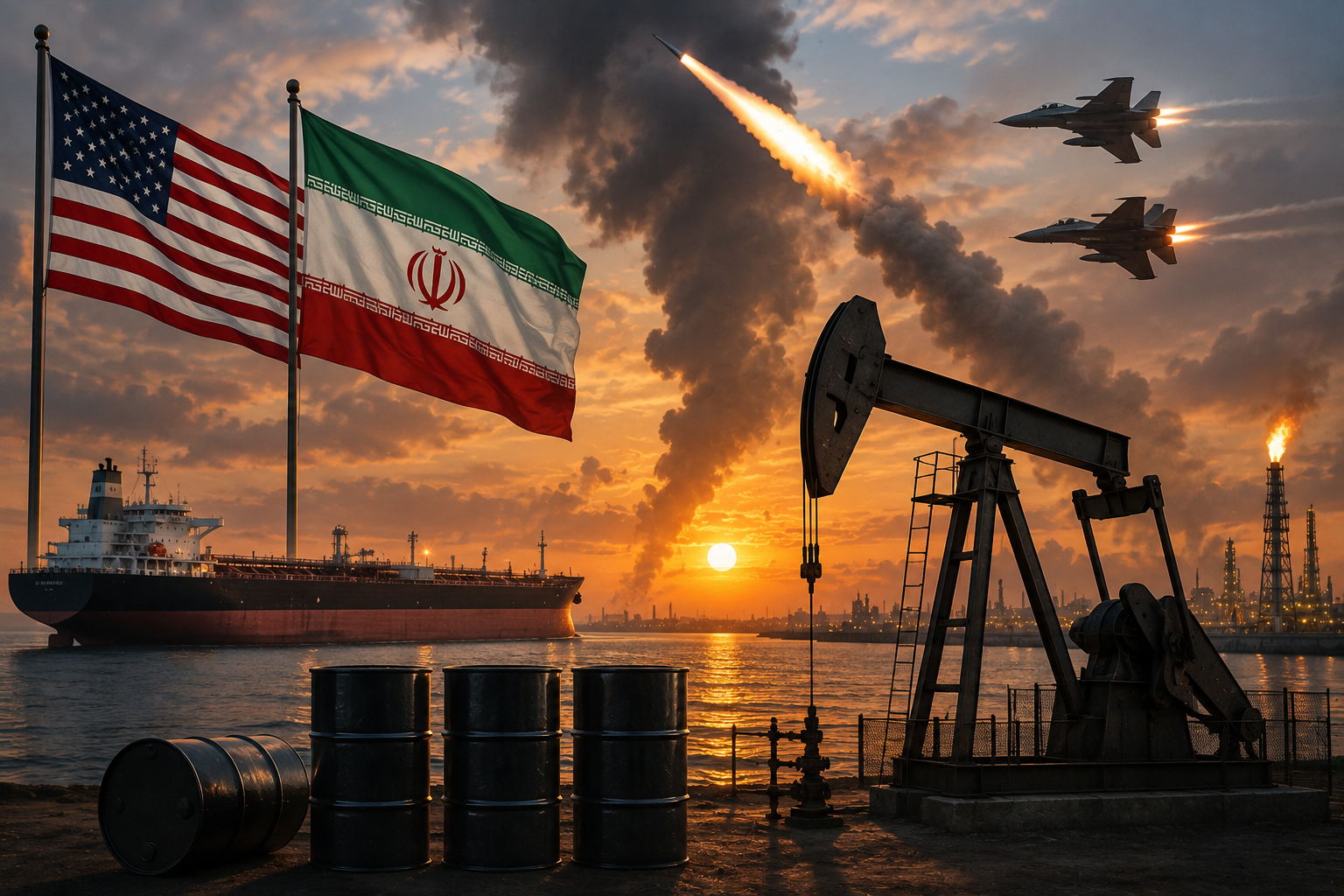
Brent Crude Climbs Above $90 as Middle East Conflict Enters Fresh Escalation Phase
Oil prices jumped more than 2% in early Asian trading on Monday after US forces attacked an Iranian island in the Strait of Hormuz, raising fresh concerns over the security of a critical global oil-supply route.
Brent crude futures climbed $2.51, or 2.85%, to $90.61 a barrel as of 0241 GMT, while US West Texas Intermediate (WTI) crude rose $2.13, or 2.55%, to $85.53 a barrel.
The sharp increase came after a fresh round of military action between the United States and Iran, with investors assessing the possibility of further disruption to oil supplies and commercial shipping across the Gulf region.
US Strikes Iranian Launchers on Larak Island
US forces struck two Iranian launchers on Larak Island in the Strait of Hormuz on Sunday.
The attack was the first known US strike on Iran since late July and represents a renewed escalation in a conflict that has now entered its sixth month.
Iran responded by attacking two US air bases in Jordan, according to Iranian media reports citing the country's Revolutionary Guards.
The latest developments have increased uncertainty over whether the conflict could expand further and begin affecting oil production, export infrastructure and shipping routes more directly.
Strait of Hormuz at the Centre of Oil Market Concerns
The Strait of Hormuz has become the key focus for energy traders.
Before the conflict began at the end of February, roughly one-fifth of global oil flows passed through the waterway.
Any significant and prolonged disruption could therefore have a major impact on international crude prices.
Although oil continues to move through the strait, shipping companies are becoming increasingly cautious because of the growing security risk.
Vessel Traffic Through the Strait Falls
Shipping data showed that the number of visible commodity vessels passing through the Strait of Hormuz over the weekend fell to around five vessels a day.
The decline indicates that shipping companies are taking a more cautious approach to the region.
Lower vessel traffic does not immediately mean that global oil supplies have been disrupted, but it increases the risk that physical crude flows could tighten if the trend persists.
Traders will therefore closely track tanker movements over the coming days.
Tanker Incident Adds to Shipping Concerns
The security situation for commercial vessels has also deteriorated.
The United Kingdom Maritime Trade Operations reported that a tanker was struck by a projectile while travelling inbound through the Strait of Hormuz on Saturday.
The incident could encourage shipping companies to demand higher insurance premiums or reconsider voyages through the region.
If more vessels avoid the waterway, transportation costs could rise and the physical availability of crude could become tighter.
Analysts Warn of Another Escalation Phase
IG market analyst Tony Sycamore described the latest developments as another escalation phase.
The duration of the escalation remains difficult to predict, with the conflict potentially continuing for days or weeks.
This uncertainty is one of the main reasons crude prices are responding sharply to individual military developments.
Oil traders are effectively pricing the probability of a larger disruption rather than simply reacting to current physical supply.
WTI Resistance at $85.80-$85.90 in Focus
Technical indicators are providing important levels for traders.
Analysts said that if WTI crude decisively breaks above the $85.80-$85.90 per barrel resistance zone, the market could open the way for additional gains.
The first potential target is around $87.69, which represents last week's high.
A sustained move beyond that level could bring the $93.50 July high into focus.
A move above $93.50 would represent a significant technical development and could indicate that geopolitical risk is becoming embedded in the broader oil trend.
Brent Crude Could Remain Above $90
Brent's move above $90 has once again placed the benchmark at a psychologically important level.
If prices remain above $90, traders are likely to assess whether the market is beginning to price a more persistent supply-risk premium.
However, a diplomatic breakthrough or restoration of normal shipping activity could quickly reverse some of the recent gains.
The sustainability of the move will therefore depend more on actual supply disruption than on military headlines alone.
Oil Still Faces Monthly Decline
Despite Monday's sharp rise, both Brent and WTI remain on track for modest monthly declines.
Both benchmarks fell more than 4% last week, marking their first weekly decline in three weeks.
This suggests that the latest rally is, at least initially, a reaction to renewed geopolitical risk rather than evidence of a major physical shortage.
The market will need to see sustained disruption to oil flows for prices to maintain a stronger upward trend.
Negotiations to Reopen Strait Remain Uncertain
Efforts to end the conflict and restore normal movement through the Strait of Hormuz remain stalled.
Mediators are working towards reopening the waterway, but negotiations have yet to produce a clear breakthrough.
A diplomatic settlement could reduce the geopolitical premium currently reflected in crude prices.
However, continued military action could have the opposite effect, particularly if energy infrastructure or commercial shipping is directly affected.
US Threatens Additional Secondary Sanctions
US Treasury Secretary Scott Bessent said Washington is likely to introduce new secondary sanctions on Iran on a weekly basis.
The objective is to further isolate Iran from the dollar-based international financial system.
Additional sanctions could affect Iranian oil exports, financial transactions and companies conducting business with Iranian entities.
For global oil markets, the important question will be whether these measures significantly reduce Iran's ability to export crude.
Iranian Oil Exports Remain a Key Variable
Iran remains an important participant in the global energy market.
Any significant reduction in Iranian crude exports could tighten the global supply-demand balance.
The impact could become larger if Iranian export disruptions occur simultaneously with problems in the Strait of Hormuz.
Traders are therefore monitoring both sanctions policy and physical oil shipments.
Venezuela Could Provide Additional Supply
US President Donald Trump said oil from a recently struck agreement with Venezuela would be used to replenish the US Strategic Petroleum Reserve.
The reserve has fallen close to its lowest level in 44 years.
Additional Venezuelan crude entering international markets could potentially help offset some supply pressure elsewhere.
However, the actual market impact will depend on production volumes, export infrastructure and how quickly Venezuelan barrels reach international buyers.
Strategic Petroleum Reserve Back in Focus
The US Strategic Petroleum Reserve could become increasingly important if geopolitical tensions result in a prolonged disruption to crude supplies.
Replenishing the reserve could improve US energy security and provide an additional buffer during future supply shocks.
However, strategic stockpiles cannot fully compensate for a prolonged disruption affecting a major international shipping route.
The scale and duration of any supply interruption will ultimately determine the market impact.
Inflation Risk Returns to the Spotlight
Higher crude prices could create a renewed inflation challenge for the global economy.
Oil is directly and indirectly linked to transportation, manufacturing, electricity generation and logistics costs.
If Brent remains above $90 for an extended period, higher energy costs could eventually feed into consumer prices.
This would be particularly important for central banks that are already assessing whether inflation has returned to a sustainable path.
Federal Reserve Faces a Difficult Policy Environment
The oil rally comes at a sensitive time for the US Federal Reserve.
Markets have already increased expectations of a possible September rate hike following hawkish signals from Fed officials.
If rising crude prices translate into higher inflation expectations, policymakers could face additional pressure to maintain or increase interest rates.
That could result in higher Treasury yields and increased volatility across global equity markets.
Higher Oil Prices Could Strengthen the Dollar
A combination of geopolitical uncertainty and higher US interest-rate expectations could provide support to the US dollar.
A stronger dollar can make commodities priced in dollars more expensive for international buyers.
For emerging economies, the combination of higher crude and a stronger dollar can be particularly challenging.
It can increase import bills while simultaneously putting pressure on local currencies.
India Among the Economies Sensitive to Crude Prices
India remains particularly sensitive to international crude prices because of its dependence on imported oil.
A sustained increase in Brent could raise the country's overall import bill and put pressure on the rupee.
Higher energy costs can also affect transportation, aviation, logistics, chemicals, paints, tyres and other industries.
The impact on inflation will depend on the duration of the crude-price increase and the extent to which higher costs are passed on to consumers.
Indian Rupee Could Face Additional Pressure
Higher crude prices can increase demand for US dollars from Indian oil importers.
At the same time, elevated US Treasury yields can make dollar assets more attractive to global investors.
This combination could create pressure on the Indian rupee.
A weaker rupee would further increase the domestic cost of imported crude, potentially creating an additional inflationary effect.
Indian Equity Sectors to Watch
The latest oil-price movement could result in divergent performance across Indian sectors.
Potentially vulnerable sectors include:
-
Aviation
-
Paints
-
Tyres
-
Chemicals
-
Logistics
-
Transportation
-
Oil-intensive manufacturing
Potential beneficiaries could include:
-
Upstream oil and gas producers
-
Selected energy companies
-
Companies with limited exposure to imported crude
The impact will ultimately depend on individual companies' pricing power, hedging strategies and cost structures.
Refiners Could See a Mixed Impact
Refining companies could face a more complicated situation.
Higher crude prices do not automatically translate into higher profitability because refining margins, product prices and inventory gains or losses also influence earnings.
If global petroleum-product prices rise alongside crude, refiners could maintain margins.
However, if crude prices rise faster than product prices, margins could come under pressure.
Shipping Costs Could Rise Further
The Strait of Hormuz crisis could have implications beyond crude prices.
If vessels avoid the region or take alternative routes, shipping distances could increase.
Higher insurance premiums, security costs and freight rates could add to the cost of moving oil and other commodities.
This could create another layer of inflationary pressure for the global economy.
Global Equity Markets Remain Vulnerable
The oil shock comes as global equity markets are already dealing with elevated bond yields and changing interest-rate expectations.
Higher energy prices could weigh on corporate margins and consumer spending.
At the same time, higher interest rates can reduce equity valuations.
The combination of these factors creates a challenging environment for risk assets.
Gold Faces Competing Forces
Geopolitical escalation would normally support demand for gold as a safe-haven asset.
However, higher Treasury yields can work in the opposite direction.
Gold does not generate interest income, so rising yields can reduce its relative attractiveness.
This explains why gold can decline even during periods of significant geopolitical uncertainty.
What Investors Should Watch
The crude market's next move will depend on several key developments:
-
Further US-Iran military action
-
Iranian retaliation
-
Security of commercial shipping
-
Oil tanker traffic through the Strait of Hormuz
-
Progress in diplomatic negotiations
-
New US sanctions on Iran
-
Iranian crude exports
-
Venezuelan oil supply
-
US Strategic Petroleum Reserve purchases
-
Brent's ability to sustain above $90
-
WTI's breakout above $85.80-$85.90
Any major change in these factors could result in significant volatility.
Three Possible Oil-Market Scenarios
De-escalation Scenario
If diplomatic negotiations progress and shipping activity normalises, the geopolitical premium could decline.
In this scenario, Brent could retreat from current elevated levels as traders refocus on underlying supply and demand.
Prolonged Conflict Scenario
If military tensions continue without directly disrupting oil infrastructure, crude could remain volatile around elevated levels.
Markets would likely continue pricing a moderate geopolitical risk premium.
Supply Disruption Scenario
The most bullish scenario for oil would involve a sustained disruption to crude exports or shipping through the Strait of Hormuz.
Such an event could push Brent substantially higher and potentially trigger broader inflation concerns.
Market Outlook
Oil prices are likely to remain highly volatile and headline-driven as investors assess the consequences of renewed US-Iran military escalation. Brent crude above $90 a barrel has brought the Strait of Hormuz back into sharp focus, while WTI's $85.80-$85.90 resistance zone is an important technical level for the next move. A sustained break above resistance could open the path towards $87.69 and potentially $93.50 if the conflict intensifies. For India, prolonged high crude prices could pressure the rupee, inflation and oil-sensitive sectors, while upstream energy companies could receive relative support. The immediate direction of crude will depend on the security of oil shipments through the Strait of Hormuz, the pace of Iranian retaliation, additional US sanctions and whether diplomatic efforts can prevent the conflict from developing into a wider supply disruption.
:::