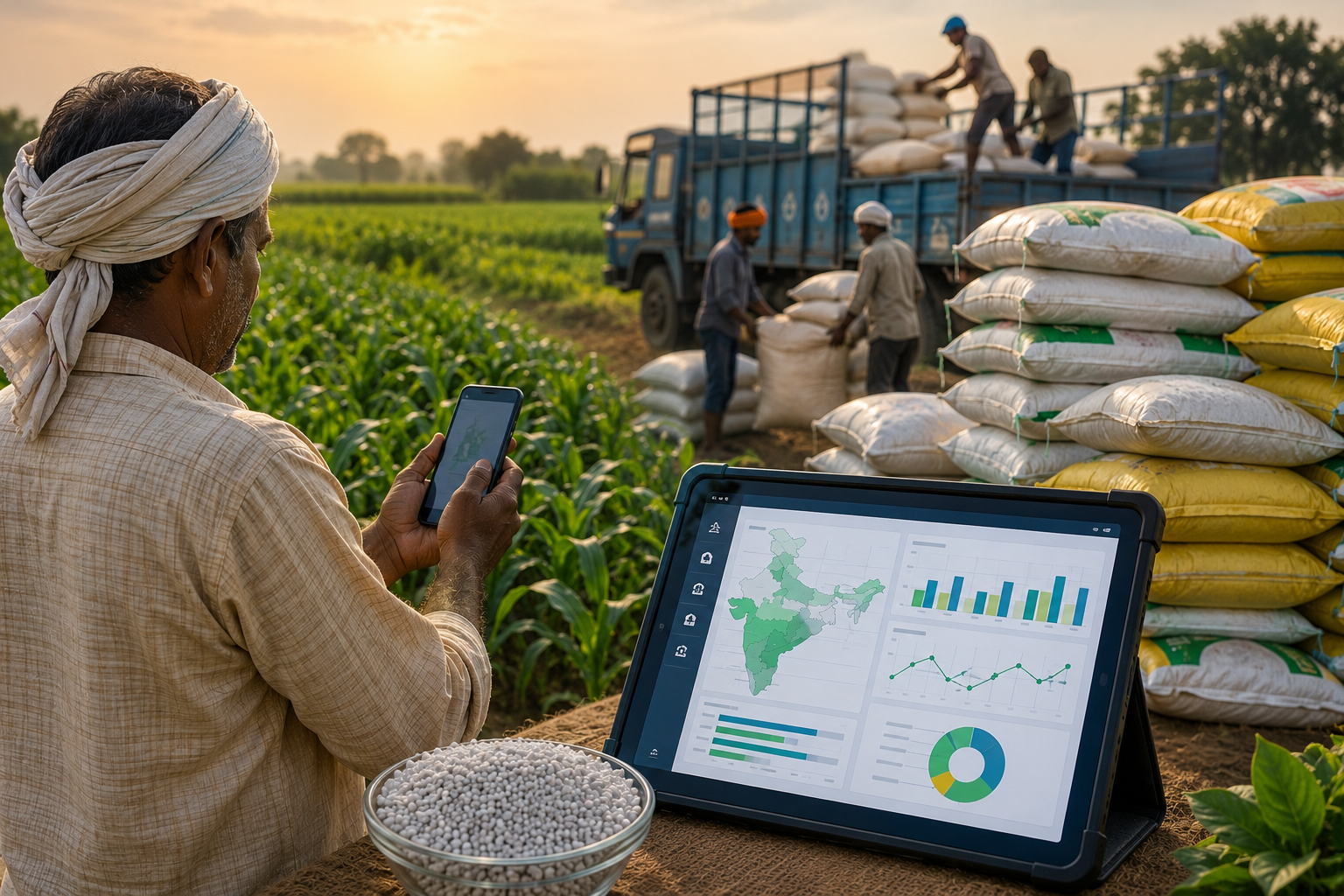
Centre Links Fertiliser Supply Chain With iFMS and AgriStack
The Fertiliser Ministry has rolled out a new real-time analytical tool and national-to-retail dashboard to monitor fertiliser dispatches, movement and inventories across the country, in an effort to prevent localised shortages and ensure timely availability to farmers.
The system is designed to identify emerging shortages, unusual buying patterns and possible leakages in the distribution network before they develop into larger supply disruptions.
Officials said the new monitoring mechanism is being reviewed at the highest level and will enable authorities to take corrective measures more quickly when stocks begin to fall in particular districts or retail markets.
The initiative comes at a time when fertiliser availability remains a critical issue for India's agricultural economy, particularly during periods of peak sowing and crop demand.
Real-Time Dashboard to Track Fertiliser From Dispatch to Retail
The new dashboard is intended to provide authorities with visibility across the fertiliser supply chain, starting from dispatches by manufacturers and importers and extending to distributors and retail outlets.
By tracking movement and inventories in real time, the government can identify locations where stocks are declining faster than expected.
Officials can then intervene by redirecting supplies, accelerating dispatches or examining unusual purchasing activity.
The system is expected to reduce the gap between identifying a shortage and taking corrective action, which can be particularly important during critical agricultural seasons.
iFMS Provides the Digital Infrastructure
The monitoring system is closely aligned with the government's Integrated Fertiliser Management System (iFMS), which serves as a major digital platform for fertiliser distribution and transactions.
More than 140 million Aadhaar-linked fertiliser buyers are connected to the system, while over 250,000 retail outlets process fertiliser sales.
Nearly 70 million tonnes of fertiliser transactions are handled through the digital network every year.
The scale of the database provides the government with a large pool of transaction-level information that can be used to understand consumption trends across regions.
₹3 Trillion Subsidy Network Gets Greater Visibility
The fertiliser distribution system is also linked to the government's large subsidy programme.
Around ₹3 trillion of annual fertiliser subsidies are processed through the broader digital framework.
Improving visibility over actual sales and consumption could help the government better manage this substantial expenditure.
The data can potentially help authorities identify where subsidised fertiliser is being consumed, whether purchases are concentrated in particular regions and whether demand is consistent with agricultural activity.
AgriStack Integration Could Improve Demand Forecasting
The Fertiliser Ministry's digital infrastructure has now been linked with the agriculture ministry's AgriStack databases.
AgriStack is intended to create a dynamic digital database of India's farmers and agricultural activity.
The integration of the two systems could eventually allow fertiliser purchases to be assessed against information such as land ownership, acreage and crop patterns.
This could help authorities build a more accurate picture of actual fertiliser requirements across individual states and districts.
Farmer IDs Could Become Central to Fertiliser Distribution
Digital Farmer IDs are an important component of the AgriStack programme.
According to the agriculture ministry's latest assessment, around 61 per cent of India's sown area was linked to a Farmer ID as of August 15, 2026.
However, adoption remains uneven across the country.
States including Bihar, Jharkhand, Punjab, Haryana, Assam, Kerala, Odisha and West Bengal had less than one-third of their sown area linked to a Farmer ID, according to the assessment.
Expanding Farmer ID coverage will therefore be important for creating a comprehensive digital picture of fertiliser demand.
Fertiliser Purchases Could Be Matched With Land and Crops
Officials said linking Farmer IDs with fertiliser sales could allow purchases to be progressively verified against land ownership and crop patterns.
This would help authorities determine whether fertiliser purchases are broadly consistent with the agricultural requirements of a particular farmer.
For example, unusually high purchases relative to a farmer's registered acreage or crop profile could trigger additional scrutiny.
At the district level, the data could help identify areas where consumption is significantly higher than expected.
QR-Based Purchases Could Improve Transparency
The government is also looking at greater use of digital mechanisms for fertiliser purchases.
Under the proposed approach, farmers could book required quantities through mobile applications, generating QR codes that can be validated at point-of-sale devices.
Such a system could provide an additional layer of traceability between the farmer, retailer and fertiliser transaction.
It could also help reduce multiple or irregular purchases and make distribution more transparent.
Focus on Preventing Localised Shortages
One of the immediate objectives of the new system is to prevent a situation in which national stocks are adequate but individual districts face shortages.
Fertiliser demand can vary significantly depending on crop cycles, rainfall, sowing patterns and regional agricultural conditions.
A shortage in one district can therefore develop quickly even when overall national inventory levels appear comfortable.
The real-time dashboard could allow the Centre and states to identify these localised imbalances earlier.
Urea Consumption Reaches Record Levels
Urea remains at the centre of the government's fertiliser-management challenge.
India's urea consumption crossed 40 million tonnes in FY26, reaching a record level.
Higher consumption can reflect genuine agricultural demand, but policymakers have also raised concerns about inefficient usage, diversion and leakages in the distribution system.
The government is therefore seeking to improve the quality of consumption data before making future supply and subsidy decisions.
35% of Farmers Account for Maximum Urea Usage
An official assessment found that around 65 per cent of farmers purchased five to seven bags of urea annually during 2024-25, a level considered broadly reasonable.
The remaining 35 per cent accounted for the maximum load of urea consumption.
This concentration has prompted authorities to examine the reasons behind unusually high purchases.
The new digital monitoring system could help determine whether higher consumption reflects crop requirements, regional agricultural patterns or other factors.
163 Districts Identified as High-Usage Areas
The government has identified around 163 of the country's 730 districts as areas with high fertiliser usage.
These districts are likely to be important areas for data-based monitoring.
Combining sales information with Farmer IDs, land records and crop data could help authorities identify the underlying reasons for high consumption.
The information could also support more targeted distribution and help authorities anticipate demand before shortages emerge.
Fertiliser Subsidy Continues to Put Pressure on Government Finances
The rising cost of fertiliser subsidies is another reason behind the push for better monitoring.
In FY26, India's fertiliser subsidy exceeded the original Budget allocation of ₹1.67 trillion by nearly 11 per cent, reaching around ₹1.86 trillion.
Officials expect actual expenditure for the year to be above ₹2 trillion.
Higher fertiliser sales and rising international prices contributed to the increase.
The government's ability to control leakages and improve consumption efficiency could therefore have a meaningful impact on the fiscal burden.
FY27 Subsidy Could Also Exceed Budget Estimate
For FY27, the Centre has budgeted approximately ₹1.70 trillion for fertiliser subsidies.
Officials expect the Revised Estimate could be significantly higher.
The continuing geopolitical uncertainty in West Asia, global energy prices and fluctuations in international fertiliser prices could raise the cost of imports and production.
At the same time, strong domestic consumption could increase the subsidy requirement further.
West Asia Conflict Adds to Fertiliser Cost Risks
India imports significant quantities of fertiliser products and raw materials.
Global energy prices have a direct and indirect impact on fertiliser manufacturing costs, particularly for nitrogen-based products.
Any prolonged disruption in energy markets or shipping routes could therefore increase procurement costs.
The government may have to balance maintaining adequate fertiliser supplies with managing the resulting fiscal burden.
Better Data Could Reduce Unnecessary Subsidy Leakage
A major benefit of the digital system could be improved targeting of government subsidies.
If authorities can accurately identify who is purchasing fertiliser, how much is being purchased and where it is being consumed, they can better distinguish genuine agricultural demand from potentially abnormal transactions.
This could make subsidy spending more efficient without necessarily reducing support available to genuine farmers.
States Will Play a Critical Role
The effectiveness of the system will depend heavily on state-level participation.
Farmer registration, land records and crop information are maintained through different state-level systems, while fertiliser distribution involves coordination between central and state authorities.
States with lower Farmer ID coverage will need to accelerate digitisation for the full benefits of the integrated system to emerge.
The Haryana model, where the fertiliser platform has already been integrated with the Meri Fasal Mera Byora database, could provide a framework for similar integration elsewhere.
Manufacturers and Distributors Could Benefit From Better Visibility
The new system could also improve planning for fertiliser manufacturers, importers and distributors.
More accurate demand information can help companies determine where and when supplies need to be positioned.
This could reduce unnecessary inventory accumulation in low-demand locations while ensuring adequate supplies reach areas where demand is rising.
For distributors and retailers, improved inventory visibility could also make replenishment more predictable.
Technology Could Reduce Farmer Queues
For farmers, the most visible benefit could be improved availability at retail outlets.
Shortages often result in long queues and uncertainty over when fresh supplies will arrive.
If authorities can detect declining inventories earlier and redirect supplies before retail stocks are exhausted, such disruptions could potentially be reduced.
Digital booking and QR-based verification could further streamline the purchasing process.
Digital Monitoring Could Improve Agricultural Planning
The data generated through the system could eventually be used for broader agricultural planning.
Authorities could analyse fertiliser consumption alongside crop patterns, rainfall, acreage and historical demand.
This could help identify changes in agricultural practices and improve future estimates of fertiliser requirements.
Over time, a stronger data ecosystem could also support more efficient planning of imports, domestic production and subsidy requirements.
Implementation Remains the Key Challenge
Despite the potential benefits, the effectiveness of the system will depend on the quality and completeness of the underlying data.
Farmer ID coverage remains incomplete in several states, while land and crop databases may differ in structure and accuracy.
Ensuring that retail transactions are properly recorded and consistently linked with farmer information will also be important.
The government will therefore need continued coordination with states, retailers, manufacturers and farmers to make the system effective at scale.
Potential Impact on India's Fertiliser Sector
The move represents a significant shift towards data-driven management of India's fertiliser supply chain.
For fertiliser manufacturers, demand visibility could improve production and distribution planning.
For the government, better transaction monitoring could improve subsidy management.
For farmers, timely supply and reduced queues could improve access to essential agricultural inputs.
The long-term impact will depend on how effectively the digital platforms are integrated and how quickly Farmer ID coverage expands.
Market Outlook
The Centre's real-time fertiliser monitoring initiative is expected to improve supply visibility, inventory management and subsidy efficiency across India's agricultural input chain. The integration of iFMS with AgriStack and state-level farmer databases could provide the government with a more accurate picture of fertiliser demand and help reduce localised shortages and distribution leakages.
For the fertiliser sector, the operating environment will continue to depend on domestic consumption, government subsidy policy, global fertiliser prices, energy costs and import availability. Companies with strong distribution networks and efficient production capabilities could benefit from more predictable demand, while elevated international prices could continue to create cost pressure. The key factors to watch will be the expansion of Farmer ID coverage, digital purchase verification, fertiliser inventory levels and the FY27 subsidy revision.