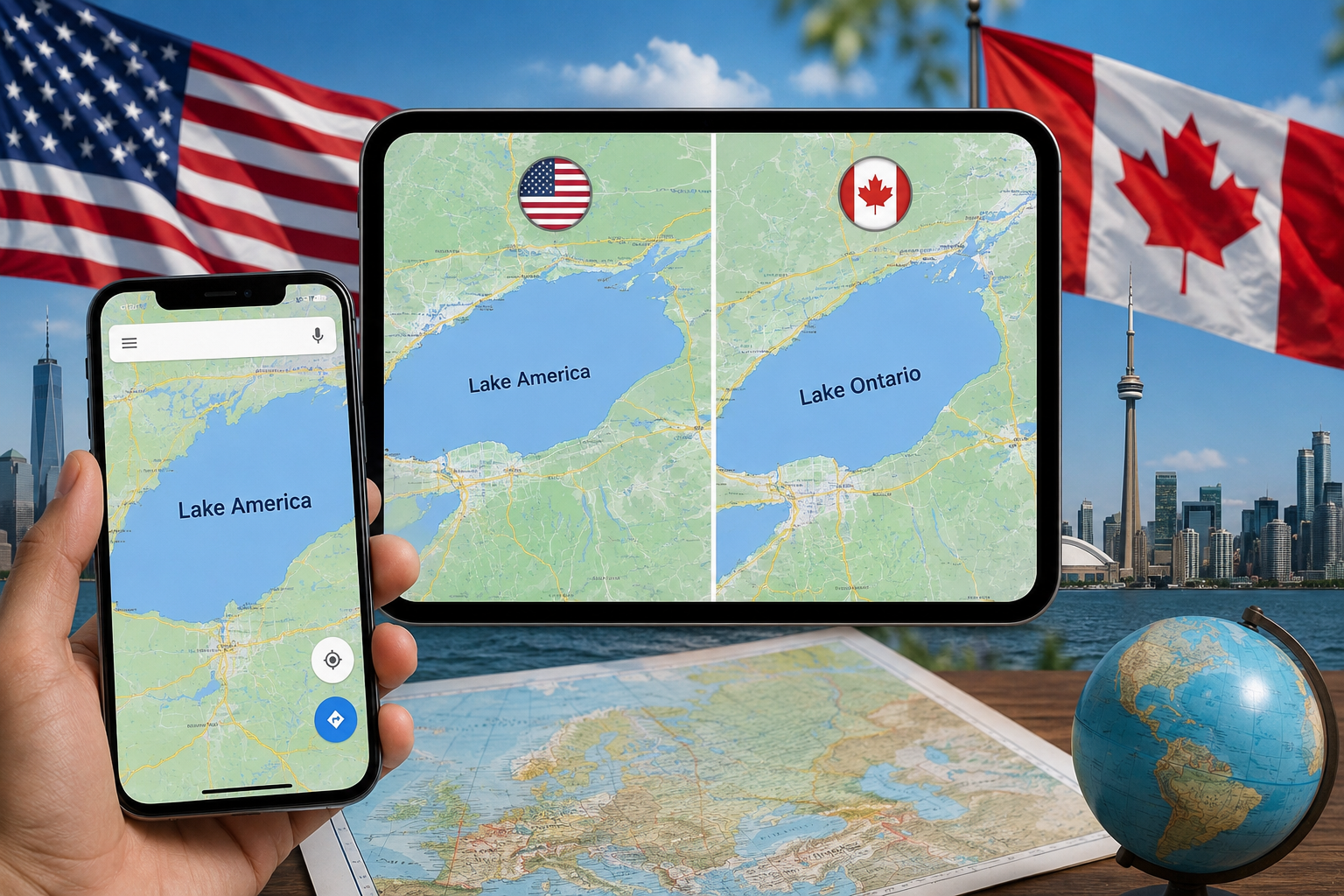
Google Maps Adopts New US Government Name, While Canada Retains Lake Ontario
Google Maps has begun displaying Lake Ontario as “Lake America” for users in the United States, following the formal adoption of the new name by the US Geographic Names Information System (GNIS).
The change follows an executive order issued by US President Donald Trump directing federal agencies to update official maps and databases to use the name “Lake America”.
Google said its mapping service reflects geographic names used by official government sources in the relevant jurisdiction. As a result, users accessing Google Maps from the US will see “Lake America”, while users in Canada will continue to see Lake Ontario.
For users outside the United States and Canada, Google is expected to display both names, with “Lake America” appearing in parentheses after “Lake Ontario”.
Why Google Maps Changed Lake Ontario's Name
Google said the update is consistent with its long-standing policy for bodies of water and geographic features whose names differ across countries.
The company relies on official government geographic databases when determining how certain locations should be labelled.
Since the US Geographic Names Information System has formally adopted “Lake America” for use within the United States, Google Maps has incorporated the designation for users in that country.
The change does not alter the physical location, boundaries or geographical characteristics of the lake.
Canada Continues to Call It Lake Ontario
Canada has not adopted the new name.
The body of water continues to be known as Lake Ontario in Canada, where it is an important geographic and economic landmark.
Lake Ontario is shared by Canada and the United States and forms part of the Great Lakes system.
The difference in naming has therefore created a situation in which the same international body of water is displayed under different names depending on the user's location.
Ontario Premier Doug Ford Rejects the Renaming
Ontario Premier Doug Ford has publicly rejected the US government's decision.
Ford unveiled a large billboard-style sign along the Canadian shoreline carrying the message “Lake Ontario. Now and Always” in both English and French.
The display was presented as a symbolic response to the American decision.
Ford said the lake would continue to be called Lake Ontario in Canada and argued that the traditional name would outlast the current political disagreement.
Canadian Government Highlights Historical Significance
Canadian Prime Minister Mark Carney has also pushed back against the renaming.
Carney pointed to the Indigenous origins of the name Ontario and its longstanding historical significance.
The name is associated with the Wendat language and has commonly been interpreted as referring to a “beautiful lake” or “big lake.”
Canadian officials have emphasised that the name has existed for centuries and predates the formation of modern Canada and the United States.
Indigenous Leaders Raise Cultural Concerns
The dispute has also prompted criticism from Indigenous representatives.
Wendat Nation Grand Chief Pierre Picard criticised the renaming and highlighted the importance of preserving the historical and cultural origins of the name.
The controversy has consequently expanded beyond a disagreement between two governments and into a wider debate over Indigenous heritage, historical identity and geographic naming.
New York Officials Also Question the Change
The renaming has not received unanimous support within the United States.
New York Governor Kathy Hochul, whose state borders Lake Ontario, has indicated opposition to adopting the new terminology.
The position demonstrates that the federal government's decision does not necessarily mean that every state, local government or organisation will immediately change the name in everyday usage.
Other Mapping Services Retain Lake Ontario
Google Maps is currently taking a different approach from some competing digital mapping platforms.
Apple Maps and Waze continued to identify the body of water as Lake Ontario, according to reports.
MapQuest has also indicated that it does not intend to change the traditional name.
This means users could see different names for the same lake depending on the mapping platform they use.
Lake Ontario's Geographic Importance
Lake Ontario is the smallest of the five Great Lakes by surface area, but it has significant economic and geographic importance.
The lake borders the Canadian province of Ontario and the US state of New York.
It is connected to Lake Erie through the Niagara River and forms part of the Great Lakes-St. Lawrence waterway system.
The region surrounding the lake supports major population centres, industrial activity, shipping, tourism and recreational industries.
Shared Waterway Requires Cross-Border Cooperation
The lake's importance extends beyond its name.
Canada and the United States cooperate on issues involving shared waterways, including water levels, navigation, environmental management and infrastructure.
The Boundary Waters Treaty provides a framework for addressing disputes concerning shared waters between the two countries.
While the US government can determine how its own federal agencies label the lake, it cannot compel Canada to adopt the same terminology.
The Name Difference Could Affect Digital Searches
The divergence could increasingly become visible in online searches and digital services.
A person searching for “Lake America” in the United States could receive results referring to the same geographic feature that Canadians continue to identify as Lake Ontario.
This could create minor complications for international travel, tourism, logistics, academic research and cross-border communication.
Digital platforms may also need to account for both names when presenting location information to global audiences.
Google Uses Location-Based Naming
Google's approach means that geographic terminology can vary according to the user's location.
This is particularly relevant for disputed or internationally shared geographic features.
Instead of forcing a single global name, mapping services can reflect the terminology recognised by local authorities.
In the case of Lake Ontario, this results in different labels for users in the United States and Canada.
Trump Previously Changed Gulf of Mexico Terminology
The latest decision follows another high-profile geographic naming change by the Trump administration.
The administration previously directed US agencies to use the name “Gulf of America” instead of Gulf of Mexico in federal usage within the United States.
Google Maps subsequently reflected the terminology for US-based users while maintaining different naming conventions elsewhere.
The Lake Ontario decision follows a similar model.
US-Canada Relations Add Political Context
The renaming comes at a time when relations between Washington and Ottawa have been strained by disagreements over trade and tariffs.
The two countries have been involved in a broader economic dispute, with the US imposing tariffs on Canadian goods and Canada responding with retaliatory measures.
The geographic naming issue has therefore taken on additional symbolic importance.
What might ordinarily have remained an administrative decision has instead become part of a wider political dispute.
Trade Tensions Remain More Economically Significant
While the renaming has generated considerable political attention, its direct economic impact is limited.
For investors and businesses, the more important issue remains the broader US-Canada trade relationship.
Tariffs and retaliatory measures can affect manufacturing costs, agricultural exports, industrial supply chains and cross-border commerce.
Companies operating across the US-Canada border will therefore continue to focus primarily on trade policy rather than the change in geographic terminology.
Potential Impact on Tourism
Lake Ontario is an important tourism destination for communities on both sides of the border.
Boating, fishing, waterfront tourism, hospitality and recreational activities contribute to local economies.
The different naming conventions could appear in online maps, promotional material and travel searches.
However, the physical destination remains unchanged and businesses in Canada are expected to continue using Lake Ontario.
Shipping and Logistics Remain Unaffected
The naming change does not alter the lake's physical boundaries or shipping routes.
Commercial vessels will continue operating under existing navigation and international regulatory frameworks.
Ports, shipping companies and logistics operators are unlikely to change operational procedures simply because the US government has adopted a different name.
The practical significance for maritime trade is therefore expected to remain limited.
Geographic Naming Becomes a Digital-Era Issue
The controversy illustrates how geographic naming decisions have become more visible in the digital age.
In the past, a government could update an official map without the change immediately reaching millions of consumers.
Today, mapping platforms can incorporate such changes rapidly, putting government terminology directly into navigation applications used worldwide.
This gives technology companies an increasingly important role in how geographic disputes are presented to the public.
Different Names Can Coexist
There is no requirement for every country or mapping platform to use identical terminology for a geographic feature.
National governments can establish names for their own official purposes, while international organisations and neighbouring countries can continue using established terminology.
The Lake Ontario dispute is therefore likely to result in parallel naming conventions rather than an immediate global replacement of the traditional name.
What Users Currently See
The naming approach can broadly be summarised as follows:
-
Google Maps users in the US: Lake America
-
Google Maps users in Canada: Lake Ontario
-
Google Maps users outside the US and Canada: Lake Ontario, with Lake America also displayed
-
Some competing mapping services: Lake Ontario
-
Canadian government and officials: Lake Ontario
The geographic feature itself remains unchanged.
Could the Dispute Escalate Further?
The naming dispute is unlikely by itself to produce major economic consequences.
However, its significance could increase if it becomes part of a wider deterioration in US-Canada relations.
Further tariff measures, trade restrictions or diplomatic disputes could have considerably greater consequences for companies and financial markets.
Investors will therefore be more focused on whether the political disagreement translates into additional economic action.
Implications for Investors
From an investment perspective, the direct impact of the Lake Ontario naming change is expected to be minimal.
The areas that could matter more for markets include:
-
US-Canada tariff policy
-
Cross-border trade volumes
-
Agricultural exports
-
Automotive supply chains
-
Industrial manufacturing
-
Energy trade
-
Currency movements
-
Consumer and business confidence
-
Diplomatic relations between Washington and Ottawa
Any significant escalation in trade restrictions could have broader implications for affected companies and sectors.
Broader Diplomatic Significance
The controversy demonstrates how symbolic political decisions can become intertwined with economic and diplomatic relationships.
The United States and Canada have extensive trade, investment and cultural ties, making stability in their bilateral relationship important for businesses operating across North America.
The disagreement over the lake's name is unlikely to change those underlying economic relationships, but it reflects the increasingly confrontational tone of the broader political environment.
Market Outlook
The renaming of Lake Ontario as “Lake America” for US Google Maps users is unlikely to have a direct impact on financial markets. The more important consideration for investors is the broader US-Canada relationship, particularly ongoing tariff disputes and their potential impact on cross-border trade, manufacturing and supply chains. Unless the naming dispute develops into additional economic or diplomatic measures, its market impact should remain limited. Investors should instead monitor developments in US-Canada trade policy, tariff negotiations, currency movements and sectors with significant exposure to North American cross-border commerce.