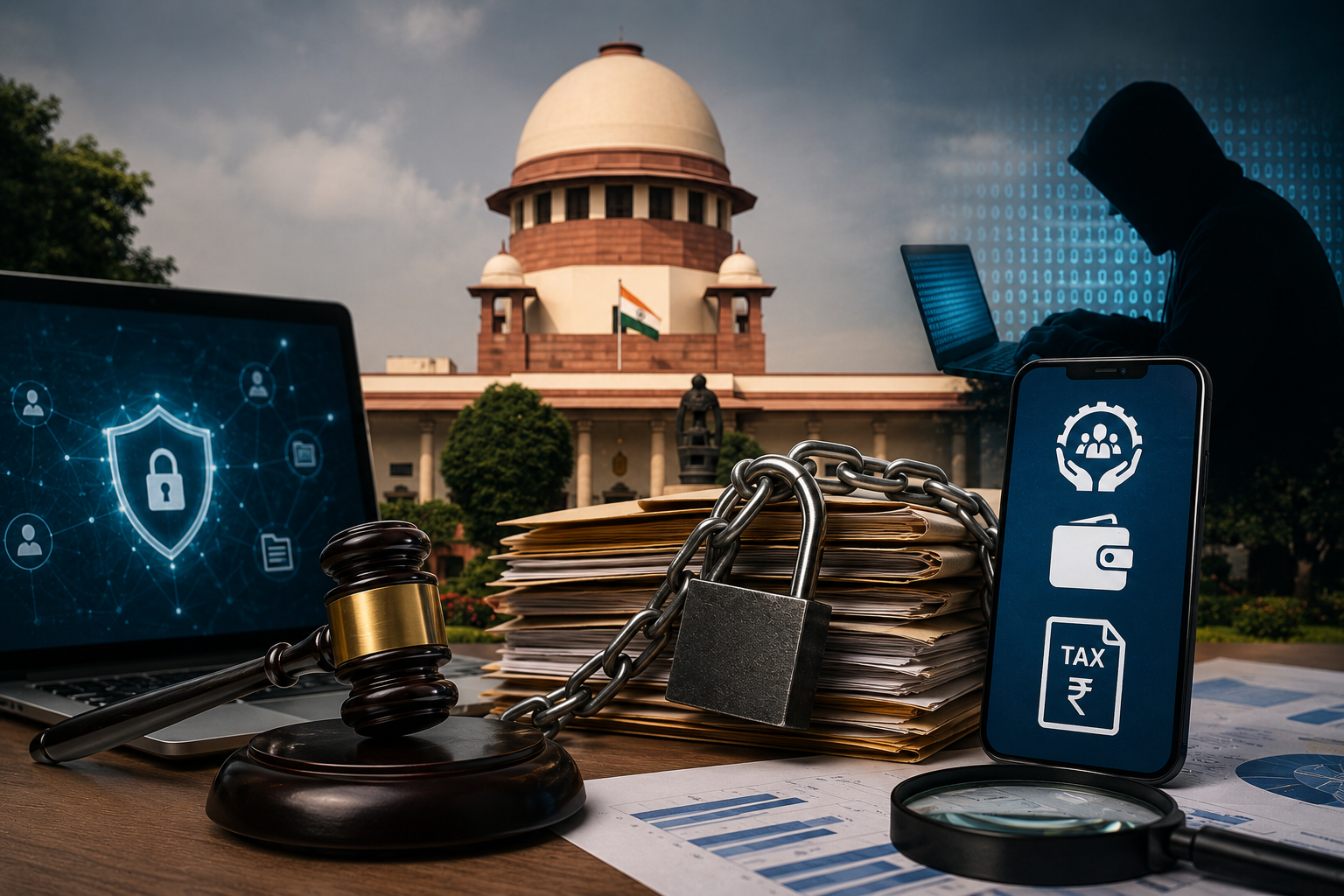
The Supreme Court has raised concerns over the alleged access of sensitive employment and income-tax information by private entities, highlighting the need for stronger consent, authentication and data-protection mechanisms.
The Supreme Court has expressed concern over the alleged ability of private technology and verification platforms to access sensitive information linked to Employees’ Provident Fund Organisation (EPFO) and Income Tax records.
A bench comprising Chief Justice Surya Kant and Justices Joymalya Bagchi and V Mohana described private access to such information as “worrisome” and asked the Centre to consider developing an effective mechanism to prevent misuse of personal data.
The observations were made while the court declined to entertain a public interest litigation (PIL) filed by Piyush Sharma. Although the bench did not take up the PIL, it indicated that the concerns raised involve important policy and data-governance issues that warrant examination by the government.
Supreme Court Seeks Government Action
The bench suggested that the Centre could examine the issue with the assistance of domain experts and formulate appropriate safeguards.
The court's concern centres on the possibility that information submitted by individuals to government authorities under statutory requirements could subsequently become accessible to private entities for commercial purposes.
The issue is particularly significant because government-linked databases contain information that can reveal detailed aspects of an individual's employment and financial history.
The court therefore asked the government to take necessary steps to prevent private enterprises from misusing individual data.
What the PIL Alleged
According to the petitioner, a growing commercial technology ecosystem appears to be using information corresponding to statutory employment and financial records for verification and profiling purposes.
The petitioner alleged that such systems could potentially be used for:
-
Employment and background verification
-
Detection of alleged moonlighting or dual employment
-
Labour-market profiling
-
Employee screening
-
Employment-related decision-making
The petitioner's concerns were not limited to a conventional data breach.
Instead, the PIL questioned whether private entities can obtain information corresponding to government-held records without adequate consent and authorisation from the individual concerned.
PAN and UAN Access Under Scrutiny
During the hearing, the petitioner claimed that his own inquiry suggested that providing PAN and UAN details through a private verification workflow could lead to retrieval of employment-related information.
The petitioner further alleged that the process did not require an OTP, explicit consent or a clearly visible authorisation-based identity verification mechanism.
These allegations have raised questions over whether sensitive government-linked information can be retrieved using relatively limited identifiers.
However, the allegations made in the PIL should not be treated as a finding that government databases have been breached. The petitioner specifically did not allege that government agencies had suffered a data leak.
The concern instead relates to how information may be accessed, verified and commercially processed through private technology systems.
Why EPFO Information Is Sensitive
EPFO-related information can potentially provide a detailed picture of an individual's formal employment history.
Employment records may reveal previous employers, periods of employment and changes in employment status. Such information can have legitimate uses in background verification, but unrestricted access could also create privacy risks.
The issue becomes more sensitive when such information is used to make decisions about recruitment or continued employment.
A verification platform that confirms a particular employment claim serves a different purpose from a system that creates a detailed employment profile of an individual.
Income-Tax Information Raises Larger Privacy Concerns
Income-tax records are even more sensitive because they can contain information relating to an individual's financial affairs and tax obligations.
Any unauthorised access, excessive processing or inappropriate commercial use of such information could potentially expose individuals to financial, reputational and privacy risks.
The Supreme Court's intervention therefore brings renewed attention to the principle that sensitive information collected for statutory purposes should not automatically become available for unrelated commercial activities.
Consent Could Become a Key Safeguard
One of the biggest issues emerging from the controversy is whether individuals are adequately informed when their information is accessed.
A strong consent framework would ideally allow an individual to understand:
-
What information is being requested
-
Which entity is requesting it
-
Why the information is required
-
Whether access is mandatory or optional
-
How long the information will be retained
-
Whether the information will be shared with third parties
-
How an individual can challenge inaccurate information
For sensitive employment and financial records, merely agreeing to a broad verification process may not provide sufficient transparency.
Authentication May Need Strengthening
The alleged ability to retrieve information using basic identifiers has also raised questions about authentication.
PAN and UAN numbers are important identifiers, but the mere possession of such information should not necessarily be treated as proof that an individual has authorised access to all information associated with those identifiers.
Additional authentication layers could help establish that the individual is aware of the request and has approved access.
Such systems would also need to maintain detailed audit trails so that unauthorised access can be identified and investigated.
The Moonlighting Verification Challenge
The controversy comes at a time when employers are increasingly using technology to verify employment histories and identify potential dual employment.
Digital employment verification can help organisations detect inconsistencies in resumes and declarations. However, government-linked employment information could provide significantly more information than is necessary for a specific verification exercise.
For example, confirming whether a person worked for a particular organisation during a specified period may require limited information. Access to a complete employment history could go beyond what is necessary for that purpose.
This raises the broader principle of data minimisation — collecting and processing only the information genuinely required for a particular purpose.
Risk of Automated Employment Decisions
Another concern is how data retrieved through such platforms could be used.
If employment records are fed into automated screening systems, individuals could potentially be flagged based on apparent inconsistencies or overlapping records.
But employment data may require context.
An overlap could arise because of notice periods, delayed statutory updates, contractual arrangements or administrative errors. Treating every apparent discrepancy as evidence of wrongdoing could therefore produce incorrect outcomes.
Businesses using automated verification systems may consequently need mechanisms for human review and correction.
Accuracy of Government-Linked Data Matters
Data protection is not only about preventing unauthorised access.
The accuracy of information is equally important when that information is used to make consequential decisions.
An outdated or incorrect employment record could potentially affect a job applicant's prospects if it is treated as definitive evidence by a private verification platform.
Individuals therefore need meaningful ways to review and challenge information that is being used against them.
A transparent correction mechanism could become an important component of any future framework.
Private Verification Industry Faces Greater Scrutiny
The issue could have implications for companies operating in background verification, recruitment technology, financial data services and employee analytics.
Businesses in these sectors may increasingly be required to demonstrate that they have:
-
A legitimate purpose for processing sensitive information
-
Appropriate consent mechanisms
-
Strong authentication systems
-
Data-access logs
-
Retention and deletion policies
-
Controls over third-party sharing
-
Procedures for correcting inaccurate information
The objective would be to ensure that digital verification does not become synonymous with unrestricted access to personal information.
Government Faces a Difficult Balancing Act
The Centre will have to balance two competing objectives.
On one side, digital verification can make government services, recruitment and financial transactions faster and more efficient.
On the other, excessive access to interconnected government databases could create significant privacy and cybersecurity risks.
A regulatory framework that is too restrictive could reduce the efficiency of legitimate digital services, while inadequate safeguards could leave individuals exposed to unauthorised profiling and commercial exploitation.
The challenge will therefore be to establish clear rules around purpose, consent, access and accountability.
Broader Implications for India's Digital Economy
The Supreme Court's observations come at a time when India is rapidly expanding its digital public infrastructure.
As government databases become increasingly interconnected and digital identity becomes more widely used, the economic value of personal information is also increasing.
Employment history, tax information and financial records can provide valuable insights for businesses. But the fact that information is technologically accessible does not necessarily mean that it should be commercially accessible without appropriate safeguards.
The distinction between digital availability and lawful, authorised access could become increasingly important.
What Could Change Going Forward?
The government's response could potentially involve consultation with technology specialists, cybersecurity experts, privacy professionals and representatives of affected sectors.
Possible safeguards could include stronger authentication requirements, explicit consent mechanisms, purpose-based access controls, detailed audit trails and penalties for misuse.
The framework could also establish clearer rules governing how long sensitive information may be retained and whether it can be transferred to other companies.
For individuals, greater transparency could eventually mean knowing when their government-linked information is being accessed and why.
A Larger Question About Data Ownership and Control
The Supreme Court's intervention ultimately raises a fundamental question about control over personal information.
Citizens often provide employment and financial information to government authorities because the law requires them to do so. That creates a strong expectation that such information will be protected and used only for legitimate purposes.
As private technology ecosystems increasingly connect with public databases, the boundary between government-held information and commercially processed information is becoming more important.
The Supreme Court's concerns could therefore trigger a wider policy discussion on how India protects sensitive personal information while continuing to build a digital economy.