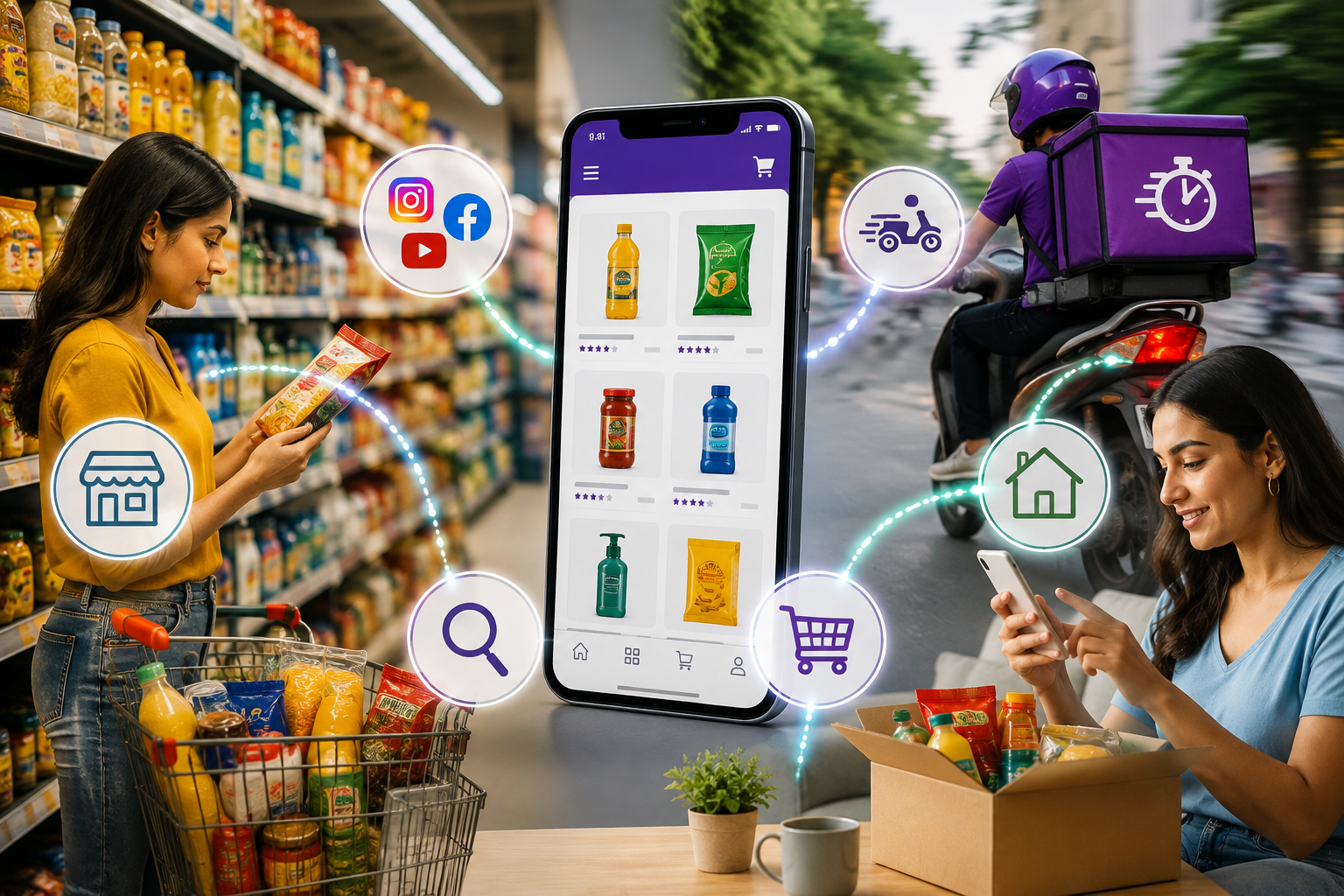
Consumer journeys are becoming increasingly fragmented as social media, quick commerce, marketplaces and physical stores compete for attention
The Indian fast-moving consumer goods (FMCG) industry is undergoing a structural shift in the way brands attract consumers, drive purchases and build long-term relationships.
For decades, FMCG companies relied on a familiar growth formula: mass advertising, extensive distribution, attractive shelf placement and promotional offers. The objective was simple — ensure that consumers noticed a product when they entered a store and make it easy for them to buy it.
That model is now being challenged by the rapid expansion of quick commerce, ecommerce marketplaces, social media, digital search and brand-owned applications.
Consumers increasingly move between online and offline channels depending on their requirements. A product may be discovered through a social media video, researched on Google, compared on a marketplace, purchased through a quick-commerce application and subsequently replenished at a neighbourhood store.
For FMCG companies, this means that physical shelf space is no longer the only battleground for consumer attention. The digital shelf is becoming equally important.
Consumer behaviour is becoming omnichannel
According to NielsenIQ (NIQ), nearly nine in 10 households purchase FMCG products across multiple channels.
The shift reflects a broader change in shopping behaviour. Consumers are increasingly choosing channels according to the nature of the purchase rather than remaining loyal to one format.
Grant Thornton Bharat research cited in the report found that 45 per cent of consumers use quick commerce for emergencies, last-minute requirements or daily top-ups, while 19 per cent use it for impulse purchases and snacking.
More than 70 per cent of consumers surveyed said they would continue using quick commerce even if discounts were reduced.
This indicates that convenience and speed are becoming independent drivers of consumption, rather than merely serving as alternatives to lower prices.
The digital shelf is becoming a new competitive battlefield
In traditional retail, brands compete for eye-level shelf positions, attractive displays and retailer recommendations.
On digital platforms, the equivalent battle takes place through search rankings, sponsored listings, product images, customer reviews, pricing, availability and recommendations generated by the platform.
A product can be physically available in a warehouse but effectively invisible to consumers if it does not appear prominently when they search.
This is forcing FMCG companies to rethink digital merchandising.
Brands now have to consider not only whether their products are available online, but also how easily consumers can discover them and how compelling the digital presentation is.
Quick commerce moves from fulfilment to discovery
Quick-commerce platforms were initially built around one core proposition: rapid delivery.
Their role in FMCG is now expanding.
Consumers increasingly browse quick-commerce applications much like digital stores. They search for categories, compare products and discover new brands while looking for something else.
NIQ's March report indicated that quick commerce accounts for more than three-fourths of ecommerce FMCG sales in India.
Redseer estimates India's quick-commerce GMV at approximately $11.5 billion in 2025, with the market projected to reach around $25 billion in 2026.
The expansion is encouraging FMCG companies to develop products specifically suited to quick-commerce consumption patterns.
Channel-specific products gain importance
A product designed for traditional retail may not necessarily be the ideal product for quick commerce.
Companies are increasingly examining pack sizes, price points and product formats according to the channel.
For example, smaller packs can appeal to impulse buyers, while premium or specialised products can benefit from the discovery-oriented nature of digital platforms.
This is leading to greater experimentation with channel-specific assortments and pack-price architecture.
The objective is to ensure that the product, price and packaging match the reason why consumers are using a particular channel.
Is digital commerce creating new demand?
The expansion of distribution channels also presents a major challenge for FMCG companies.
Adding a new channel does not automatically mean adding new consumption.
A consumer who previously purchased a packet of snacks from a supermarket may now buy the same packet through a quick-commerce platform.
For the FMCG company, the sales channel has changed, but the underlying demand may not have increased.
At the same time, digital platforms can create genuinely incremental demand by introducing consumers to new brands, encouraging impulse purchases and increasing purchasing frequency.
The challenge for companies is therefore to determine whether a channel is generating incremental sales or simply shifting existing sales.
Marketing costs are becoming more complex
An omnichannel strategy can also increase the cost of reaching consumers.
Brands may need to spend separately on traditional advertising, social media campaigns, ecommerce promotions, quick-commerce visibility, retail media and in-store activation.
Platform commissions and promotional expenses can further affect margins.
This makes return on investment more difficult to measure.
A consumer may see a social media advertisement, search for the product online and eventually buy it from a physical retailer. Assigning the entire sale to one channel could therefore provide a misleading picture of marketing effectiveness.
FMCG companies increasingly need attribution models that account for the entire consumer journey.
Social media becomes a discovery engine
Social media is playing an increasingly important role in the early stages of product discovery.
Short-form videos, influencers, product demonstrations, user reviews and creator-led recommendations can introduce consumers to products before they actively search for them.
This is particularly relevant for new-age brands and premium categories where visual presentation and consumer engagement can influence purchasing decisions.
The challenge is to convert attention into transactions.
A viral campaign may generate millions of views but have limited commercial impact if the product is unavailable, difficult to find or priced incorrectly.
Consequently, FMCG brands are increasingly trying to connect content, discovery, availability and purchase into a single consumer journey.
Physical retail remains an important part of the ecosystem
Despite the growth of digital commerce, physical stores continue to play a crucial role in FMCG.
For several categories, consumers still value the ability to see products, compare them physically and purchase them immediately.
Fresh and gourmet products can particularly benefit from physical retail because product quality, presentation and trust can influence the purchase decision.
Physical stores can also increasingly function as local fulfilment centres for online orders.
This creates a hybrid model in which the store is no longer merely a place where consumers make purchases. It can also become part of the company's digital delivery network.
Brand-owned apps offer greater control
Marketplaces and quick-commerce platforms provide scale, but they also control much of the consumer interface.
Brand-owned websites and apps can give companies greater control over customer relationships.
These platforms can be used for:
-
Personalised recommendations
-
Loyalty programmes
-
Exclusive products
-
Customer feedback
-
Subscription models
-
Direct communication
-
Repeat purchases
For companies with strong consumer brands, owning the digital relationship can become an important strategic advantage.
Data is becoming central to FMCG decision-making
The rise of multiple channels is generating large amounts of consumer data.
Companies can increasingly analyse search behaviour, purchasing frequency, product preferences, geographical demand and promotional response.
The key opportunity is to use this information to answer questions such as:
Which consumers are discovering the brand online?
Which channels generate the highest repeat purchases?
Which promotions create genuine incremental demand?
Which products work better on quick commerce than traditional retail?
Where is digital demand not being converted because of poor availability?
These insights can influence everything from product development to inventory planning.
Emerging brands get a larger digital opportunity
Digital-first commerce is also lowering some of the traditional barriers faced by smaller FMCG brands.
Historically, building a national consumer brand required extensive distributor networks, retailer relationships and large advertising budgets.
Digital platforms can provide smaller brands with access to consumers without requiring immediate nationwide physical distribution.
However, the competition for digital visibility is becoming intense.
New brands must compete for search rankings, advertising space, consumer reviews and platform recommendations alongside established FMCG companies.
Therefore, digital access does not eliminate the need for strong brands — it changes how those brands are built.
Convenience is becoming part of the product proposition
The growing popularity of quick commerce also suggests that convenience itself is becoming part of the value proposition.
Consumers are increasingly willing to pay for immediacy when the product is required urgently or when convenience saves time.
For FMCG companies, this can influence product assortment and pricing.
A brand that understands the reason behind a purchase — emergency replenishment, impulse consumption, planned shopping or premium discovery — can potentially design a more effective channel strategy.
The new FMCG growth model
The Indian FMCG industry is moving towards a model where distribution, discovery and consumer engagement operate together.
The new consumer journey increasingly looks like:
Social media → Digital discovery → Search and comparison → Quick commerce/ecommerce → Physical retail → Repeat purchase
Not every consumer will follow this exact path, but the increasing overlap between channels is changing how companies need to think about growth.
The traditional question was: “How much shelf space can we secure?”
The emerging question is broader: “How many opportunities do we have to be discovered, considered, purchased and remembered?”
For FMCG companies, the next phase of competition is therefore likely to revolve not only around distribution reach, but also around digital visibility, convenience, product relevance, data-driven decision-making and the ability to convert discovery into repeat consumption.