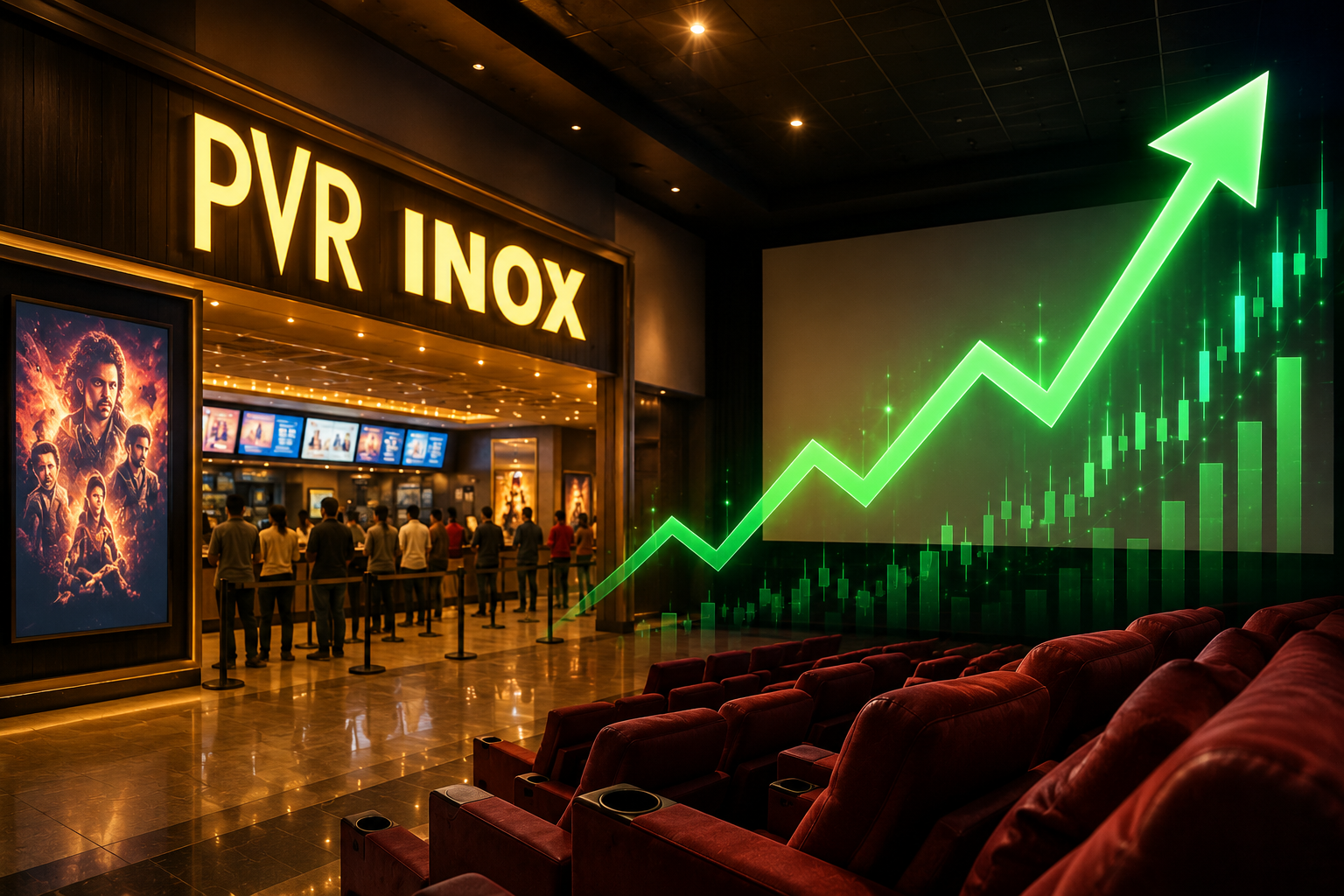
PVR Inox shares climbed nearly 4 per cent to hit a fresh 52-week high after the multiplex operator announced that its board will consider a proposal to buy back the company’s equity shares.
PVR Inox Shares Hit Fresh 52-Week High
Shares of PVR Inox Ltd gained nearly 4 per cent in intra-day trading after the company announced that its board of directors would consider a share buyback proposal.
The stock touched a fresh 52-week high of ₹1,283, surpassing its previous high of ₹1,249 recorded on October 30, 2025.
The sharp movement came after the company informed the stock exchanges about the upcoming board meeting, where directors will consider a proposal to buy back equity shares.
The announcement comes at a time when PVR Inox shares have been witnessing a strong recovery from their 2026 lows.
Board to Consider Buyback on August 31
PVR Inox said its board of directors will meet on August 31 to consider and approve, among other matters, a proposal for the buyback of the company's equity shares.
The shares have a face value of ₹10 each.
The board will also consider matters related to the proposed transaction, including incidental and ancillary matters.
The company said the outcome of the meeting will be communicated to the stock exchanges after the conclusion of the meeting in accordance with applicable regulations.
Importantly, the announcement at this stage is a proposal for consideration by the board. Details such as the number of shares to be bought back, buyback price, total amount and method of buyback will become clearer once the board takes a decision.
What Is a Share Buyback?
A share buyback is a corporate action under which a company purchases its own shares from existing shareholders.
When shares bought back by the company are cancelled, the total number of outstanding shares declines.
If the company's earnings remain stable or grow after the reduction in share count, earnings attributable to each remaining share can potentially increase, resulting in higher earnings per share (EPS).
Buybacks can also provide shareholders with an opportunity to sell shares directly to the company, depending on the method and terms approved.
The financial impact of the PVR Inox buyback will therefore depend on the final size, price and structure of the transaction.
Stock Has Gained Around 20% in One Month
PVR Inox shares have delivered a strong recovery over the past month.
The stock has gained approximately 20 per cent in one month, significantly outperforming the broader market during the same period.
It has also recovered nearly 43 per cent from its 52-week low of ₹900.05, touched on March 2, 2026.
The latest rally has pushed the stock above its earlier 52-week high and brought renewed investor attention to the multiplex operator.
However, despite the recent recovery, the stock remains well below its lifetime high of ₹2,211.55, recorded in August 2022.
Long-Term Stock Performance Remains Weaker
The recent recovery needs to be viewed against PVR Inox's longer-term stock performance.
Over the past three years, the company's share price has declined around 29 per cent, while the BSE Sensex gained approximately 18.4 per cent during the same period.
The company has faced several challenges in rebuilding cinema occupancy and profitability following the disruption caused by the pandemic.
The recent improvement in theatrical collections, stronger movie content and cost-control measures have helped improve the operating environment.
The proposed buyback has now added another potential catalyst for the stock.
India's Box Office Collections Grow 20%
PVR Inox management highlighted a significant improvement in India's theatrical business during its June 2026 quarter earnings discussion.
According to the company, India's total box-office collections increased approximately 20 per cent year-on-year during the quarter.
The growth was broad-based across metropolitan markets as well as Tier 2 and Tier 3 cities.
A wider selection of successful films across languages and genres supported the improvement.
For multiplex operators, stronger box-office collections can translate into higher admissions, better screen utilisation and increased spending on food and beverages.
Content Pipeline Remains Crucial for Multiplex Business
The availability of quality movie content remains one of the most important factors influencing PVR Inox's performance.
The company expects the upcoming content calendar across Hindi, Hollywood and regional cinema to support footfalls.
The pipeline includes major Hindi releases such as King, Toxic and Ramayana: Part 1.
The Hollywood slate includes titles such as Avengers: Doomsday and Dune Part III.
A strong mix of large-scale releases and mid-sized films could provide greater consistency in theatrical footfalls across the year.
The company expects improving content availability to gradually support occupancy recovery towards pre-COVID levels.
Premiumisation Could Support Revenue Per Customer
PVR Inox is focusing not only on increasing footfalls but also on increasing revenue generated from each customer.
The company has identified several areas that could support revenue and profitability, including:
-
Premium cinema formats
-
Higher average ticket prices
-
Food and beverage sales
-
Premium seating
-
F&B bundles
-
Owned food brands
-
Digital-led offers
-
Alternative programming
-
Weekday footfall initiatives
Premiumisation can help the company generate higher revenue from customers even when overall admissions do not increase at the same pace.
Food and Beverage Revenue Remains Important
Food and beverage is an important component of multiplex economics.
PVR Inox is looking to increase F&B monetisation through its own brands, bundled offerings and other customer-focused initiatives.
Higher spending per patron can improve overall revenue without requiring a proportional increase in screen capacity.
The company is also focusing on improving the customer experience through premium formats and differentiated offerings.
PVR Inox Plans 100-110 New Screens
PVR Inox plans to add approximately 100-110 screens in FY27.
However, the company intends to maintain a focus on capital-efficient expansion rather than relying entirely on conventional company-funded formats.
It plans to use models such as Franchise-Owned, Company-Operated (FOCO) and other asset-light formats.
Such models can allow the company to expand its screen network while limiting the amount of capital required for every new location.
Asset-Light Expansion Could Improve Capital Efficiency
Capital expenditure has historically been an important consideration for multiplex operators because opening new screens requires investment in real estate, interiors, equipment and technology.
PVR Inox's increased focus on asset-light models could help reduce the capital intensity of future expansion.
This could allow the company to add screens in additional markets while maintaining greater control over capital expenditure.
The success of the strategy will depend on the productivity and profitability of the new screens.
Hollywood Box Office Recovery Provides Additional Support
The recovery in Hollywood collections could provide another positive factor for the multiplex industry.
North American box-office collections were reportedly around 14 per cent ahead of the previous year, reaching approximately $4.8 billion during the first half of 2026.
The improvement suggests that theatrical movie consumption continues to remain relevant despite the growth of streaming platforms.
For PVR Inox, a healthy Hollywood release pipeline could complement its Hindi and regional content portfolio.
Occupancy Remains the Biggest Operating Variable
Despite the improving industry environment, occupancy remains one of the biggest variables for PVR Inox.
Multiplex economics are highly dependent on the number of seats sold across the company's screen network.
A strong movie release can significantly improve occupancy, while a weak content calendar can result in lower footfalls even when the company's overall screen capacity remains unchanged.
This makes quarterly performance difficult to predict because content quality and release schedules are largely outside the company's control.
Analyst Flags Occupancy Risk
Motilal Oswal Financial Services has highlighted the recovery in Hollywood collections and the upcoming content pipeline as positives for PVR Inox.
The brokerage also noted the company's efforts to control operating expenses, optimise capital costs and improve its balance sheet.
However, it pointed out that the business remains highly sensitive to occupancy.
According to the brokerage's assessment, even a 200-300 basis point decline in occupancy could materially affect screen economics and create downside risk to earnings estimates.
Revenue and EBITDA Growth Estimates
Motilal Oswal Financial Services has estimated a 9 per cent revenue CAGR and 15 per cent EBITDA CAGR for FY26-FY29, assuming broadly stable occupancy levels of around 25-26 per cent.
The brokerage had previously assigned a target price of ₹1,220 per share, which the stock has now moved above following its recent rally.
With the share price trading at elevated levels, future earnings growth and the actual terms of the proposed buyback are likely to remain important factors for investors.
Buyback Details Are Yet to Be Finalised
The market reaction has been positive, but the proposed buyback does not yet have final terms.
The board will need to decide the size and structure of the transaction.
Key details expected to emerge include:
-
Number of shares proposed to be bought back
-
Buyback price
-
Maximum amount allocated
-
Method of buyback
-
Eligibility criteria
-
Record date
-
Other terms and conditions
Until the board formally approves the proposal, these details remain subject to the company's decision.
Buyback Could Affect Share Capital
If the proposed buyback is completed and the repurchased shares are cancelled, PVR Inox's outstanding share count would decline.
The extent of the impact on EPS and other per-share financial metrics would depend on the number of shares bought back and the price at which they are repurchased.
The use of cash for the buyback would also need to be considered alongside the company's expansion plans, capital expenditure requirements and balance-sheet position.
Cost Optimisation Remains a Focus
Alongside revenue growth, PVR Inox has been working on improving profitability through cost optimisation.
The company is focusing on better screen productivity, controlling operating expenses and improving capital efficiency.
Higher admissions, improved occupancy and stronger F&B monetisation could provide operating leverage if costs are controlled effectively.
The combination of revenue growth and cost optimisation could therefore play an important role in determining the pace of EBITDA recovery.
Cinema Industry Faces Competition From Streaming
Despite improving theatrical demand, multiplex operators continue to operate in a competitive entertainment environment.
The expansion of streaming platforms has changed consumer viewing habits and shortened the traditional gap between theatrical and digital releases.
This makes the quality of theatrical content increasingly important.
Large-format films, premium experiences and event-based cinema can provide multiplexes with differentiation that cannot be easily replicated through home viewing.
PVR Inox's focus on premium formats and customer experience is therefore an important component of its broader business strategy.
Key Factors to Track for PVR Inox
Investors will be watching several operating and financial indicators as the company moves ahead.
These include:
-
Cinema occupancy
-
Admissions growth
-
Average Ticket Price (ATP)
-
Spend Per Head (SPH)
-
Food and beverage revenue
-
Screen productivity
-
Premium-format utilisation
-
New screen additions
-
Operating expenses
-
EBITDA margins
-
Cash flow
-
Debt levels
-
Content pipeline
-
Buyback size and price
The proposed buyback has provided a fresh trigger for PVR Inox shares, while the company's ability to sustain improving occupancy, monetise customers effectively and deliver growth from its upcoming content pipeline will remain important for its financial performance.