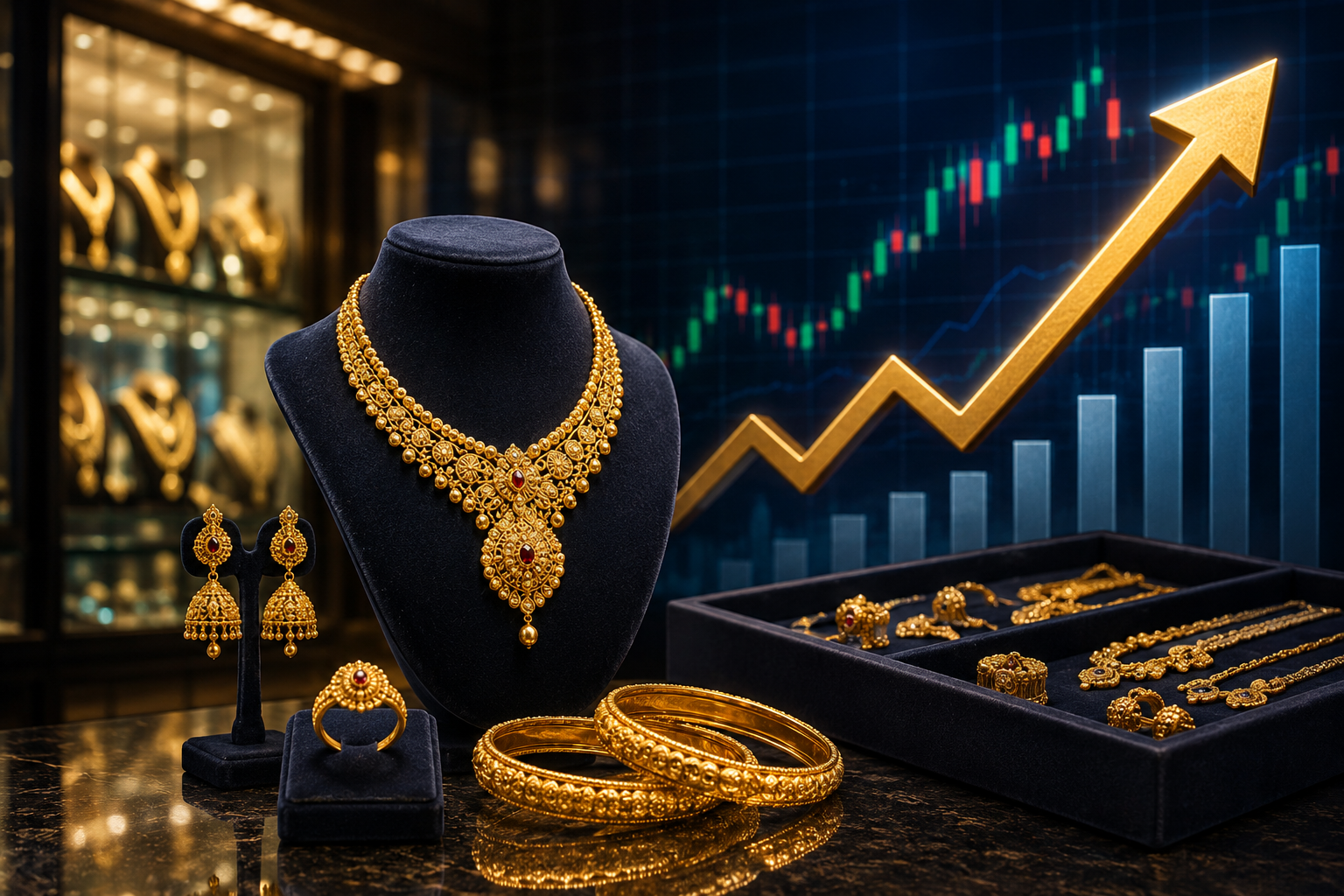
Shankesh Jewellers made a stronger-than-expected stock market debut on Tuesday, with shares listing at an 11.08 per cent premium on the NSE despite a relatively moderate IPO subscription and a subdued grey market premium ahead of listing.
Shares of Shankesh Jewellers made a strong debut on the Indian stock exchanges on Tuesday, outperforming pre-listing expectations. The jewellery wholesaler's shares listed at a premium of more than 11 per cent on the NSE, giving IPO allottees an immediate gain.
On the National Stock Exchange (NSE), Shankesh Jewellers shares opened at ₹103.30, representing a 11.08 per cent premium over the IPO issue price of ₹93. On the BSE, the stock debuted at ₹102.20, translating into a 9.89 per cent premium.
The strong debut was notable because the stock's grey market premium before listing had indicated only a modest gain.
NSE Listing Beats Grey Market Expectations
Ahead of the listing, Shankesh Jewellers shares were reportedly commanding a grey market premium of around ₹2.75 per share.
At that level, the stock was expected to list at approximately ₹95.75, implying a premium of around 3 per cent over the IPO's upper price band of ₹93.
However, the actual NSE listing price of ₹103.30 was significantly higher than the implied grey-market price.
The difference indicates that investor demand during the actual listing session was stronger than suggested by the pre-listing unofficial market indications.
The stock therefore delivered a better-than-expected debut for investors who received shares in the IPO.
₹367-Crore Shankesh Jewellers IPO
Shankesh Jewellers had raised approximately ₹367 crore through its initial public offering.
The IPO opened for subscription on August 18, 2026, and closed on August 20, 2026. The issue received total subscriptions of 2.80 times during the three-day bidding period.
While the issue was oversubscribed, the overall response was relatively moderate compared with several recent IPOs that have attracted substantially higher demand.
The category-wise subscription data, however, showed significant differences between investor segments.
Category-Wise IPO Subscription
| Investor Category | Subscription |
|---|---|
| Qualified Institutional Buyers (QIB) | 1.32 times |
| Non-Institutional Investors (NII) | 5.68 times |
| Retail Investors | 2.42 times |
| Overall | 2.80 times |
The NII segment emerged as the strongest category, with the portion subscribed 5.68 times. Retail investors also showed healthy participation, while the QIB portion was subscribed 1.32 times.
IPO Price Band Was ₹88-₹93
The company had fixed the IPO price band at ₹88 to ₹93 per share.
At the upper end of the price band, investors were allotted shares at ₹93. The NSE debut at ₹103.30 translated into an absolute gain of ₹10.30 per share for investors who received shares at the upper issue price.
The BSE debut at ₹102.20 represented a gain of ₹9.20 per share over the issue price.
The positive listing provides IPO investors with an immediate mark-to-market gain, although the stock's subsequent performance will depend on market conditions and the company's financial performance.
IPO Structure: Fresh Issue and Offer for Sale
The Shankesh Jewellers IPO consisted of a combination of a fresh issue and an offer for sale.
The fresh issue was valued at approximately ₹274.18 crore, while the offer-for-sale component stood at around ₹93 crore.
The fresh capital will be available to the company for strengthening its balance sheet and supporting its operational requirements.
How Shankesh Jewellers Plans to Use IPO Funds
The company intends to use the proceeds from the fresh issue primarily for:
-
Repayment of outstanding debt
-
Funding working capital requirements
-
General corporate purposes
Debt repayment is particularly important because lower borrowing could help reduce finance costs and strengthen the company's balance sheet.
At the same time, working capital remains a critical requirement for a jewellery wholesaler because the business requires substantial capital to maintain inventory and support customer orders.
Mumbai-Based Gold Jewellery Wholesaler
Shankesh Jewellers is a Mumbai-based wholesaler of handcrafted gold jewellery.
The company operates primarily in the business-to-business jewellery market and supplies products to organised jewellery chains and regional jewellers.
Its customer base includes established names such as Joyalukkas India, Kalyan Jewellers, PN Gadgil & Sons and Novel Jewels, associated with the Aditya Birla Group.
Relationships with established jewellery retailers can provide the company with recurring order opportunities and help strengthen its distribution network.
80% of Customers Were Repeat Customers in FY26
A key feature of Shankesh Jewellers' business model is its repeat customer base.
According to the company's disclosures, repeat customers accounted for approximately 80 per cent of total customers in FY26.
A high repeat-customer ratio can be an important positive factor for a wholesale business because established relationships may support recurring orders and reduce the need to continuously acquire new customers.
However, investors should also monitor customer concentration and the contribution of major clients to overall revenue.
A strong relationship with large jewellery chains can be beneficial, but excessive dependence on a limited number of customers could become a risk if purchasing patterns change.
Product Portfolio Covers 22-Karat and 18-Karat Jewellery
Shankesh Jewellers offers 22-karat and 18-karat gold jewellery across more than 30 product categories.
Its portfolio includes a variety of handcrafted jewellery products designed to meet the requirements of different jewellery retailers.
The broad product portfolio gives the company exposure to multiple jewellery categories and allows it to serve different requirements within the organised and regional jewellery market.
Jewellery Industry Provides Growth Opportunity
India remains one of the world's major jewellery markets, with gold playing an important role in consumer purchases, weddings and cultural occasions.
The continued shift towards organised jewellery retailing can create opportunities for established wholesalers that have relationships with organised chains.
Shankesh Jewellers' existing customer relationships could therefore provide a platform for future expansion if the company is able to increase order volumes and add new customers.
However, the jewellery industry remains highly sensitive to gold prices and consumer demand.
Rising Gold Prices Can Increase Working Capital Requirements
One of the important factors investors need to consider is the impact of gold prices on the company's working capital.
When gold prices rise sharply, the value of inventory and the amount of capital required to finance purchases can also increase.
Higher gold prices can therefore increase working-capital requirements even if the physical volume of jewellery sold remains unchanged.
For a wholesale jewellery business, efficient inventory management and cash-flow management will remain critical.
Key Risks for Investors
Despite the strong listing, investors should not overlook the company's business and sector-specific risks.
Gold Price Volatility
Large fluctuations in gold prices can influence jewellery demand, inventory values and working-capital requirements.
Working Capital Intensity
The jewellery business generally requires significant capital for inventory. Efficient management of inventory and receivables will be important for maintaining healthy cash flows.
Customer Concentration
The company has relationships with several large jewellery retailers. Investors should monitor whether revenue remains sufficiently diversified across customers.
Competition
The jewellery wholesale market is competitive, with organised and regional players competing on product range, pricing, quality and delivery capabilities.
Post-Listing Valuation
The strong listing has increased the stock price significantly above the IPO issue price. Investors entering after listing need to evaluate the company's valuation against its earnings and growth prospects rather than relying solely on the initial listing performance.
Strong Listing Does Not Guarantee Long-Term Returns
The positive debut is clearly a favourable development for IPO investors, but a strong listing should not automatically be interpreted as confirmation of long-term investment potential.
Once the initial listing excitement settles, investors will focus on the company's quarterly earnings, revenue growth, margins, debt levels, working-capital cycle and cash flows.
The company's ability to expand its customer base while retaining existing clients will also be an important factor in determining its long-term growth trajectory.
What Investors Should Watch Going Forward
Following the strong debut, investors should track several key parameters:
-
Revenue growth and order volumes
-
Profit margins and earnings growth
-
Debt reduction after the IPO
-
Working-capital requirements
-
Inventory turnover
-
Cash-flow generation
-
Customer concentration
-
Repeat-order trends
-
Addition of new jewellery-chain customers
-
Valuation compared with listed jewellery-sector peers
These factors will provide a clearer picture of whether the company's post-listing valuation is supported by fundamentals.
Shankesh Jewellers IPO: Key Takeaways
Shankesh Jewellers delivered a stronger-than-expected stock market debut, with the NSE listing at ₹103.30 against the IPO issue price of ₹93.
The company's 11.08 per cent NSE listing premium was considerably higher than the roughly 3 per cent premium indicated by the pre-listing grey market premium.
The IPO itself received a moderate overall response, with subscription of 2.80 times. However, the NII category was subscribed 5.68 times, demonstrating strong demand from non-institutional investors.
The company enters the listed market with an established wholesale jewellery business, relationships with major jewellery retailers and a high repeat-customer ratio.
At the same time, investors will need to carefully assess gold-price volatility, working-capital intensity, customer concentration, debt and post-listing valuation.