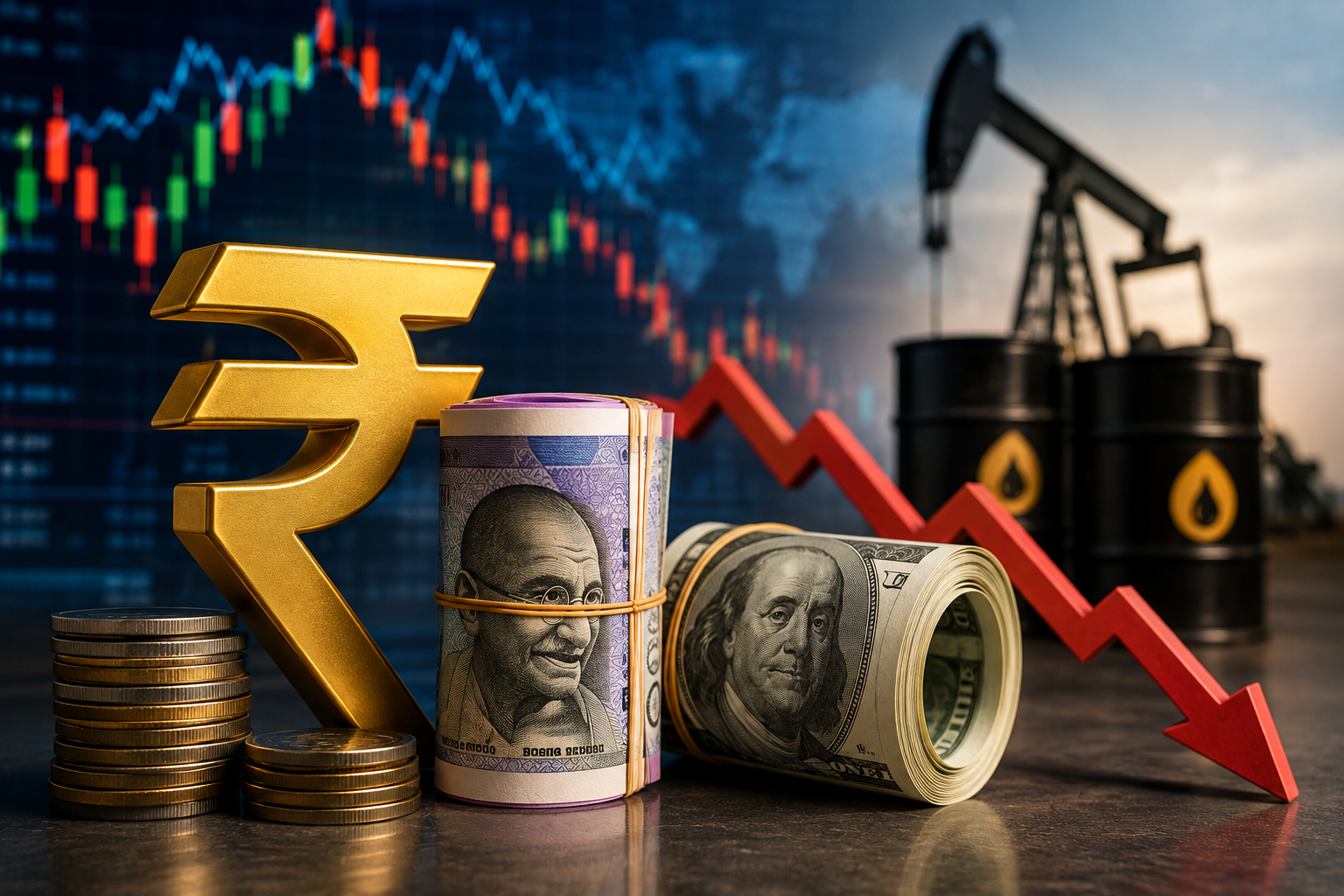
Indian currency gets support from a softer US dollar, but elevated Brent crude, importer demand and geopolitical uncertainty limit the recovery
The Indian rupee strengthened marginally against the US dollar in early trade on Monday, August 24, as weakness in the greenback offered some support to the domestic currency. However, the gains remained limited as elevated crude oil prices, steady dollar demand from importers and uncertainty surrounding fresh US sanctions on Iran continued to weigh on sentiment.
At the interbank foreign exchange market, the rupee opened at 95.68 per US dollar and moved up to 95.64, gaining 7 paise from its previous close of 95.71.
The currency had gained just 3 paise on Friday, indicating that the rupee continues to trade in a relatively narrow range despite changing global market conditions.
Softer US dollar provides initial support
The weakness in the US dollar emerged as one of the key positive factors for the rupee during Monday's early session.
The Dollar Index was around 98.82, showing limited movement but remaining an important indicator for emerging-market currencies.
A weaker dollar generally reduces pressure on currencies such as the rupee by lowering the relative cost of dollar-denominated payments. It can also improve investor appetite for emerging-market assets when accompanied by favourable global risk sentiment.
However, the benefit from the softer greenback was partly offset by commodity and geopolitical concerns.
Crude oil remains a major challenge for the rupee
Oil prices continue to be one of the most important variables for the Indian currency.
Brent crude futures were trading at around $93.14 per barrel, down 1.32 per cent during early trade.
Although the decline provided some immediate relief, crude remains at a level that can continue to influence India's external balance.
India is heavily dependent on imported crude oil to meet its energy requirements. Therefore, a sustained increase in global oil prices can raise the country's import bill and increase demand for US dollars from oil companies and other importers.
This creates a direct channel of pressure on the rupee.
Iran sanctions emerge as fresh market risk
Currency and oil markets are also closely watching Washington's planned fresh sanctions on Iran.
The proposed measures are expected to target areas including Iran's oil trade, banking network and shipping routes.
The impact of the sanctions will depend heavily on their scope and enforcement. Any disruption to Iranian oil exports could tighten global supply conditions and potentially push crude prices higher.
For India, such a development could become particularly important because higher oil prices can increase the country's import costs and put additional pressure on the rupee.
Market participants are therefore likely to remain cautious until greater clarity emerges on the sanctions and their potential impact on global energy flows.
Geopolitical uncertainty keeps investors defensive
The currency market is also responding to broader geopolitical risks.
Market participants are increasingly focused on the possibility that tensions involving Iran could affect other countries and businesses with trade or energy links to the region.
Amit Pabari, Managing Director at CR Forex Advisors, noted that the market's concern extends beyond Iran itself to the potential spillover effects on economies that continue to engage with Iranian trade.
Such uncertainty can encourage investors to maintain defensive positions and increase demand for traditionally safer currencies.
Importer dollar demand limits rupee gains
Another factor preventing a stronger recovery in the rupee is continued demand for dollars from domestic importers.
Import-heavy companies require dollars to settle overseas payments. When importer demand rises, it can absorb dollar supply from exporters and foreign investors.
The balance between exporter dollar selling and importer demand will therefore remain important for the rupee's near-term trajectory.
If crude prices remain elevated, oil companies could also generate additional demand for dollars, creating another potential source of pressure.
Strong forex reserves provide a cushion
India's external position continues to provide a significant buffer against excessive currency volatility.
According to the Reserve Bank of India, India's foreign exchange reserves increased by $9.905 billion to $716.907 billion during the week ended August 14.
The large reserve position strengthens India's ability to manage periods of excessive volatility in the foreign exchange market.
While reserves cannot prevent the rupee from responding to global forces, they provide an important layer of confidence and liquidity during periods of heightened uncertainty.
Foreign fund flows remain crucial
Foreign institutional activity is another important factor for the rupee.
Foreign institutional investors were net sellers of Indian equities worth ₹542.71 crore on Friday, according to exchange data.
Persistent foreign selling can create additional dollar demand as investors convert rupee proceeds into foreign currency.
On the other hand, renewed foreign investment into Indian equities and debt markets could provide support to the rupee by increasing foreign currency inflows.
Investors will therefore closely monitor whether foreign fund flows improve or remain under pressure in the coming sessions.
Indian stock market opens higher
The rupee's movement came against a positive opening for domestic equities.
The Sensex rose 202.42 points to 77,744.15, while the Nifty gained 55.35 points to 24,309 in early trade.
A positive domestic equity market can improve sentiment towards Indian assets and potentially support capital inflows. However, global developments remain the dominant driver for the currency in the near term.
Why the rupee remains vulnerable to oil prices
The relationship between crude oil and the rupee remains particularly important for investors.
When crude prices rise:
-
India's import bill increases.
-
Oil companies require more dollars for overseas purchases.
-
Demand for the US currency rises.
-
The country's trade balance can come under pressure.
-
The rupee can face depreciation pressure.
Conversely, a sustained decline in crude prices can reduce India's import costs and potentially support the domestic currency.
This makes Brent crude one of the most important external indicators for rupee traders.
Dollar trajectory will also determine currency direction
Beyond crude, the global direction of the US dollar will remain critical.
If expectations of US monetary easing increase and US yields decline, the dollar could weaken further, potentially providing support to emerging-market currencies.
However, stronger-than-expected US economic data, higher Treasury yields or renewed demand for safe-haven assets could strengthen the dollar and put pressure on the rupee.
Consequently, the rupee's direction is likely to be determined by the interaction between US monetary policy expectations, crude prices and geopolitical developments.
Key factors to watch
Market participants should closely monitor the following indicators:
-
Brent crude oil prices
-
Dollar Index
-
US Treasury yields
-
Federal Reserve policy expectations
-
US sanctions on Iran
-
West Asia geopolitical developments
-
Foreign institutional investment flows
-
Importer dollar demand
-
Exporter dollar selling
-
India's foreign exchange reserves
-
Domestic inflation and economic data
-
Global risk appetite
Rupee Outlook: Range-bound trade likely amid competing forces
The rupee's move to 95.64 per dollar represents a modest recovery, but it is too early to interpret the gain as a sustained reversal in the currency's broader trend.
The softer dollar, falling Brent prices in early trade and India's robust foreign exchange reserves are positive factors. At the same time, crude remains elevated, importer demand continues and geopolitical uncertainty surrounding Iran could quickly alter market sentiment.
What could support the rupee?
A sustained decline in crude prices, continued weakness in the US dollar, stronger foreign capital inflows and easing geopolitical tensions could help the rupee strengthen further.
What could pressure the rupee?
A sharp rebound in oil prices, tighter US sanctions on Iranian energy exports, renewed global risk aversion, stronger dollar demand from importers or continued foreign portfolio outflows could push the domestic currency lower.
Market Outlook
The rupee is likely to remain range-bound with a cautious bias in the near term. Traders will be particularly sensitive to developments surrounding Iran sanctions because any disruption to global oil supplies could have a direct impact on India's import bill.
For the domestic currency, Brent crude and the Dollar Index will remain the two key external indicators, while foreign portfolio flows and importer demand will determine the domestic demand-supply balance.
India's forex reserves of more than $716 billion provide a substantial external cushion, reducing the risk of disorderly currency movements. Nevertheless, the rupee remains vulnerable to a sudden increase in crude prices or a renewed geopolitical shock.
For investors, the immediate focus should remain on the 95–96 per dollar zone, crude oil's next move and the direction of foreign capital flows. Until there is greater clarity on the Iran sanctions and global oil supply outlook, sharp directional bets on the rupee may remain risky.