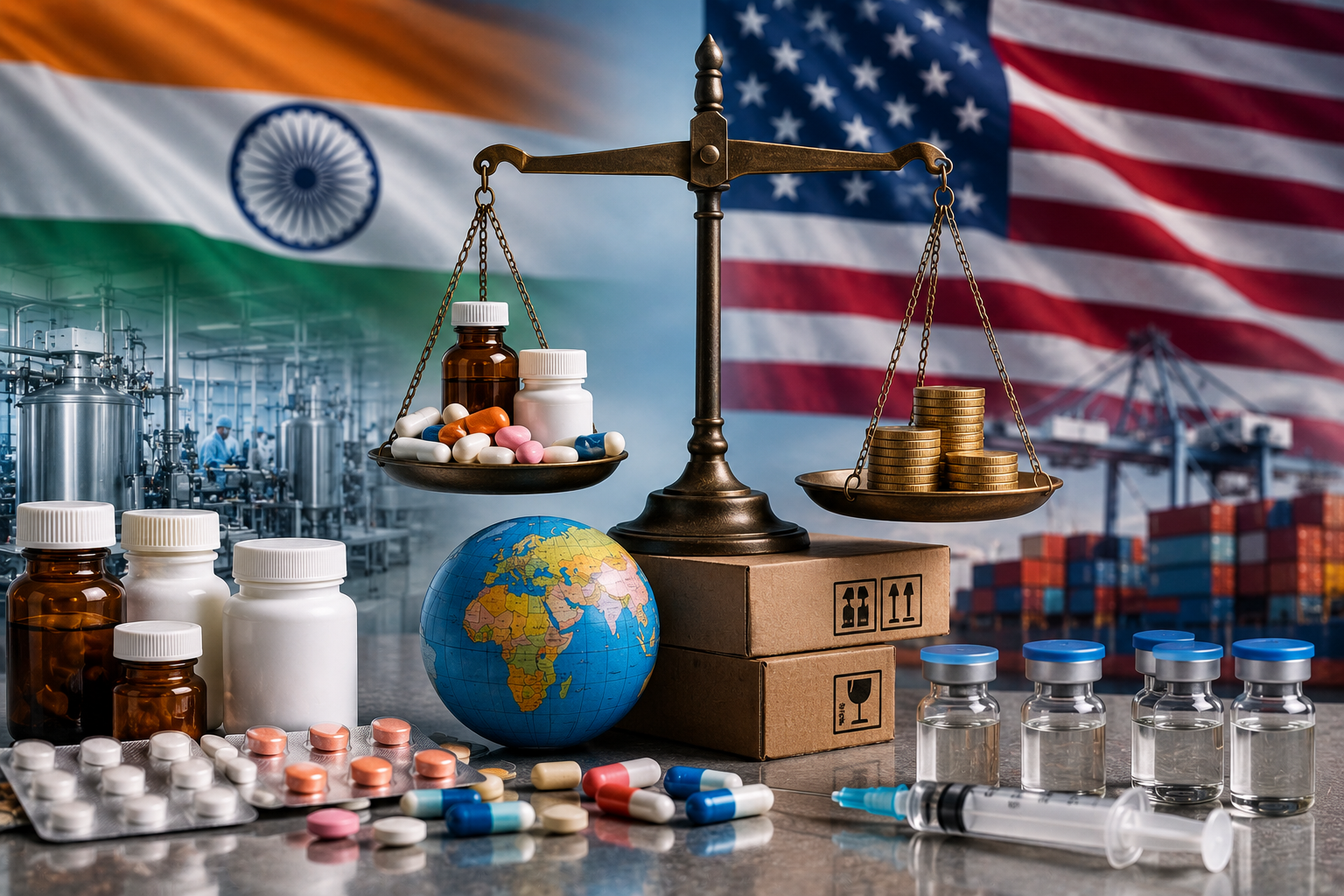
Proposed US tariffs on imported generic medicines could disrupt supply chains, raise drug prices and create political pressure, giving Indian drugmakers room to adapt rather than rush into costly US expansion
India's pharmaceutical industry may face a fresh challenge from the United States as President Donald Trump pushes for policies aimed at bringing more drug manufacturing onto American soil. However, despite the possibility of steep tariffs on imported generic medicines, Indian pharmaceutical companies may have little reason to make immediate and large-scale changes to their manufacturing strategies.
The proposed tariff regime would seek to encourage drugmakers producing off-patent medicines outside the US to establish manufacturing operations domestically. But the economics of generic medicines, the importance of low-cost drugs to American healthcare and the enormous investment required to recreate a large-scale pharmaceutical ecosystem in the US could make the policy difficult to implement in its most aggressive form.
For Indian companies, the situation represents a risk, but it could also reinforce the importance of their cost advantages, manufacturing scale and diversified global supply chains.
US tariff threat puts generic drug supply chain in focus
The US pharmaceutical market has become heavily dependent on international manufacturers for generic medicines. Once patents on branded drugs expire, generic manufacturers enter the market with equivalent medicines, increasing competition and substantially lowering prices.
This system has benefited American consumers while creating a huge export market for pharmaceutical companies in India.
Indian drugmakers have spent decades developing expertise in formulation, process chemistry, manufacturing and regulatory compliance. Their ability to manufacture medicines at competitive costs has helped them become major suppliers to the US market.
Trump's proposed tariff approach is designed to reverse some of this dependence by encouraging companies to manufacture more medicines within the US.
However, shifting an established global supply chain is considerably more complicated than imposing an import duty.
Generic medicines operate on thin margins
One of the biggest challenges for the proposed policy is the economics of generic medicines.
Unlike innovative pharmaceutical companies that can generate substantial returns from patented drugs, generic manufacturers compete primarily on price, volume and efficiency. Once several companies manufacture the same medicine, pricing pressure can become intense.
That leaves manufacturers with relatively limited room to absorb extremely high tariffs.
If a tariff is imposed, pharmaceutical companies could potentially respond in three ways: absorb the additional cost, increase prices or reduce their exposure to the US market.
Absorbing the entire tariff could significantly damage profitability. Raising prices could reduce competitiveness and increase healthcare costs. Cutting supply could create shortages and potentially attract regulatory and political pressure.
This makes generic medicines particularly difficult to subject to very high tariffs without creating unintended consequences.
American patients could ultimately pay more
The biggest political challenge for Washington could be the impact on American consumers.
Generic drugs are important precisely because they are affordable. Any policy that substantially increases the cost of these medicines risks affecting millions of patients, insurers, hospitals and healthcare providers.
If pharmaceutical companies pass tariffs through the supply chain, higher import costs could eventually translate into higher prices for medicines.
That would potentially undermine one of the major advantages created by the generic-drug system.
The political equation becomes even more complicated if higher prices are accompanied by shortages of essential medicines.
Supply shortages could become a bigger concern
Generic pharmaceutical manufacturing is a global network involving active pharmaceutical ingredients, intermediates, formulations, packaging and distribution.
A disruption at any major stage can affect the availability of medicines.
If tariffs make certain products commercially unattractive, manufacturers may reduce production or withdraw lower-margin medicines from the US market. Such decisions could particularly affect older generic drugs where prices are already extremely competitive.
For policymakers, avoiding medicine shortages is likely to remain a higher priority than simply increasing domestic production at any cost.
This could ultimately encourage Washington to consider exemptions, phased tariffs or targeted incentives for strategically important medicines.
Building US manufacturing capacity is not an overnight process
Another major obstacle is the time and capital required to establish pharmaceutical manufacturing facilities in the US.
A company cannot simply shift production from India to America within a few months. New facilities require land, construction, specialised equipment, skilled employees, quality-control infrastructure, regulatory approvals and validated production processes.
Pharmaceutical plants must also meet stringent standards before medicines can be commercially supplied.
The cost structure is another consideration. Manufacturing in the US can involve significantly higher labour, compliance and operating expenses than manufacturing in established pharmaceutical hubs such as India.
Consequently, even if tariffs are imposed, companies will have to determine whether relocating production actually makes economic sense.
India has built a powerful pharmaceutical ecosystem
India's competitive position in pharmaceuticals is the result of decades of investment and experience.
Indian companies developed deep expertise in chemistry, formulation development, process optimisation and large-scale manufacturing. Over time, the industry also built relationships with global distributors, healthcare companies and regulators.
The US became one of the most important international markets for Indian pharmaceutical companies.
This ecosystem creates an advantage that cannot easily be replicated through tariffs.
Even if Washington encourages domestic manufacturing, US companies may still face higher production costs and challenges in achieving the same scale and efficiency as established Asian manufacturers.
Indian companies are already diversifying
The tariff threat does not mean Indian pharmaceutical companies are completely dependent on manufacturing in India.
Several major Indian drugmakers have already established or expanded manufacturing capabilities in the US.
Companies including Sun Pharmaceutical Industries and Aurobindo Pharma have invested in American operations, particularly in areas where local production can support higher-value medicines and strategic expansion.
However, these investments are largely driven by commercial considerations rather than simply responding to tariff threats.
For Indian companies, a selective US manufacturing strategy could be more attractive than moving their entire generic portfolio overseas.
Complex generics could become increasingly important
The changing trade environment could accelerate a broader shift within the Indian pharmaceutical industry towards complex and higher-margin products.
Simple oral-solid generics often face intense price competition. Complex injectables, specialty medicines, difficult-to-manufacture formulations and differentiated products can offer stronger barriers to entry.
Companies with expertise in these areas may have greater pricing power and could potentially justify manufacturing investments closer to the US market.
This could encourage Indian pharma companies to use American facilities selectively while continuing to manufacture cost-sensitive products in India.
The 2028 political equation matters
The timing of the proposed tariff policy is also significant.
A policy that substantially increases prescription costs or contributes to shortages could face strong resistance from patients, healthcare providers and industry groups.
Political pressure could become especially important as the US approaches the 2028 presidential election cycle.
This does not guarantee that the tariff proposal will be abandoned. But it does suggest that implementation could eventually be more targeted than the initial rhetoric indicates.
Exemptions for essential medicines, lower tariffs for certain categories or incentives for strategic manufacturing could emerge as potential compromises.
What it means for Indian pharma stocks
For investors, the tariff threat should be treated as a risk factor rather than an immediate structural threat to the entire Indian pharmaceutical industry.
Companies with high US revenue exposure and a concentration in low-margin generics could face greater sensitivity if tariffs are implemented.
On the other hand, businesses with diversified geographic exposure, strong complex-generic portfolios, specialty products and established US manufacturing capabilities may be better positioned.
Investors should therefore look beyond headline tariff percentages and examine individual companies' product mix and geographical exposure.
Key factors to monitor
US revenue exposure: Companies generating a large share of sales from the American market could face greater direct risk.
Product mix: Complex generics and specialty medicines may offer better economics than commoditised products.
Manufacturing footprint: Companies with production facilities in both India and the US could have greater flexibility.
Margins: Higher-margin businesses may have more capacity to absorb temporary tariff-related costs.
Regulatory approvals: A strong portfolio of US-approved products can provide an important competitive advantage.
Supply-chain diversification: Companies sourcing ingredients and manufacturing across multiple locations may be better prepared for policy changes.
A potential opportunity hidden inside the tariff threat
The proposed US policy could also encourage Indian pharmaceutical companies to move further up the value chain.
Rather than competing purely on low manufacturing costs, Indian drugmakers could increasingly focus on complex formulations, specialty pharmaceuticals, contract development and manufacturing services, biosimilars and other areas where technical expertise provides stronger competitive barriers.
Such a transition could ultimately improve the industry's earnings quality.
The challenge, however, is that moving towards higher-value medicines requires sustained investment in research, regulatory capabilities and manufacturing technology.
India remains difficult to replace overnight
The US can encourage domestic manufacturing, but rebuilding an entire pharmaceutical ecosystem will take years.
India's competitive advantage is not limited to cheap labour. It includes manufacturing scale, supplier networks, technical expertise, regulatory experience and a mature pharmaceutical ecosystem.
That makes a complete replacement of Indian manufacturing capacity extremely difficult in the short term.
For American policymakers, the more realistic objective may therefore be to create additional domestic capacity for critical medicines while continuing to rely on international suppliers for a significant portion of generic-drug requirements.
Policy could become more targeted
A targeted approach could potentially achieve Washington's strategic objective without severely disrupting the generic-drug market.
Instead of imposing blanket tariffs, policymakers could offer incentives for production of medicines considered essential to national security or healthcare resilience.
Government procurement guarantees, tax incentives, financing support and faster regulatory pathways could encourage manufacturers to establish production in the US without dramatically increasing medicine prices.
Such a framework would also give pharmaceutical companies greater certainty when making long-term capital investments.
Outlook for Indian pharmaceutical companies
The proposed US tariff policy represents a meaningful uncertainty for Indian pharmaceutical exporters, but it is too early to conclude that the industry faces a major structural disruption.
Indian companies have several potential responses available, including selective US manufacturing, greater supply-chain diversification, expansion into complex products and increased focus on higher-margin therapies.
At the same time, Washington will have to balance its desire for domestic manufacturing with the need to keep medicines affordable and widely available.
Smart Investment Outlook
For investors, the key takeaway is that the tariff headline may be more alarming than the eventual economic impact.
A very high tariff on generic medicines could create significant consequences for American healthcare costs, drug availability and inflation. That gives pharmaceutical companies, healthcare providers and policymakers strong incentives to negotiate a more workable framework.
Indian pharma companies should nevertheless remain cautious and prepare for multiple scenarios rather than assume the tariffs will disappear.
The strongest players are likely to be those with diversified manufacturing networks, complex-product portfolios, strong US regulatory capabilities and healthy balance sheets.
In the near term, investors should focus on company-specific exposure rather than treating the entire Indian pharmaceutical sector uniformly. If US policy eventually shifts towards targeted incentives instead of broad-based tariffs, India's pharmaceutical industry could retain its global cost advantage while simultaneously expanding its presence in higher-value segments.
The US may want more medicines made at home, but replacing decades of India's pharmaceutical expertise and scale will be far more difficult than imposing a tariff.