Revenue and profit surged in the June quarter, while room air-conditioner volumes jumped 45%; brokerages remain positive on long-term growth but flag near-term margin and execution risks
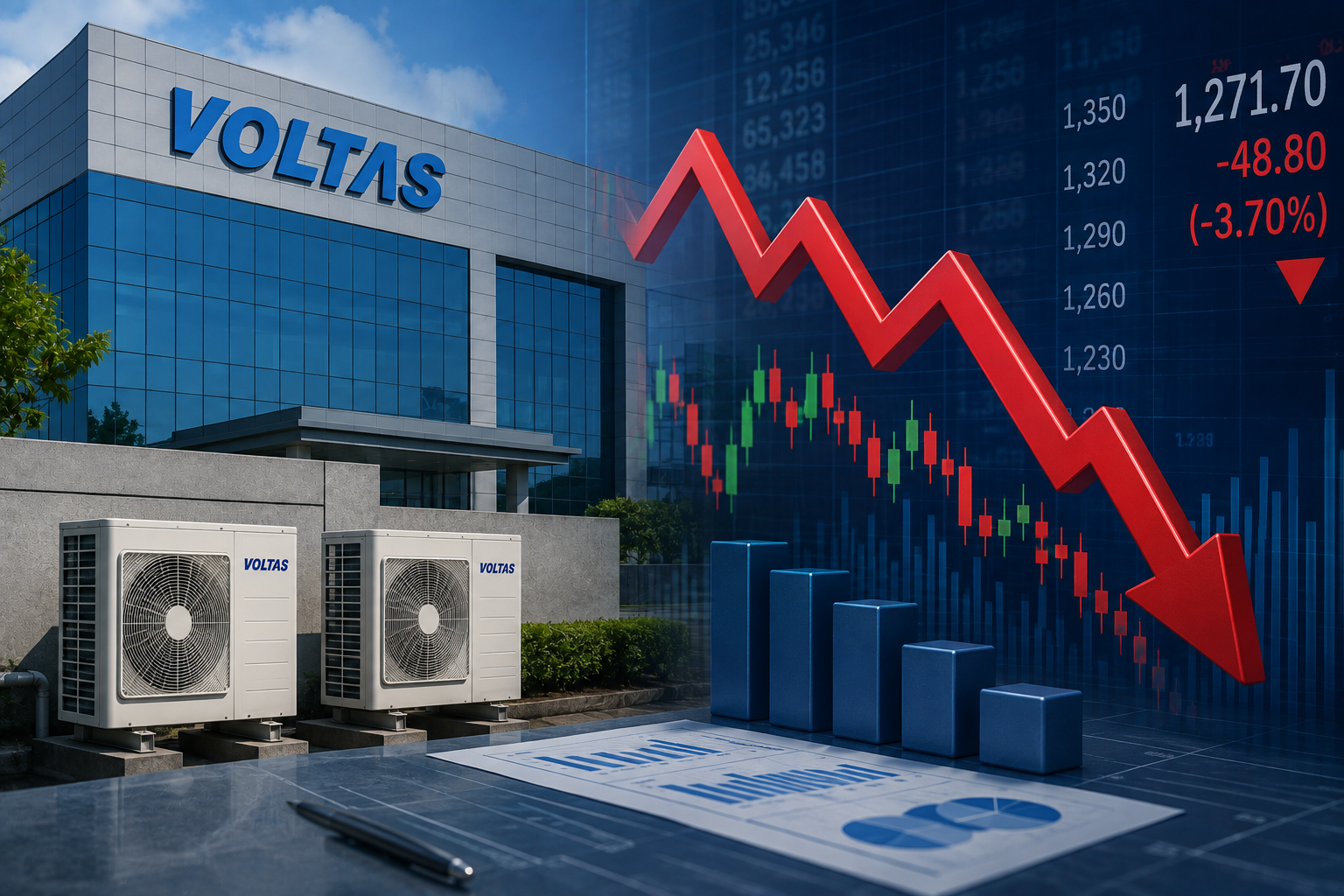
Shares of Tata Group company Voltas Ltd declined around 4 per cent despite the company reporting a strong financial performance for the first quarter of FY27.
The company delivered robust revenue and profit growth, supported by strong room air-conditioner sales, price increases and operating leverage. However, concerns over margins, input-cost inflation, geopolitical uncertainty and the pace of recovery in profitability weighed on investor sentiment.
Brokerage views remain mixed, with Elara Securities retaining an 'Accumulate' rating while Nomura maintained a 'Neutral' stance.
Voltas Revenue Jumps 18.5%
Voltas reported revenue from operations of ₹4,765 crore, registering an 18.5 per cent year-on-year increase from ₹4,021 crore in the corresponding quarter.
The growth was supported by strong demand in the room air-conditioner segment and higher realisations following price increases.
The company has been able to combine volume expansion with pricing actions, helping it maintain momentum despite inflationary pressures across several input categories.
Profit Rises 51% in Q1
Profit after tax increased to ₹213 crore, compared with ₹141 crore in the year-ago quarter.
The 51 per cent growth in profit was significantly faster than revenue growth, reflecting the benefits of operating leverage and improved business performance.
The result indicates that Voltas continues to benefit from strong demand in its core air-conditioning business.
However, analysts believe the sustainability of margin expansion will be an important factor for future earnings.
Room AC Volumes Surge 45%
The room air-conditioner business remained the primary growth engine for Voltas.
RAC volumes increased 45 per cent year-on-year, reflecting strong consumer demand and the company's continued market-share gains.
The company also implemented price increases of around 10-12 per cent year-to-date, helping offset inflation in raw materials and other operating costs.
The combination of higher volumes and pricing has provided significant support to revenue growth.
Voltas Strengthens Market Leadership
Voltas gained around 400 basis points of market share over the second-largest player, strengthening its leadership position in the room air-conditioner market.
The market-share improvement is particularly important because Voltas is operating in an industry with strong competition from domestic and multinational brands.
The company's ability to expand market share while maintaining profitability will remain a key focus for investors.
India's AC Market Offers Long-Term Growth Potential
India's air-conditioner market remains structurally attractive because penetration is still relatively low compared with several developed markets.
Rising household incomes, urbanisation, increasing temperatures and changing consumer preferences are supporting demand.
The replacement cycle is also expected to become increasingly important as India's installed air-conditioner base expands.
Voltas is well positioned to participate in this growth because of its established brand, distribution network and leadership position.
Price Hikes Help Protect Margins
Voltas has raised prices by around 10-12 per cent year-to-date.
The pricing action has helped the company absorb part of the increase in input costs.
Higher volumes have also generated operating leverage, helping support profitability.
However, continued price increases may eventually face resistance if consumers become more price-sensitive or competitors adopt aggressive pricing strategies.
Margin Pressure Remains the Main Concern
Despite the strong headline numbers, analysts remain cautious about the company's margin trajectory.
Input-cost inflation, foreign-exchange movements and geopolitical uncertainty could continue to affect profitability.
Elara Securities said margins remained resilient due to price increases and operating leverage, but near-term pressure remains.
This has resulted in a more cautious earnings outlook for the immediate future.
Elara Cuts FY28 EPS Estimate by 8%
Following the Q1 results, Elara Securities reduced its FY28 earnings-per-share estimate by 8 per cent.
The revision reflects expectations of continued near-term margin pressure.
However, the brokerage remains positive about the company's longer-term earnings potential.
It raised its FY29 EPS estimate by 5 per cent, partly reflecting the expected benefits from Voltas' compressor manufacturing joint venture.
Elara Raises Target Price to ₹1,410
Despite the FY28 earnings cut, Elara retained its 'Accumulate' rating on Voltas.
The brokerage increased its target price from ₹1,360 to ₹1,410.
Its positive outlook is based on the long-term growth opportunity in India's room air-conditioner market and Voltas' position as a market leader.
Elara expects Voltas to deliver strong earnings growth over the FY26-29 period.
Earnings CAGR Expected to Remain Strong
Elara expects Voltas to post an earnings CAGR of around 62 per cent during FY26-29E.
The brokerage also estimates average ROE and ROCE of approximately 15 per cent and 14 per cent, respectively, during FY27-29E.
These estimates assume continued growth in the RAC business, improving operating leverage and eventual benefits from greater localisation.
Compressor Joint Venture Could Be a Long-Term Catalyst
One of the most important strategic developments for Voltas is its proposed joint venture with Atomberg Innovation for manufacturing room-air-conditioner compressors.
The initial planned capacity is around 2.8 million compressor units.
The move could increase domestic sourcing and reduce dependence on imported compressors.
Since compressors represent a critical component of an air conditioner, greater localisation could potentially improve supply-chain control and provide cost benefits.
Local Manufacturing Could Improve Supply-Chain Resilience
The compressor joint venture could become increasingly important as global supply chains remain vulnerable to geopolitical disruptions.
Greater domestic manufacturing could help Voltas reduce exposure to international shipping costs, currency fluctuations and overseas supply constraints.
However, the financial benefits are unlikely to appear immediately.
The project will need to achieve scale and competitive manufacturing economics before it can materially influence the company's margins.
Nomura Maintains Neutral Rating
Nomura has taken a more cautious view of the stock.
The brokerage maintained its 'Neutral' rating while reducing its target price from ₹1,368 to ₹1,357.
Nomura's primary concern is that Voltas' focus on gaining market share rather than maximising profitability could result in a slower margin recovery.
Market Share Versus Margins
The central investment debate around Voltas is increasingly about the balance between market-share expansion and profitability.
Strong volume growth is positive for long-term scale.
However, gaining market share through aggressive pricing or promotional activity can put pressure on margins.
The company will need to demonstrate that its market-share gains can eventually translate into stronger earnings and cash flows.
Compressor JV Execution Is a Key Monitorable
Nomura has also identified the execution of the compressor joint venture as an important factor.
Investors will need to monitor:
- Plant commissioning
- Production ramp-up
- Capacity utilisation
- Manufacturing costs
- Product quality
- Contribution to margins
Successful execution could strengthen Voltas' long-term cost structure, while delays could postpone the expected benefits.
Operating Leverage Supports Earnings
Higher sales volumes can provide significant operating leverage for Voltas.
Manufacturing, distribution and other fixed expenses can be spread across a larger revenue base as production increases.
This creates the potential for margins to expand if volume growth remains strong and input costs stabilise.
The challenge is ensuring that additional volumes are not achieved at the expense of profitability.
Input Costs Remain a Risk
Raw-material costs remain a key variable for consumer-durable companies.
Metals, electronic components and other inputs can account for a significant portion of manufacturing costs.
Any sharp increase in commodity prices could put pressure on Voltas' margins.
The company's ability to pass higher costs to consumers will determine how much of this pressure can be absorbed.
Currency Movements Could Affect Costs
Foreign-exchange movements can also influence profitability because some components and materials may be imported.
A weaker rupee can increase the cost of imported inputs.
Greater domestic sourcing through initiatives such as the compressor joint venture could eventually reduce some of this exposure.
Geopolitical Risks Remain a Near-Term Headwind
Global geopolitical developments can affect commodity prices, logistics and supply chains.
For consumer-durable manufacturers, disruptions can increase procurement costs or delay component availability.
This remains one of the reasons brokerages are cautious about near-term margin recovery despite strong demand.
Competition Remains Intense
The Indian air-conditioner market has several established players competing aggressively for market share.
Companies are competing through:
- Pricing
- Energy efficiency
- Product features
- Distribution
- Brand positioning
- After-sales service
Voltas' recent market-share gains demonstrate strong competitive momentum, but maintaining those gains without sacrificing margins will be important.
Energy Efficiency Could Support Premium Products
Energy consumption is becoming a more important consideration for air-conditioner buyers.
Higher electricity costs and greater consumer awareness are encouraging demand for energy-efficient models.
Manufacturers that can combine energy efficiency with competitive pricing could potentially command stronger customer loyalty.
For Voltas, continued investment in product innovation could support its premiumisation strategy.
Distribution Network Remains a Strength
Voltas has a broad distribution and service network across India.
This provides an advantage when demand increases rapidly during periods of high temperatures.
A strong distribution network also allows the company to reach smaller cities and towns where air-conditioner penetration remains relatively low.
This could provide another avenue for long-term volume growth.
Replacement Demand Could Become Increasingly Important
As India's installed air-conditioner base grows, replacement demand is likely to become an increasingly important part of the market.
Consumers replacing older units may prefer newer models with better energy efficiency and additional features.
This creates a recurring demand opportunity for established brands.
What Could Drive Voltas Earnings Higher?
Several factors could support stronger earnings over the medium term:
- Continued RAC volume growth
- Further market-share gains
- Stabilisation of input costs
- Improved operating leverage
- Successful compressor localisation
- Higher AC penetration
- Growth in replacement demand
- Stronger premium-product sales
A combination of these factors could improve profitability beyond the current estimates.
What Could Pressure the Stock?
The key risks include:
- Prolonged input-cost inflation
- Aggressive industry competition
- Slower margin recovery
- Weak consumer demand following price increases
- Currency volatility
- Geopolitical disruptions
- Delays in the compressor joint venture
- Higher-than-expected capital expenditure
Investors will need to assess whether the company's long-term growth opportunity sufficiently offsets these near-term risks.
Brokerages Present a Balanced Picture
The brokerage commentary suggests that Voltas has a strong structural growth story but faces near-term profitability challenges.
| Brokerage | Rating | Target Price | Key View |
|---|---|---|---|
| Elara Securities | Accumulate | ₹1,410 | Strong RAC growth; near-term margin pressure but long-term earnings potential |
| Nomura | Neutral | ₹1,357 | Market-share focus could delay margin recovery; compressor JV execution important |
The divergence in target prices reflects the uncertainty surrounding the pace at which strong revenue growth will translate into sustainable margin expansion.
Voltas' Long-Term Growth Story Remains Intact
Despite the near-term concerns, the structural opportunity remains significant.
India's relatively low AC penetration gives manufacturers a long runway for growth.
Climate trends, urbanisation, rising incomes and increasing consumer demand for cooling products could continue supporting the industry.
For Voltas, maintaining its leadership position while improving profitability will be the central challenge.
Market Outlook
Voltas' Q1FY27 results underline the strength of its core business, with revenue rising 18.5 per cent, net profit increasing 51 per cent and room air-conditioner volumes growing 45 per cent.
The company's approximately 400-basis-point market-share gain is another positive signal, demonstrating that Voltas continues to strengthen its competitive position.
However, the stock's decline following the results shows that investors are increasingly focused on earnings quality and margin sustainability rather than revenue growth alone.
The proposed compressor joint venture with Atomberg could become an important long-term catalyst. Successful localisation could improve supply-chain resilience, reduce import dependence and potentially support margins as the facility reaches scale.
The broader sector outlook remains favourable because India's AC penetration is still low and structural demand drivers remain intact. However, commodity prices, competition, pricing power and geopolitical risks could influence near-term profitability.
For Voltas, the next phase of growth will depend on its ability to convert market-share gains into sustainable earnings expansion. If strong RAC volumes continue, input-cost pressures moderate and the compressor JV is executed successfully, the company could see a stronger margin recovery over the longer term. Conversely, continued competition and cost inflation could keep profitability under pressure for longer than expected.