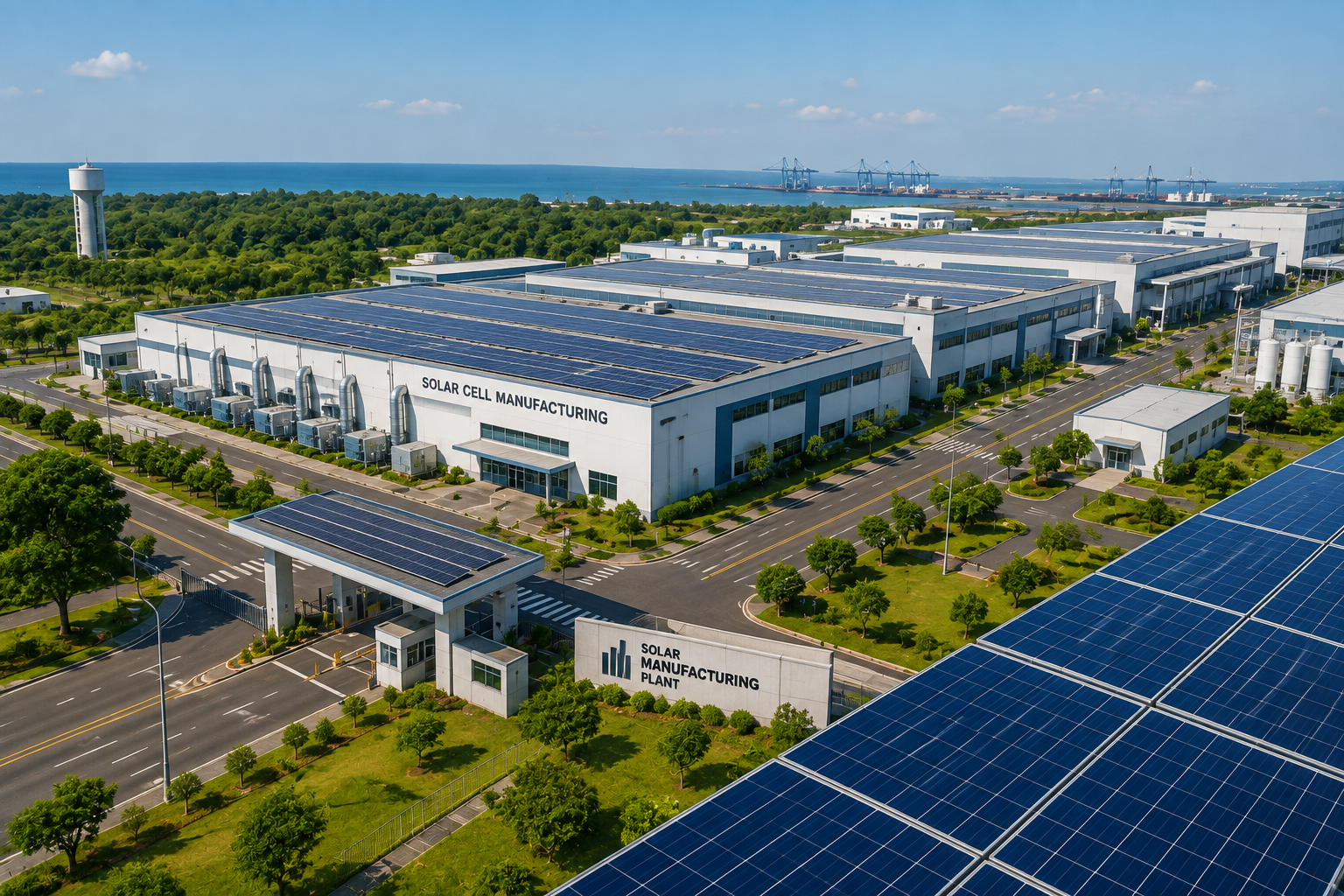
Gopalpur expansion will deepen Saatvik’s manufacturing integration, strengthen domestic solar supply chains and create a new growth platform for the company
Saatvik Solar Industries has taken another major step towards expanding its solar manufacturing footprint by signing an initial pact with the Industrial Promotion and Investment Corporation of Odisha Ltd (IPICOL) to establish a 3.6 GW solar cell manufacturing facility at Gopalpur, Odisha.
The proposed facility will form part of the company's next phase of manufacturing expansion and is expected to strengthen Saatvik's position across India's rapidly growing solar value chain.
The project is also expected to generate employment and support the development of an ecosystem of suppliers, service providers and ancillary industries around the facility.
3.6 GW Facility to Strengthen Cell Manufacturing Capacity
The proposed Gopalpur facility will add 3.6 GW of solar cell manufacturing capacity to Saatvik's planned production footprint.
Solar cells are one of the most critical components of photovoltaic modules. Expanding internal cell manufacturing can provide greater control over sourcing and production while reducing dependence on external suppliers.
For Saatvik, the move represents an important step towards building a more integrated manufacturing operation.
Existing 2.4 GW Cell Capacity Forms the Base
The company is already progressing with a 2.4 GW solar cell manufacturing facility in Odisha, along with 4 GW of module manufacturing capacity.
The additional 3.6 GW Phase-II facility would significantly increase the company's planned cell manufacturing scale.
This expansion could allow Saatvik to align its cell and module manufacturing operations more closely, creating a more integrated production chain.
Vertical Integration at the Centre of Expansion Strategy
Saatvik's latest investment reflects a broader strategy of moving deeper into the solar manufacturing value chain.
Rather than depending heavily on third-party suppliers for key components, the company is seeking greater control over manufacturing.
Vertical integration can potentially provide benefits such as:
- Better supply-chain control
- Improved production planning
- Greater quality control
- Reduced dependence on external suppliers
- Better utilisation of manufacturing capacity
- Potential improvement in operating efficiency
However, the benefits will depend on the company's ability to maintain high capacity utilisation and competitive manufacturing costs.
Odisha Emerging as an Important Solar Manufacturing Base
Gopalpur is becoming an important location for large-scale industrial development.
The proposed Saatvik facility could strengthen Odisha's position in the renewable-energy manufacturing ecosystem while supporting ancillary industrial activity.
The project is expected to generate direct employment opportunities as well as indirect jobs across logistics, engineering, maintenance, transportation and other services.
Company Targets Greater Manufacturing Scale
Saatvik's expansion comes at a time when India's solar industry is undergoing a major capacity-building cycle.
Growing demand for solar power is encouraging manufacturers to expand production of cells, modules and other components.
The company's strategy is to build sufficient scale to participate in this structural growth while gradually increasing the level of integration within its manufacturing operations.
Cell Manufacturing Could Improve Supply Security
Solar manufacturers can face supply disruptions and price fluctuations when they rely extensively on external cell suppliers.
By manufacturing cells internally, Saatvik could potentially improve visibility over its production pipeline.
This could be particularly useful when demand for modules rises sharply or when global supply chains face disruptions.
Domestic Manufacturing Gains Strategic Importance
India is seeking to reduce its dependence on imported solar components and build a stronger domestic photovoltaic manufacturing ecosystem.
The expansion of domestic cell manufacturing capacity is therefore strategically important.
Companies with integrated cell and module production could be better positioned to serve projects where domestic-content requirements are relevant.
DCR Market Could Provide Additional Opportunity
Domestic Content Requirement, or DCR, is an important factor in India's renewable-energy market.
Projects subject to DCR requirements need eligible domestically manufactured components.
As Saatvik expands its own cell manufacturing capabilities, it could potentially strengthen its ability to supply products for such projects.
This may create an additional avenue for growth as India's domestic solar manufacturing ecosystem expands.
Module Manufacturing Adds to the Opportunity
Cell production is only one part of Saatvik's broader manufacturing strategy.
The company is also building significant module manufacturing capacity.
The combination of cell and module production could allow the company to control more stages of the manufacturing process.
Such integration may also help the company respond more quickly to changes in customer requirements and market demand.
Scale Could Become a Competitive Advantage
The solar manufacturing industry is becoming increasingly capital-intensive.
Larger production facilities can potentially generate economies of scale through more efficient procurement, automation and utilisation of manufacturing infrastructure.
However, scale can become an advantage only when facilities operate efficiently.
Low utilisation or weak product realisations could instead result in higher fixed costs and pressure profitability.
Solar Market Provides Structural Demand
India's long-term renewable-energy ambitions remain a key growth driver for the solar industry.
Electricity demand is increasing, while governments, businesses and utilities continue to invest in renewable-energy generation.
Solar power is expected to remain a major component of India's energy transition.
This creates a structural opportunity for manufacturers of cells, modules and related equipment.
Expansion Comes With Industry-Wide Competition
The opportunity is accompanied by intense competition.
Several Indian companies are expanding their solar cell and module manufacturing capacities.
Global manufacturers are also increasing their presence across the renewable-energy supply chain.
As more capacity comes online, pricing pressure could emerge if supply grows faster than demand.
Cell and Module Prices Will Remain Important
Manufacturing profitability depends heavily on selling prices and input costs.
Even if demand grows strongly, falling module or cell prices can reduce margins.
Saatvik will therefore need to balance capacity expansion with market demand and production economics.
The ability to maintain competitive costs will become increasingly important as industry capacity expands.
Technology Upgrades Will Be Critical
Solar technology continues to evolve rapidly.
Manufacturers are investing in higher-efficiency cell technologies to improve energy output and reduce the cost of solar generation.
For Saatvik, the new manufacturing facility will need to remain technologically competitive over the long term.
The ability to adopt new technologies without significant production disruption could become a key differentiator.
Expansion Could Strengthen the Company's Supply Chain
A larger internal manufacturing footprint can also improve supply-chain planning.
Instead of coordinating every stage with multiple external suppliers, a more integrated manufacturer can potentially align cell and module production more efficiently.
This can help reduce lead times and improve production visibility.
Employment Generation Could Benefit the Region
The Gopalpur project is expected to create employment opportunities in Odisha.
A large solar manufacturing facility typically requires workers across several functions, including:
- Manufacturing
- Engineering
- Quality control
- Maintenance
- Logistics
- Administration
- Research and development
The wider industrial ecosystem can also create indirect employment.
Ancillary Industries Could Develop Around Gopalpur
Large manufacturing projects often attract suppliers and service providers.
The proposed Saatvik facility could create opportunities for companies involved in:
- Industrial equipment
- Packaging
- Logistics
- Electrical systems
- Maintenance
- Engineering services
- Industrial automation
This could gradually strengthen the renewable-energy manufacturing cluster around Gopalpur.
Saatvik's Strategy Goes Beyond Cells and Modules
The company's broader expansion strategy points towards a more comprehensive renewable-energy platform.
The solar manufacturing ecosystem includes several stages, from upstream materials to cells and modules and finally project development and installation.
Increasing participation across these stages can potentially create greater control over the value chain.
Future Integration Could Go Further Upstream
A deeper level of integration would involve manufacturing upstream components used to produce solar cells.
Such a strategy could potentially reduce dependence on imported inputs and provide greater control over costs and supply.
However, upstream manufacturing also requires substantial capital investment, technology expertise and operational scale.
Capital Allocation Will Be Important
Large manufacturing projects require significant investment.
For Saatvik, successful expansion will depend not only on completing the facility but also on generating sufficient returns on the capital deployed.
Investors will therefore need to track:
- Project expenditure
- Funding structure
- Debt levels
- Capacity utilisation
- Production ramp-up
- Operating margins
- Working capital
These factors will determine whether the capacity expansion translates into sustainable earnings growth.
Execution Remains a Key Factor
Large-scale manufacturing projects can face delays related to construction, equipment installation, approvals and commissioning.
The timing of commercial production will therefore be important.
A smooth commissioning process would allow Saatvik to start monetising its additional capacity sooner, while delays could increase capital costs and postpone revenue generation.
Strong Demand Will Need to Match New Capacity
The company's expansion makes sense only if sufficient market demand exists to absorb the additional production.
India's solar demand outlook remains structurally positive, but the industry is simultaneously adding substantial manufacturing capacity.
Saatvik will therefore need to secure customers and maintain strong utilisation as the new facility ramps up.
Integrated Manufacturing Could Improve Competitive Position
If successfully executed, the combination of cell and module capacity could provide Saatvik with a stronger competitive position.
The company could potentially offer customers greater supply assurance while reducing dependence on external cell procurement.
It may also provide greater flexibility in serving different segments of the domestic solar market.
The Expansion Fits India's Energy Transition
The proposed project comes against the backdrop of India's broader transition towards renewable energy.
Solar power is expected to remain a major source of new electricity-generation capacity.
As the renewable-energy market expands, demand will not only increase for solar farms but also for the manufacturing infrastructure required to build them.
Saatvik's investment is therefore aligned with a long-term structural shift in India's energy economy.
Key Factors to Monitor
The proposed 3.6 GW facility creates a significant growth opportunity, but investors should track the company's execution closely.
The most important factors include:
Capacity commissioning: Whether the facility is completed according to schedule.
Utilisation: How quickly the new capacity reaches commercially meaningful utilisation.
Realisation: Whether cell and module prices remain supportive.
Margins: Whether increased scale translates into better operating profitability.
Technology: Whether the facility remains competitive as solar-cell technology evolves.
Capital expenditure: Whether expansion remains financially disciplined.
Orders: Whether demand remains strong enough to absorb additional production.
Market Outlook
Saatvik Solar's agreement with IPICOL to establish a 3.6 GW Phase-II solar cell manufacturing facility at Gopalpur marks another significant step in the company's manufacturing expansion strategy.
Combined with its existing 2.4 GW cell and 4 GW module manufacturing plans, the project could substantially increase Saatvik's manufacturing scale and strengthen its position in India's domestic solar supply chain.
The larger opportunity lies in vertical integration. Greater control over cell manufacturing can potentially improve supply security, support DCR-related opportunities and give the company greater flexibility across its module business.
However, the expansion also increases the importance of execution. Capacity utilisation, capital expenditure, technology competitiveness, cell prices, module realisations and industry-wide oversupply will determine how much value the additional capacity ultimately creates.
If Saatvik can commission the facility efficiently, secure strong demand and maintain competitive manufacturing economics, the Gopalpur expansion could become an important contributor to its next phase of growth.
The project also reinforces a broader industry trend: as India expands renewable-energy generation, domestic solar manufacturing capacity is becoming increasingly important, creating opportunities for companies that can build scale while maintaining technology and cost competitiveness.