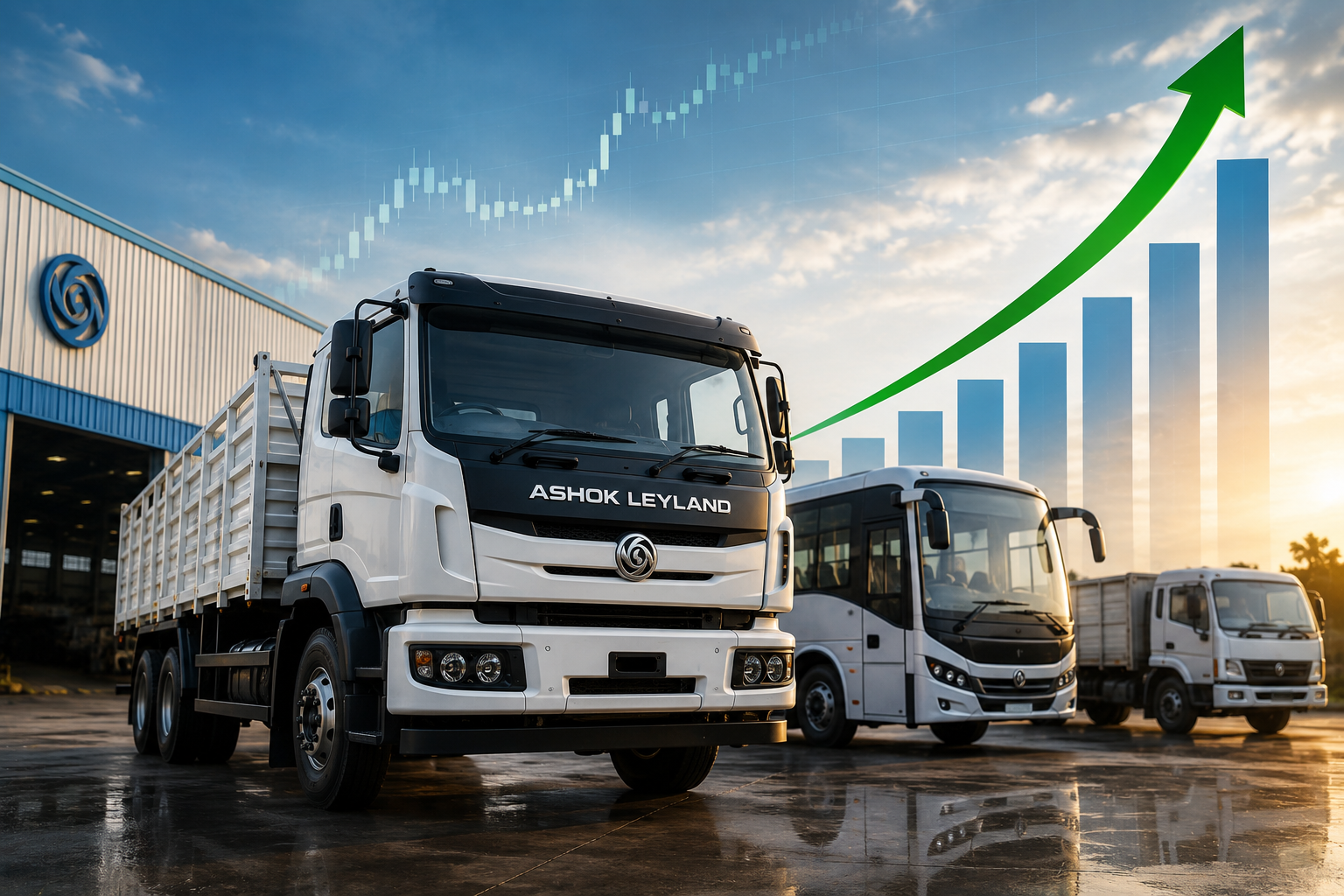
Record commercial vehicle volumes drive highest-ever Q1 revenue and net profit; margin pressure from commodity costs remains the key near-term challenge
Shares of Ashok Leyland gained nearly 3% in early trading on Monday after the commercial vehicle manufacturer reported a strong operating performance for the first quarter of FY27. The company's revenue rose at a double-digit pace, while volumes reached a record high, providing a strong indication of continued demand across the commercial vehicle segment.
The stock climbed as much as 2.92% to ₹176.45 during intraday trading. At around 9:41 AM, Ashok Leyland shares were trading 1.78% higher at ₹174.69, even as the Nifty 50 declined 0.29% to 24,296.40.
The company's Q1 performance was led by record volumes and higher revenue, although profitability growth remained relatively subdued because of elevated commodity costs.
Ashok Leyland Revenue Rises 12% to Record Q1 High
Ashok Leyland reported revenue from operations of ₹13,069.59 crore for the April-June quarter, up 12% from ₹11,708.54 crore in the corresponding quarter of the previous year.
The revenue figure represents the company's highest-ever revenue for a first quarter, reflecting strong commercial vehicle demand and higher volumes.
The performance comes against a backdrop of healthy industry demand, with commercial vehicle sales showing strong growth during the year so far.
The company's ability to deliver double-digit revenue growth despite higher input costs provides a positive indication of the underlying strength of its business.
Net Profit Rises Marginally
Consolidated net profit for Q1FY27 increased 0.8% year-on-year to ₹615.81 crore, compared with ₹611.07 crore in the same quarter last year.
Although the increase in profit was modest compared with the 12% growth in revenue, the company achieved its highest-ever Q1 net profit.
The limited growth in bottom-line earnings was primarily linked to pressure on operating profitability caused by higher commodity prices.
The result, however, was better than market expectations, with brokerage firm Motilal Oswal Financial Services noting that Ashok Leyland's profit after tax was approximately 12% ahead of its estimate.
Record Volumes Provide Strong Growth Signal
Volume performance emerged as one of the most important positives from Ashok Leyland's Q1 results.
The company benefited from a strong commercial vehicle demand environment, with industry volumes registering mid-teen growth on a year-to-date basis.
The improvement indicates that demand from freight operators, infrastructure activity, construction and other economically sensitive segments has remained resilient.
Higher volumes are particularly important for Ashok Leyland because stronger capacity utilisation can improve operating leverage and provide additional support to profitability once input-cost pressures begin to ease.
Commercial Vehicle Demand Remains Strong
The broader commercial vehicle industry has performed better than initially expected, according to Motilal Oswal.
The brokerage noted that demand trends have remained healthy despite the rise in commodity costs.
Several factors are supporting the sector, including infrastructure development, freight movement, replacement demand and continued economic activity.
A sustained improvement in industrial production and logistics activity could further support commercial vehicle demand through FY27.
EBITDA Margin Falls 100 Basis Points
While revenue and volumes remained strong, profitability at the operating level came under pressure.
Ashok Leyland's EBITDA margin declined 100 basis points year-on-year to 10.1% during Q1FY27.
The decline was mainly attributed to higher commodity costs.
However, the margin remained around 100 basis points above Motilal Oswal's estimate, indicating that the company managed the cost pressure better than the brokerage had anticipated.
The margin trend will remain a key focus for investors because any recovery in profitability could significantly improve earnings growth.
Commodity Costs Emerge as Key Near-Term Challenge
Higher raw material prices remain the biggest near-term challenge for Ashok Leyland.
Commercial vehicle manufacturers are exposed to fluctuations in steel, aluminium and other commodity prices, which can directly affect manufacturing costs.
The company has managed to absorb a significant portion of the cost pressure so far, but the impact has still been visible in its EBITDA margin.
Management expects the commodity-cost environment to remain challenging in the second quarter before gradually improving.
Q2 Expected to Be the Most Challenging Quarter
According to the current management outlook cited by Motilal Oswal, Q2FY27 is expected to be the most challenging quarter from a raw material cost perspective.
Commodity pressure is expected to peak during the second quarter and begin easing from Q3.
A more visible improvement in input-cost conditions is expected in Q4.
If this trajectory materialises, Ashok Leyland could enter the second half of FY27 with a stronger margin environment, allowing earnings growth to accelerate.
Margin Recovery Could Boost Earnings
The potential recovery in operating margins could become an important catalyst for Ashok Leyland.
The company is already benefiting from strong volume growth. If commodity prices moderate at the same time, the combination of higher volumes and lower input-cost pressure could improve operating leverage.
This could result in faster growth in EBITDA and profit compared with revenue.
The margin recovery therefore remains one of the most important factors for investors to monitor over the next two to three quarters.
Motilal Oswal Raises Volume Growth Expectations
Motilal Oswal has responded positively to the better-than-expected commercial vehicle demand environment.
The brokerage now expects Ashok Leyland to deliver approximately 6% volume growth in FY27 and 10% in FY28.
The revised expectations reflect stronger industry demand and the company's improving operating environment.
Higher volume growth would provide a stronger base for revenue expansion and could also help the company improve fixed-cost absorption.
Revenue, EBITDA and Profit Growth Outlook
Motilal Oswal expects Ashok Leyland to deliver annualised growth of approximately 11% in revenue, 15% in EBITDA and 17% in profit over FY26-FY28.
The expected acceleration in EBITDA and profit relative to revenue indicates that analysts are factoring in an improvement in operating margins over the forecast period.
Better margins, controlled capital expenditure and a strong cash position are expected to support the company's earnings trajectory.
Strong Cash Position Provides Financial Flexibility
Ashok Leyland's financial position remains another important positive factor.
A strong cash position provides the company with flexibility to fund growth initiatives, invest in new products and technologies and manage periods of higher input costs.
Financial strength can also support capital allocation while reducing dependence on external funding.
Motilal Oswal expects the company's controlled capital expenditure and healthy cash position to remain supportive of growth.
Infrastructure Spending Supports Commercial Vehicle Demand
Infrastructure activity remains an important demand driver for commercial vehicles.
Higher government and private-sector spending on roads, construction, industrial projects and logistics infrastructure can increase demand for trucks, buses and other commercial vehicles.
The continuation of infrastructure development could therefore provide a structural demand tailwind for Ashok Leyland.
The company's performance will also benefit from the broader expansion of India's logistics and transportation ecosystem.
Replacement Demand Could Remain Strong
Replacement demand is another important factor supporting the commercial vehicle industry.
Commercial vehicles have relatively intensive usage, meaning fleet operators periodically need to replace older vehicles.
As vehicle owners seek improved fuel efficiency, lower maintenance costs and compliance with newer emission standards, replacement cycles can create additional demand.
A healthy replacement cycle combined with economic growth could help Ashok Leyland sustain volumes even if new fleet additions moderate.
Electric Commercial Vehicles Offer Long-Term Opportunity
The commercial vehicle industry is gradually moving towards alternative powertrains, including electric vehicles.
Electric buses and commercial vehicles are gaining attention as fleet operators and public transport authorities focus on reducing fuel costs and emissions.
For Ashok Leyland, the transition towards electric and other alternative-fuel vehicles represents a long-term opportunity to expand its product portfolio.
The company's ability to develop commercially competitive new-energy vehicles and secure fleet orders could become increasingly important as vehicle electrification gathers pace.
New Technologies Could Shape Future Growth
The commercial vehicle market is also evolving through greater adoption of connected technologies, telematics and digitally enabled fleet-management systems.
Modern fleet operators increasingly look for vehicles that offer better fuel efficiency, predictive maintenance capabilities and improved operational visibility.
Ashok Leyland's ability to combine vehicle manufacturing with technology-led solutions could strengthen its competitive positioning over the long term.
The transition is likely to create both opportunities and investment requirements for traditional commercial vehicle manufacturers.
Analyst Retains Buy Rating
Motilal Oswal Financial Services has retained its 'Buy' rating on Ashok Leyland following the company's Q1 results.
The brokerage has maintained a target price of ₹198.
Its positive outlook is based on expectations of continued volume growth, improving margins, controlled capital expenditure and a strong cash position.
The brokerage's estimates indicate confidence that the current commodity-cost pressure will eventually ease and allow profitability to improve.
Stock Gains Despite Weak Broader Market
Ashok Leyland's positive stock reaction was notable because the broader market was trading under pressure.
The stock climbed almost 3% intraday while the Nifty 50 remained in negative territory.
The divergence indicates that investors were responding primarily to company-specific factors, particularly record volumes, higher revenue and the better-than-expected operating performance.
The stock's ability to hold its gains will now depend on the company's subsequent quarterly performance and the pace of margin recovery.
Key Risks for Ashok Leyland
Despite the positive outlook, several risks remain relevant.
The biggest immediate risk is the possibility of commodity prices remaining elevated for longer than expected. Prolonged cost inflation could delay the anticipated margin recovery.
Commercial vehicle demand is also cyclical and can be affected by economic growth, interest rates, freight activity and financing availability.
Competition from other domestic and global manufacturers remains another factor.
The transition towards electric and alternative-fuel vehicles could also require significant investments in technology, manufacturing and product development.
Earnings Growth Could Accelerate in Second Half
Ashok Leyland's current outlook suggests that the first half of FY27 could remain relatively challenging from a margin perspective, particularly because of commodity costs.
However, if input prices begin to moderate from Q3 and improve further in Q4, the second half could deliver stronger earnings momentum.
The combination of healthy commercial vehicle volumes and easing commodity pressure could create favourable operating leverage.
This makes the next few quarterly results particularly important for assessing whether the anticipated margin recovery is taking shape.
Market Outlook
Ashok Leyland's Q1FY27 performance highlights the continued strength of the commercial vehicle market, with record volumes driving a 12% increase in revenue to ₹13,069.59 crore. The company also recorded its highest-ever first-quarter net profit of ₹615.81 crore.
The key challenge remains profitability. EBITDA margin declined to 10.1% because of higher commodity costs, but the performance was still ahead of analyst expectations. Management expects commodity pressure to peak in Q2 and gradually ease from Q3, potentially creating room for margin recovery in the second half of FY27.
With Motilal Oswal expecting 6% volume growth in FY27 and 10% in FY28, along with 11% revenue, 15% EBITDA and 17% profit CAGR over FY26-FY28, the medium-term outlook remains positive.
Going forward, investors will closely track commercial vehicle volumes, commodity prices, operating margins, infrastructure-led demand, replacement cycles, cash generation and the company's progress in electric commercial vehicles. A combination of sustained volume growth and margin recovery could remain the key driver for Ashok Leyland's earnings and stock performance in the coming quarters.