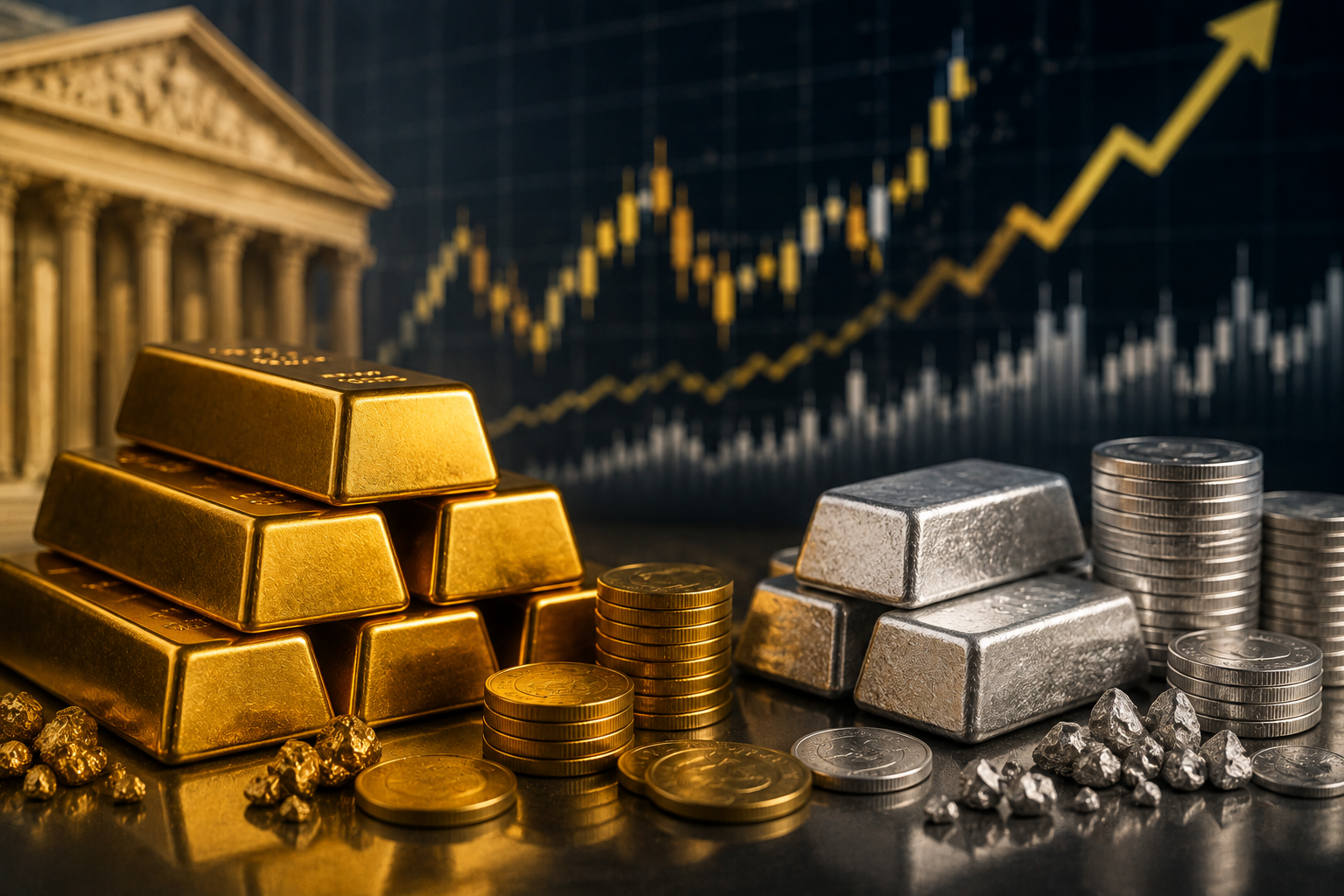
Gold gains as unexpected US Treasury bond buybacks strengthen safe-haven appeal, while silver remains under pressure despite staying above the $69 mark
Gold prices extended their strength in early trade on Monday, August 24, after the US Treasury announced higher-than-expected buybacks of long-term government bonds. The development supported demand for bullion, while investors continued to assess interest-rate expectations, the US dollar and broader global risks.
In the international market, Comex gold traded above $4,700 per ounce, while silver remained above the $69-per-ounce mark but moved lower. On the domestic front, MCX gold was trading around ₹1.64 lakh per 10 grams, while silver futures remained close to ₹2.46 lakh per kg.
The contrasting performance of the two metals highlights a divergence in investor sentiment, with gold retaining stronger safe-haven demand while silver remains more sensitive to profit-taking and industrial-growth expectations.
Gold stages strong recovery on MCX
Gold futures began Monday's session on a weaker note before attracting buying interest at lower levels.
The benchmark October gold contract on the Multi Commodity Exchange (MCX) opened at approximately ₹1,62,052 per 10 grams, down ₹386 from its previous close of ₹1,62,438.
The contract subsequently reversed the early decline and climbed to around ₹1,63,570, gaining more than ₹1,100 from the previous close. It touched an intraday high of ₹1,63,585 and a low of ₹1,62,001.
The recovery suggests that investors continue to find support at lower levels despite gold trading at historically elevated prices.
Gold futures have witnessed significant volatility this year, with the reported yearly high standing at approximately ₹1,80,779 per 10 grams.
Comex gold crosses the $4,700 threshold
International gold prices also moved higher during the session.
On Comex, gold opened at $4,673.40 per ounce, compared with the previous closing price of $4,680.60. The contract subsequently climbed to around $4,706.30 per ounce, gaining approximately $25.70.
Crossing the $4,700 level keeps gold firmly in focus among global investors and reflects continued demand for the precious metal.
However, gold remains below its reported yearly high of $5,586.20 per ounce, highlighting the substantial volatility that has characterised the bullion market this year.
US Treasury bond buybacks lift bullion sentiment
The major catalyst for Monday's move was the US Treasury's unexpected announcement of higher buybacks of long-term government bonds.
Bond-market developments are particularly important for gold because Treasury yields influence the opportunity cost of holding a non-yielding asset.
When bond yields decline or expectations of easier financial conditions increase, gold can become relatively more attractive compared with interest-bearing assets.
The latest buyback announcement therefore provided an additional supportive factor for bullion prices at a time when investors are already closely tracking US monetary-policy expectations.
Why lower yields can support gold
Gold does not generate interest income or dividends. Consequently, its relative attractiveness can increase when yields on government bonds decline.
A broad decline in bond yields can encourage investors to increase allocations towards precious metals, particularly when accompanied by concerns over inflation, geopolitical uncertainty or financial-market volatility.
On the other hand, a sharp rise in Treasury yields could increase the opportunity cost of holding gold and potentially trigger profit-taking.
For this reason, the US bond market is likely to remain a critical indicator for bullion traders.
Silver loses momentum despite staying above $69
Silver followed a different trajectory from gold.
The benchmark September silver contract on MCX opened at around ₹2,45,597 per kg, down ₹1,000 from its previous close of ₹2,46,597.
At the time of reporting, the contract was trading around ₹2,46,136 per kg, down approximately ₹461. During the session, silver touched a high of ₹2,46,475 and a low of ₹2,44,815.
Silver futures have also experienced extraordinary volatility during the year, with the reported yearly high at approximately ₹4,20,048 per kg.
The wide gap between the current price and the yearly high demonstrates why investors need to account for substantially higher volatility when trading silver.
International silver remains under pressure
Comex silver futures opened at approximately $69.34 per ounce, compared with the previous close of $69.53.
The metal was trading around $69.16 per ounce, down approximately $0.37.
Although silver remains above $69, the marginal decline contrasts with gold's stronger performance.
The metal's reported yearly high of $121.79 per ounce also underlines the sharp price swings witnessed in the global silver market.
Gold and silver no longer move in perfect tandem
While both metals are traditionally grouped under the precious-metals category, their price drivers are not identical.
Gold is primarily influenced by:
-
Interest-rate expectations
-
US Treasury yields
-
Central-bank purchases
-
Geopolitical uncertainty
-
Safe-haven demand
-
US dollar movements
-
Investor flows
Silver, on the other hand, combines monetary demand with significant industrial exposure.
It is widely used across electronics, solar-energy applications, manufacturing and other industrial sectors. As a result, expectations surrounding global economic growth can have a greater impact on silver than on gold.
This difference can explain why gold may outperform silver during periods of heightened financial uncertainty.
US dollar remains a key variable
The direction of the US dollar will remain crucial for the bullion market.
Gold and silver are internationally priced in dollars, meaning movements in the greenback can influence demand from investors holding other currencies.
A weaker dollar generally makes dollar-denominated commodities relatively cheaper for international buyers and can support bullion demand.
A stronger dollar, meanwhile, can create headwinds for precious metals.
The dollar's trajectory will therefore need to be monitored alongside US Treasury yields and Federal Reserve policy expectations.
Geopolitical uncertainty supports safe-haven demand
Global geopolitical risks continue to provide an underlying support mechanism for gold.
During periods of heightened uncertainty, investors often increase exposure to assets that can preserve value when riskier financial assets come under pressure.
Any escalation in geopolitical tensions, disruptions to global trade or concerns surrounding energy supplies could therefore strengthen demand for gold.
However, a meaningful easing of geopolitical tensions could trigger some profit-taking, particularly after the metal's substantial rally.
Rupee movement adds another layer for Indian investors
Indian investors need to track both international bullion prices and the rupee-dollar exchange rate.
Even if global gold prices remain unchanged, a weaker rupee can increase the domestic cost of imported gold.
With the rupee trading around ₹95.64 against the US dollar during early trade, currency movements remain an important factor for MCX prices.
Therefore, domestic gold prices can outperform or underperform international prices depending on the movement of the rupee.
What could drive gold prices higher?
Several factors could strengthen the bullish case for gold in the near term:
-
Falling US Treasury yields
-
A weaker US dollar
-
Expectations of monetary easing
-
Continued central-bank buying
-
Escalation in geopolitical tensions
-
Strong safe-haven demand
-
Persistent inflation concerns
-
Increased investor allocation to bullion
A combination of these factors could keep gold prices elevated and potentially encourage another attempt towards previous highs.
What could trigger a correction?
Despite the positive momentum, investors should not ignore downside risks.
Gold could face profit-taking if:
-
US Treasury yields rise sharply
-
The dollar strengthens significantly
-
Geopolitical tensions ease
-
Investors rotate towards equities and other risk assets
-
Central-bank demand slows
-
Speculative positions become excessively stretched
Given the elevated price levels, even a modest change in market expectations could result in substantial short-term volatility.
Silver needs fresh buying momentum
For silver, the outlook remains more complicated.
The metal continues to benefit from long-term industrial demand, particularly from renewable-energy and technology-related applications. However, its relatively higher volatility means it can experience sharp corrections even when its long-term fundamentals remain favourable.
The immediate focus will be whether silver can sustain itself above the $69-per-ounce zone internationally and attract renewed buying interest.
A sustained recovery in global industrial activity could provide additional support, while concerns over economic growth could weigh on demand.
MCX bullion outlook
For Indian commodity-market participants, the combination of global bullion prices, the rupee's movement and domestic demand will determine the next major move.
Gold remains comparatively stronger, supported by international buying and the latest US Treasury bond-buyback announcement. Silver, meanwhile, is consolidating after a period of extreme volatility.
Traders should avoid treating gold and silver as identical trades because their short-term drivers can diverge significantly.
Bullion Market Outlook
Gold retains a positive bias, but volatility is likely to remain elevated. The move above $4,700 on Comex indicates that buyers remain active, while the unexpected increase in US Treasury bond buybacks has strengthened the metal's appeal.
For silver, the near-term trend appears more cautious. Holding above $69 remains important, but the metal needs stronger buying participation to regain upward momentum.
For Indian investors, the rupee-dollar exchange rate will be equally important, as continued rupee weakness can amplify the impact of higher international bullion prices on domestic markets.
Key levels and indicators to watch
Gold: International prices above $4,700 remain significant for momentum, while traders will track previous highs and signs of profit-taking.
Silver: Sustaining above $69 could help stabilise sentiment, while renewed buying would be required for a stronger recovery.
Currency: The rupee's movement around the ₹95–₹96 per dollar region could influence domestic bullion prices.
Global cues: US Treasury yields, Federal Reserve expectations, the Dollar Index, geopolitical developments and global risk appetite will remain the most important external drivers.
Bottom Line
The precious-metals market begins the week with gold firmly in the spotlight. The metal's rise above $4,700 on Comex reflects continued investor demand amid shifting expectations around US bonds, interest rates and global uncertainty.
Silver remains structurally important because of its industrial applications, but its weaker performance on Monday shows that investors are currently favouring gold's defensive characteristics.
For the near term, the direction of US bond yields, the dollar and geopolitical risk will be crucial. If yields and the dollar soften further, gold could retain its advantage. If risk appetite improves sharply and yields rebound, both metals could face profit-taking.
For Indian investors, the combination of international bullion prices + rupee movement + MCX trends will ultimately determine the direction of domestic gold and silver prices.