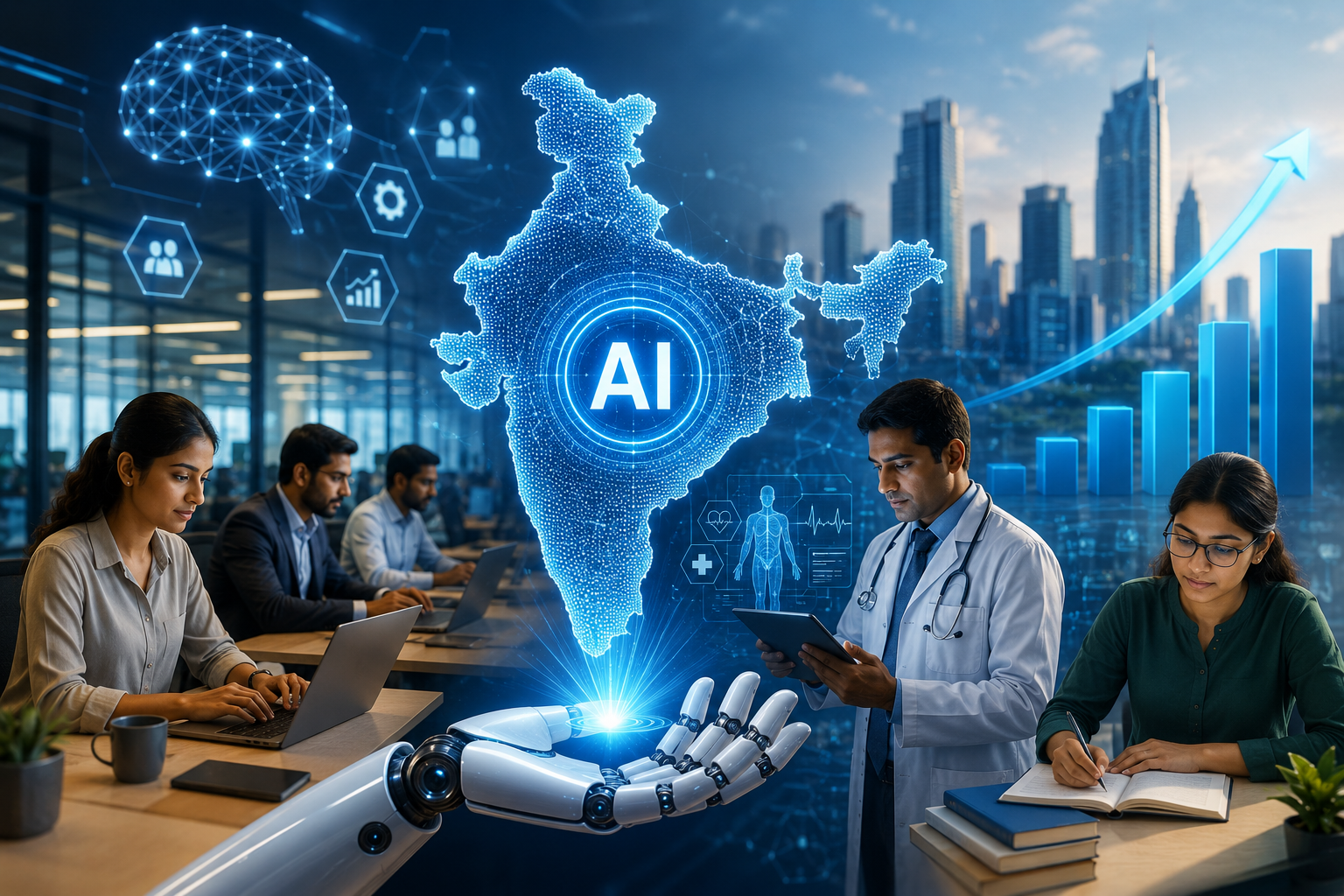
Generative AI Could Automate Up to 17% of Work Tasks, While 42–48% of India's Workforce Stands to Benefit Through Higher Productivity
Generative Artificial Intelligence (Gen-AI) is set to redefine India's workplace over the next decade, but fears of widespread job losses appear overstated. According to a latest report by Goldman Sachs, AI is expected to augment nearly half of India's non-agricultural workforce, while only a relatively small percentage of jobs face meaningful automation risk.
The global investment bank estimates that 42–48% of India's non-agricultural jobs will be complemented by AI, helping employees work faster and more efficiently, whereas only 8–12% of jobs are likely to face substitution. The report concludes that AI's primary role in India will be to improve productivity rather than replace workers.
As businesses across sectors—including information technology, banking, healthcare, education and professional services—accelerate investments in AI-powered tools, the technology is increasingly becoming a strategic business enabler rather than merely a cost-cutting solution.
AI Will Transform Tasks, Not Entire Jobs
One of the key findings of the Goldman Sachs report is that AI is expected to automate individual work tasks rather than complete occupations.
Depending on how quickly AI capabilities evolve, the report estimates that 9% to 17% of work tasks performed by India's non-agricultural workforce could eventually be automated.
Under Goldman Sachs' base-case scenario, approximately 13–15% of tasks are likely to become AI-enabled.
This distinction is significant because most jobs involve multiple activities. While AI can efficiently perform repetitive or information-based tasks, areas requiring human judgement, emotional intelligence, creativity, leadership and physical skills will continue to depend on people.
Nearly Half of India's Workforce Could Become More Productive
Rather than replacing employees, AI is expected to function as a workplace assistant for millions of professionals.
Estimated AI Impact on India's Workforce
| Category | Estimated Share |
|---|---|
| Jobs complemented by AI | 42–48% |
| Jobs at substitution risk | 8–12% |
| Jobs largely unaffected | 40–45% |
According to Goldman Sachs, employees will increasingly use AI to automate repetitive work, analyse data, draft reports, generate content and improve decision-making, allowing them to focus on higher-value responsibilities.
Knowledge-Based Industries Will Benefit the Most
The report identifies several service-oriented industries as the biggest beneficiaries of AI adoption because they rely heavily on information processing and analytical work.
Sectors with Highest AI Exposure
-
Information Technology
-
Financial Services
-
Banking
-
Healthcare
-
Education
-
Professional Services
-
Consulting
-
Media
-
Legal Services
Employees in these industries spend a significant portion of their time analysing information, preparing documentation, generating content and making complex decisions—areas where AI can substantially improve efficiency.
Healthcare professionals could benefit through AI-assisted diagnostics, while educators may leverage AI for personalised learning and content creation. Financial institutions are expected to increasingly adopt AI for customer service, fraud detection, compliance and risk management.
Manufacturing and Construction Less Exposed
Unlike knowledge-intensive sectors, industries that rely primarily on physical labour remain relatively insulated from AI disruption.
Sectors with Lower AI Exposure
-
Manufacturing
-
Construction
-
Mining
-
Logistics Operations
-
Industrial Production
Although automation and robotics will continue to evolve, current generative AI technologies are less effective in replacing jobs involving physical movement, machinery operation and on-site execution.
As a result, these industries are expected to experience gradual productivity improvements rather than significant workforce disruption.
Routine Office Roles Face the Highest Automation Risk
The report identifies occupations involving repetitive administrative work as the most vulnerable to AI-driven automation.
Higher-Risk Occupations
-
Clerical support staff
-
Administrative assistants
-
Customer support executives
-
Business Process Services (BPS)
-
Data entry professionals
-
Documentation specialists
-
Routine back-office operations
Many of these roles involve standardised and rule-based processes that can increasingly be handled by AI systems.
However, Goldman Sachs emphasises that even within these professions, AI is likely to automate specific responsibilities rather than eliminate entire jobs.
India's IT Industry Remains Resilient
Concerns that AI could significantly weaken India's IT outsourcing industry have so far not materialised.
While India's six largest listed IT services companies have reduced their combined workforce by approximately 64,000 employees, the broader technology ecosystem has continued to expand.
Technology Sector Highlights
-
Around 700,000 new jobs created by Global Capability Centres (GCCs) over the past three years.
-
GCC employment has increased to nearly 4.4 million professionals.
-
Software services exports continue to remain above pre-pandemic growth levels.
These figures suggest that while traditional outsourcing roles are evolving, demand for technology talent remains strong as companies increasingly invest in AI, cloud computing, cybersecurity and digital transformation.
AI Could Significantly Improve India's Productivity
Beyond employment, Goldman Sachs expects AI to become a major contributor to India's long-term economic growth.
The report estimates that AI could increase India's annual labour productivity growth by around 0.4 percentage points every year over the next decade.
Under a faster AI adoption scenario, annual productivity gains could rise to 0.8 percentage points.
Industries expected to experience the greatest productivity improvements include:
-
Education
-
Healthcare
-
Financial Services
-
Media
-
Professional Services
Higher productivity could improve business profitability, strengthen competitiveness and support sustained economic growth.
Infrastructure, Not Talent, Is India's Biggest Challenge
Despite possessing one of the world's largest technology talent pools, Goldman Sachs believes India's biggest obstacle to AI adoption is infrastructure.
The report highlights that India currently accounts for only around 1% of global data centre capacity, compared with:
| Country | Share of Global Data Centre Capacity |
|---|---|
| United States | 47% |
| China | 25% |
| India | 1% |
India's current data-centre capacity of roughly 1 gigawatt (GW) remains insufficient to support large-scale AI deployment.
Massive Investment Will Be Needed
To unlock AI's full economic potential, India will need substantial investment across digital infrastructure.
Key areas requiring expansion include:
-
Data centres
-
High-performance computing
-
Cloud infrastructure
-
Reliable electricity supply
-
Water availability for cooling
-
Semiconductor ecosystem
-
High-speed broadband connectivity
Without adequate infrastructure, AI adoption could remain slower than demand from businesses and consumers.
Policy Environment Will Play a Critical Role
Goldman Sachs also cautioned that international regulations could influence India's AI-driven export industry.
Governments worldwide are increasingly tightening rules around:
-
Cross-border data transfers
-
AI model deployment
-
Digital sovereignty
-
Data localisation
-
Privacy regulations
For example, the European Union has strengthened rules governing international data flows, while the United States has placed greater emphasis on AI sovereignty and domestic deployment of advanced AI models.
Such developments could affect India's software services exports and the pace at which global enterprises deploy AI solutions across borders.
AI Will Create New Career Opportunities
While certain repetitive jobs may gradually decline, AI is also expected to create entirely new employment opportunities.
Emerging career paths include:
-
AI Engineers
-
Machine Learning Specialists
-
Prompt Engineers
-
AI Product Managers
-
AI Governance Experts
-
AI Auditors
-
AI Cybersecurity Specialists
-
Data Infrastructure Professionals
-
Human-AI Collaboration Consultants
Historically, every major technological revolution has generated new industries alongside workforce disruption, and Goldman Sachs believes generative AI will follow a similar trajectory.
Key Highlights from the Goldman Sachs Report
| Indicator | Estimate |
|---|---|
| Work tasks exposed to AI | 9–17% |
| Base-case task automation | 13–15% |
| Jobs complemented by AI | 42–48% |
| Jobs at substitution risk | 8–12% |
| Annual productivity boost | 0.4 percentage points |
| Faster AI scenario | 0.8 percentage points |
| India's share of global data-centre capacity | 1% |
What It Means for Businesses and Investors
The report reinforces that AI is likely to become a major productivity driver across India's economy rather than a large-scale employment disruptor. Companies investing in artificial intelligence, cloud computing, digital infrastructure and enterprise software could benefit from rising corporate AI adoption. At the same time, sectors such as data centres, semiconductor infrastructure, power equipment, cybersecurity and digital services are expected to attract significant investment as India builds the foundation required for widespread AI deployment.
Market Outlook
India's AI adoption story is entering a phase where productivity gains are expected to outweigh job displacement. Continued investments by enterprises, growing adoption of AI across service industries and the expansion of digital infrastructure are likely to create long-term opportunities for technology companies and related sectors. However, the pace of adoption will depend on improvements in computing infrastructure, data-centre capacity, regulatory clarity and access to affordable AI technologies, making these key themes to watch over the coming years.