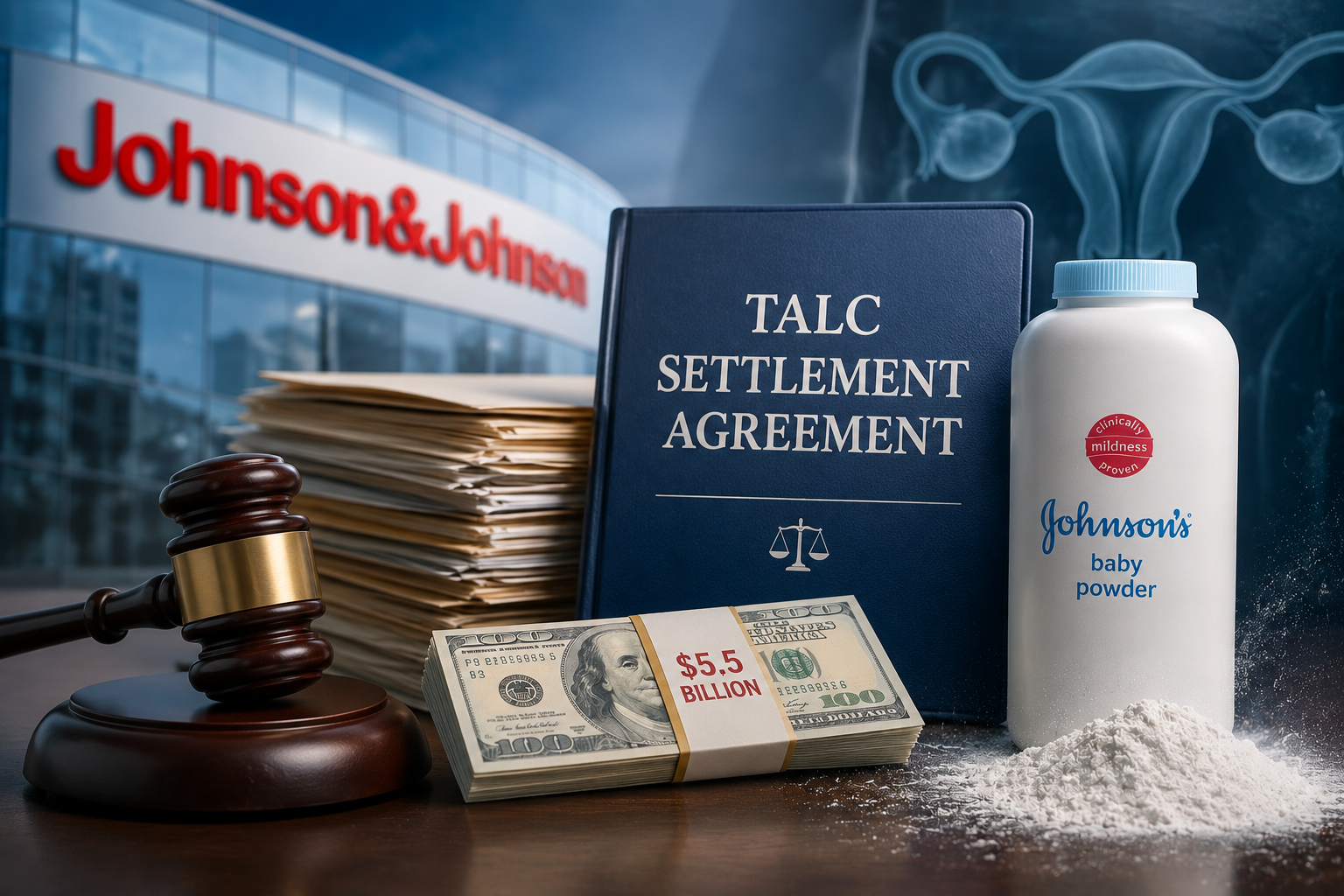
Healthcare Giant Seeks Closure to 15-Year Legal Battle While Continuing to Deny Allegations That Talc-Based Baby Powder Caused Cancer
Johnson & Johnson (J&J) has reached a proposed $5.5 billion settlement to resolve tens of thousands of lawsuits alleging that its talc-based baby powder and related products caused ovarian cancer. The agreement represents one of the largest product liability settlements in the pharmaceutical and healthcare industry and could finally bring an end to a legal dispute that has overshadowed the company for more than 15 years.
Despite agreeing to the settlement, Johnson & Johnson continues to maintain that its talc products are safe, do not contain asbestos and do not cause cancer. The company said the proposed resolution is intended to eliminate prolonged litigation, reduce legal uncertainty and allow management to focus on its core healthcare business.
The announcement was welcomed by investors, with J&J shares rising in after-hours trading as markets viewed the move as a significant step toward removing one of the company's largest legal overhangs.
Settlement Hinges on Approval from Majority of Plaintiffs
The proposed settlement is not yet final.
Johnson & Johnson said the agreement requires participation from law firms representing at least 95% of the ovarian cancer claims currently pending in US state and federal courts.
If this threshold is achieved, the settlement would resolve the overwhelming majority of the litigation through a single comprehensive agreement rather than years of additional courtroom battles.
The company described the proposal as the most efficient and equitable way to conclude one of the largest mass tort cases in US legal history.
One of the Largest Corporate Legal Battles in Healthcare
The talc litigation has become one of the most expensive and closely watched legal disputes involving a global healthcare company.
Women who filed lawsuits alleged that prolonged use of Johnson & Johnson's talc-based baby powder exposed them to asbestos, ultimately leading to ovarian cancer.
Over the years, thousands of lawsuits were filed across the United States, making the case one of the country's largest product liability litigations.
Johnson & Johnson has consistently rejected these allegations, arguing that:
-
Scientific evidence does not establish a causal relationship between talc and ovarian cancer.
-
Independent testing has shown its products did not contain asbestos.
-
Numerous regulatory agencies have supported the safety profile of cosmetic talc.
Nevertheless, the company acknowledged that continuing litigation would involve years of uncertainty and significant legal costs.
Why Johnson & Johnson Chose to Settle
While the company believes it could continue defending itself successfully in court, management concluded that a comprehensive settlement provides greater certainty for shareholders, customers and employees.
The prolonged litigation has consumed considerable financial and management resources, with numerous jury trials, appeals and legal proceedings taking place over more than a decade.
By resolving the majority of claims at once, Johnson & Johnson aims to:
-
Eliminate ongoing litigation expenses.
-
Reduce uncertainty surrounding future liabilities.
-
Improve long-term financial visibility.
-
Allow management to focus on pharmaceutical innovation and medical technology.
-
Restore investor confidence.
Baby Powder Was Withdrawn Despite Denying Wrongdoing
Although Johnson & Johnson continues to deny that its talc products pose health risks, the company has gradually discontinued talc-based baby powder around the world.
Timeline of Product Changes
-
2020: Talc-based baby powder sales stopped in the United States and Canada.
-
2023: Global discontinuation of talc-based baby powder.
The company now markets a cornstarch-based alternative and has repeatedly stated that the decision reflected evolving consumer preferences rather than safety concerns.
However, the withdrawal became one of the defining developments in the broader litigation.
Previous Bankruptcy Strategy Failed
Before announcing the latest settlement, Johnson & Johnson attempted several times to resolve the litigation through bankruptcy proceedings.
The company transferred talc-related liabilities into a separate subsidiary, hoping to use bankruptcy protections to negotiate a global settlement.
The strategy, commonly referred to as the "Texas Two-Step," drew widespread criticism from plaintiffs, legal experts and consumer advocacy groups, who argued that a financially strong multinational corporation should not use bankruptcy laws intended for distressed businesses.
Several courts rejected or questioned aspects of the restructuring strategy, forcing Johnson & Johnson back into direct settlement negotiations.
Thousands of Claims Still Pending
At the time of the settlement announcement, Johnson & Johnson continued to face approximately 76,000 lawsuits related to talc products.
Legal analysts had warned that the number of claims could eventually exceed 90,000, significantly increasing the company's financial exposure if litigation continued.
The legal battle has produced several large jury verdicts over the years.
One of the most notable came in October last year when a California jury ordered Johnson & Johnson to pay $966 million to the family of a woman whose cancer was allegedly linked to lifelong use of the company's baby powder.
Although many verdicts have later been appealed or reduced, the litigation remained a major uncertainty for investors.
Company Had Already Built a Large Legal Reserve
Johnson & Johnson has spent years preparing financially for a potential settlement.
Earlier this year, the company disclosed that it had earmarked approximately $11 billion to address talc-related legal liabilities.
Analysts had estimated that resolving nearly all pending claims could cost between $10 billion and $12 billion, meaning the newly announced settlement broadly aligns with market expectations.
The company's strong balance sheet and robust cash generation mean the settlement is unlikely to materially affect its long-term financial strength.
Impact on Johnson & Johnson's Business
The proposed settlement is expected to remove one of the largest legal distractions facing the company.
Johnson & Johnson remains one of the world's largest healthcare companies, operating across three major business segments:
-
Innovative Medicines
-
Medical Technology
-
Consumer Health (through the separated Kenvue business)
By resolving the talc litigation, management is expected to devote greater attention to:
-
Drug discovery and research.
-
Medical device innovation.
-
Strategic acquisitions.
-
Expansion into high-growth therapeutic areas.
-
Long-term shareholder value creation.
Investor Sentiment Improves
Financial markets reacted positively to the announcement.
Johnson & Johnson shares gained in after-hours trading as investors welcomed the possibility of finally closing a legal chapter that had weighed on the stock for years.
Market participants generally view legal certainty favourably because it enables more accurate earnings forecasts and reduces the risk of unexpected litigation-related expenses.
Analysts also believe the settlement may improve investor confidence by removing a major overhang that has influenced valuation multiples.
Key Takeaways for Investors
Positive Developments
-
Potential resolution of a 15-year legal dispute.
-
Significant reduction in litigation uncertainty.
-
Improved visibility on future legal costs.
-
Strong financial capacity to absorb settlement payments.
-
Management can refocus on core healthcare operations.
Risks That Remain
-
Settlement requires approval from at least 95% of eligible claimants.
-
Some claims may remain outside the agreement.
-
Additional legal challenges cannot be completely ruled out.
-
Reputational concerns may persist despite the settlement.
Market Outlook
Johnson & Johnson's proposed $5.5 billion settlement marks one of the most significant legal resolutions in the global healthcare sector and could finally draw a line under one of the company's most challenging corporate disputes. While the company continues to deny that its talc-based products caused cancer or contained asbestos, the agreement reflects a pragmatic effort to eliminate years of costly litigation and provide greater certainty for shareholders.
If the required plaintiff participation is secured, the settlement is expected to strengthen investor confidence, reduce future legal uncertainty and allow Johnson & Johnson to concentrate on its core pharmaceutical and medical technology businesses. For investors, the resolution removes a major overhang and shifts the focus back to the company's earnings growth, innovation pipeline and long-term strategic execution.