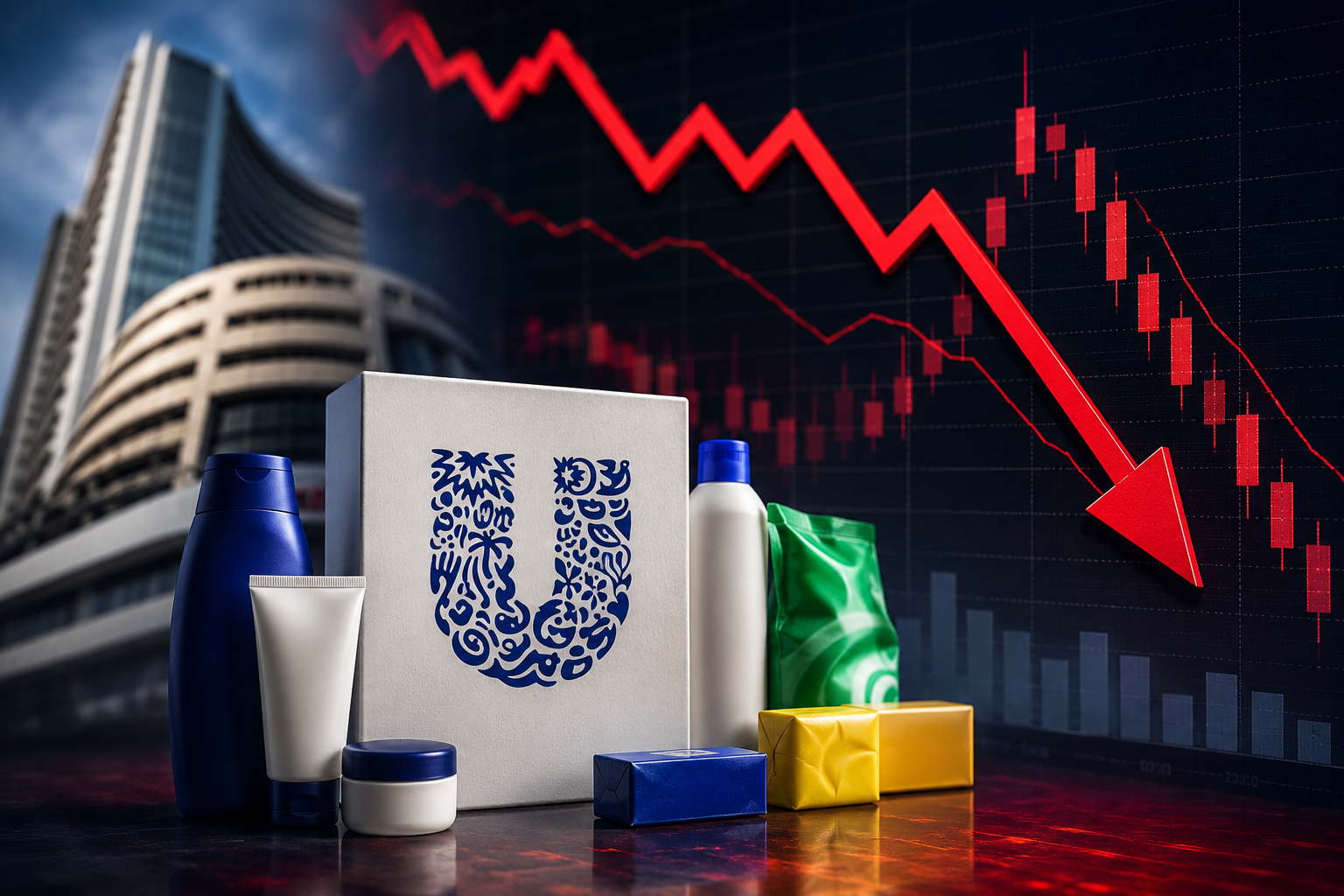
FMCG Major Disappoints Investors with Lower-Than-Expected June Quarter Performance as Weak Profitability Triggers Sharp Selling
Shares of Hindustan Unilever Ltd. (HUL) witnessed heavy selling pressure on Tuesday, falling more than 5% after the country's largest fast-moving consumer goods (FMCG) company reported weaker-than-expected financial results for the first quarter of FY27. Despite maintaining its leadership across several consumer product categories, the company's earnings fell short of Street expectations, prompting investors to book profits and reassess growth prospects.
The stock declined to an intraday low of around ₹2,062.70 on the National Stock Exchange (NSE), making it one of the biggest losers in the benchmark indices during the session. The sharp decline also weighed on the broader FMCG sector, as investors grew cautious about earnings momentum across consumer-focused businesses.
Q1 Profit Declines as Earnings Miss Street Estimates
For the quarter ended June 2026, Hindustan Unilever reported a consolidated net profit of ₹2,673 crore, compared with ₹2,756 crore in the corresponding quarter of the previous financial year, reflecting a decline of around 3% year-on-year.
The performance was below analysts' expectations, who had projected a 9–10% year-on-year increase in net profit, supported by expectations of improving consumer demand and lower raw material costs.
The earnings miss came despite stable revenue growth, highlighting the pressure on profitability rather than top-line performance.
Margin Pressure Remains the Biggest Concern
A key factor behind the negative market reaction was the continued pressure on operating margins. While the company managed to sustain sales across key product categories, higher operating expenses, promotional spending and an evolving product mix affected profitability during the quarter.
Investors were expecting a stronger recovery in margins, especially after commodity prices had moderated over recent months. However, the results indicated that the benefits of lower input costs have yet to fully translate into improved earnings.
Market analysts believe that maintaining competitive pricing in an increasingly aggressive FMCG landscape has also limited the company's ability to expand margins.
Investor Sentiment Turns Negative
The disappointing quarterly performance triggered broad-based selling in HUL shares, with institutional investors leading the decline. The stock emerged as one of the largest contributors to the weakness in both the Nifty 50 and the Sensex, reflecting its significant weight in the benchmark indices.
Brokerages noted that while HUL remains fundamentally strong, the weaker-than-expected earnings could result in downward revisions to FY27 earnings estimates if margin improvement remains slower than anticipated.
Some analysts also believe that premium valuations leave little room for earnings disappointments, making the stock particularly sensitive to quarterly performance.
Demand Environment Remains Mixed
Management commentary suggested that consumer demand continues to recover gradually, although the pace remains uneven across urban and rural markets.
Urban consumption has remained relatively resilient, supported by premium product demand, while rural markets continue to improve slowly following better agricultural income and easing inflation. However, competitive intensity across personal care, home care and packaged foods continues to remain high.
The company is expected to continue investing in product innovation, premiumisation and distribution expansion to strengthen long-term growth.
What Analysts Are Watching
Following the June quarter results, market participants will closely monitor several key factors over the coming quarters:
-
Improvement in operating margins as raw material costs stabilise.
-
Growth in rural consumption during the festive season.
-
Volume-led revenue expansion rather than price-driven growth.
-
Performance of premium product categories.
-
Management's strategy on pricing, innovation and cost optimisation.
Analysts believe these factors will determine whether HUL can regain earnings momentum in the second half of FY27.
Impact on the FMCG Sector
HUL's earnings have once again highlighted the challenges facing India's FMCG industry. Although inflationary pressures have eased compared to previous years, companies continue to navigate higher competitive intensity, changing consumer preferences and elevated marketing expenses.
The results also reinforce the importance of execution during an environment where consumers are becoming increasingly value-conscious while premium segments continue to expand.
Investors are now likely to focus on upcoming quarterly results from other FMCG companies to gauge whether HUL's weak profitability is company-specific or indicative of broader sector trends.
Market Outlook
Despite Tuesday's sharp decline, Hindustan Unilever remains one of India's most established consumer businesses with a diversified product portfolio, strong cash flows and an extensive distribution network. However, the latest quarterly performance suggests that near-term challenges persist, particularly in restoring operating margins and accelerating earnings growth.
For investors, the coming quarters will be crucial in determining whether HUL can capitalise on improving consumer demand and easing input costs to deliver stronger profitability. Until then, the stock may continue to witness cautious trading as the market awaits clearer signs of margin recovery and sustained earnings growth.