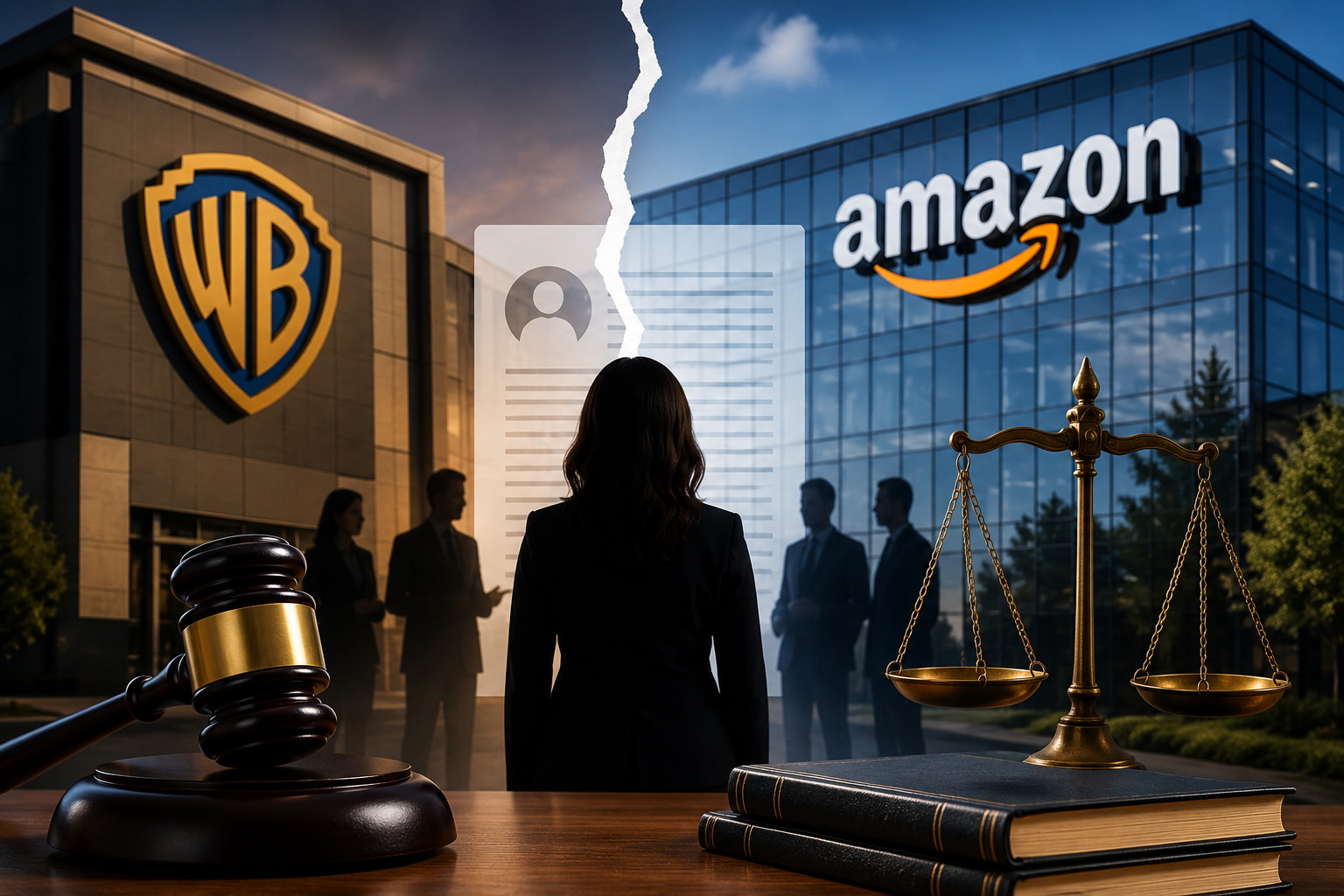
Dispute Over Senior Executive Pia Barlow Raises Questions on Employment Contracts, Executive Mobility and Corporate Recruitment Practices
A legal battle between Warner Bros. Discovery (WBD) and Amazon has brought the spotlight onto one of the most debated issues in corporate hiring—whether companies can recruit senior executives who are still bound by fixed-term employment contracts. Warner Bros. Discovery has filed a lawsuit against Amazon, alleging that the technology giant knowingly induced one of its top marketing executives, Pia Chaozon Barlow, to breach her employment agreement before its scheduled expiry.
The lawsuit, filed in the Los Angeles Superior Court, accuses Amazon of intentionally interfering with Warner Bros.' contractual relationship by hiring Barlow despite allegedly being aware that she remained under contract until October 2027. The case has quickly become one of the most closely watched legal disputes in the entertainment industry, with experts suggesting it could influence future executive hiring practices across media, technology and corporate sectors.
If the court rules in favour of Warner Bros., the decision could strengthen employers' ability to enforce long-term executive contracts. Conversely, a ruling favouring Amazon may reinforce greater freedom for companies to recruit experienced executives even when contractual obligations remain in place.
The Core of the Dispute
Unlike traditional employment disputes, this lawsuit is not centred solely on an employee resigning from her position. Instead, Warner Bros. Discovery argues that Amazon actively encouraged Barlow to leave before the completion of a legally binding employment agreement.
According to the complaint, Barlow signed a three-year employment contract with Warner Bros. Discovery that was due to expire on 31 October 2027. However, she resigned in June 2026, approximately 16 months before the end of the agreement, after accepting a senior leadership role at Amazon MGM Studios.
Warner Bros. alleges that Amazon knew about the contractual restrictions yet proceeded with the hiring process.
Legal Claims Filed Against Amazon
The entertainment giant has accused Amazon of multiple legal violations under California law.
Claims Include
-
Intentional interference with contractual relations.
-
Inducing breach of contract.
-
Intentional interference with prospective economic advantage.
-
Unfair competition.
Warner Bros. argues that Amazon's actions were not accidental but constituted a deliberate effort to persuade a senior executive to violate an existing contractual commitment.
Why Warner Bros. Is Targeting Amazon
Many employment disputes involve action against the departing employee. However, Warner Bros. has chosen to directly challenge Amazon's role in the recruitment process.
The company alleges that:
-
Amazon was informed of Barlow's employment agreement.
-
Warner Bros. communicated the contractual obligations in writing.
-
Amazon allegedly chose not to withdraw its employment offer.
-
The company continued with the appointment despite being aware of the legal risks.
The lawsuit contends that Amazon intentionally interfered with Warner Bros.' contractual rights rather than merely recruiting available talent.
Alleged Legal Support Offered to the Executive
One of the more significant allegations contained in the complaint is that Amazon allegedly assured Barlow it would provide legal protection should Warner Bros. attempt to enforce the employment agreement.
According to Warner Bros., Amazon offered to:
-
Cover legal expenses.
-
Provide legal representation.
-
Indemnify the executive against potential claims.
These allegations have not yet been tested in court, and Amazon has not publicly responded to the claims.
What Warner Bros. Must Establish
To succeed, Warner Bros. Discovery must demonstrate several key legal elements.
The company will need to prove:
-
The employment contract was legally valid and enforceable.
-
Amazon knew the agreement existed.
-
Amazon intentionally encouraged its breach.
-
The contract was violated.
-
Warner Bros. suffered measurable damages.
The court will ultimately determine whether sufficient evidence exists to support these allegations.
What Warner Bros. Wants the Court to Order
The media company has requested a range of legal remedies.
Requested Relief
-
Compensatory damages.
-
Punitive damages.
-
Injunctive relief.
-
Protection against future contractual interference.
An injunction could potentially restrict similar recruitment practices if the court concludes that unlawful interference occurred.
Who Is Pia Chaozon Barlow?
Pia Chaozon Barlow is regarded as one of the entertainment industry's leading marketing executives, with more than two decades of experience across some of the world's largest media companies.
During her career she has held senior positions at:
-
HBO.
-
Netflix.
-
Twentieth Century Fox.
-
HBO Max.
-
Amazon MGM Studios.
Her expertise in launching major streaming and entertainment franchises has earned her a strong reputation within the industry.
Campaigns She Helped Lead
Barlow has been associated with the marketing of several globally recognised productions.
Among them are:
-
House of the Dragon
-
Hacks
-
The Pitt
-
Upcoming Harry Potter television series
Her experience in building successful global campaigns made her a valuable executive for both Warner Bros. Discovery and Amazon.
Amazon's New Role for Barlow
Amazon recently confirmed Barlow's appointment as Vice President of Series Marketing at Amazon MGM Studios.
Her responsibilities are expected to include:
-
Marketing strategy for Prime Video originals.
-
Global promotional campaigns.
-
Audience acquisition.
-
Brand positioning.
-
Launch management for premium content.
The appointment reflects Amazon's continued investment in strengthening its entertainment business.
Why This Lawsuit Matters Beyond Hollywood
Although the dispute involves the entertainment industry, the outcome could influence hiring practices across multiple sectors.
Large corporations frequently compete for experienced executives in industries such as:
-
Technology.
-
Financial services.
-
Pharmaceuticals.
-
Media.
-
Consumer businesses.
The case may clarify the legal boundaries governing executive recruitment where fixed-term contracts are involved.
Corporate Talent Wars Are Intensifying
The battle also highlights how valuable experienced executives have become.
Companies increasingly compete for leaders capable of driving:
-
Digital transformation.
-
Global expansion.
-
Brand growth.
-
Streaming strategies.
-
Technology innovation.
As executive talent becomes scarcer, legal disputes over recruitment may become more common.
Could This Influence Future Hiring Practices?
Legal experts believe companies may adopt more cautious recruitment strategies depending on the outcome.
Possible changes include:
-
Greater legal due diligence.
-
More negotiated contract buyouts.
-
Stronger executive retention agreements.
-
Enhanced employment contract enforcement.
Recruiters may also seek additional legal assurances before approaching executives under long-term contracts.
What Happens Next?
The lawsuit will now proceed through the California judicial system.
Likely next stages include:
-
Initial court hearings.
-
Discovery of evidence.
-
Witness testimony.
-
Possible settlement discussions.
-
Trial, if no settlement is reached.
The case could take several months, or even years, before reaching a final conclusion.
Broader Implications for Corporate Governance
The dispute raises important questions regarding the balance between employee mobility and contractual commitments.
Key issues include:
-
How enforceable fixed-term executive contracts are.
-
Corporate responsibility during executive recruitment.
-
Fair competition for senior leadership talent.
-
Protection of long-term business interests.
The ruling could establish an important legal reference for future corporate hiring disputes.