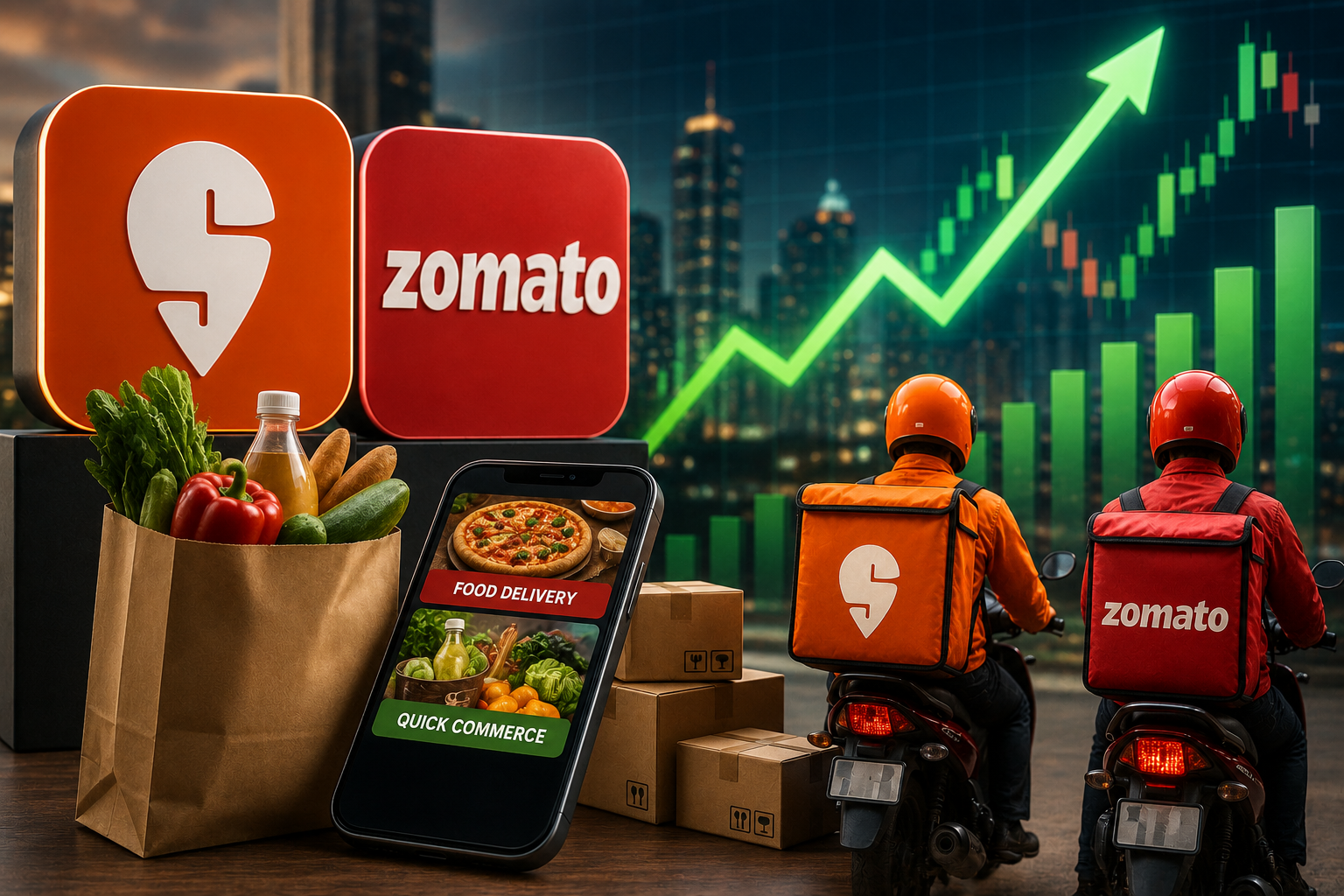
Platform Stocks Outperform the Broader Market as Investors Bet on India's Expanding Digital Consumption Economy and Multi-Year Growth in Hyperlocal Commerce
Shares of Eternal (formerly Zomato) and Swiggy surged more than 5% during Monday's trading session, outperforming the broader market amid exceptionally high trading volumes. The rally reflects growing investor confidence in India's rapidly expanding quick commerce (QC) and food delivery ecosystem, where digital adoption, urban consumption and convenience-driven shopping habits continue to reshape the retail landscape.
Eternal climbed nearly 6% during intraday trade, while Swiggy gained over 5%, with both stocks witnessing significantly higher-than-average trading volumes across the NSE and BSE. The renewed buying interest follows strong industry growth projections, encouraging quarterly updates and positive brokerage commentary that reaffirm the long-term potential of India's listed internet platform companies.
Although both companies continue to invest aggressively in expanding their delivery networks and dark-store infrastructure, analysts believe the industry is gradually moving towards a more sustainable and profitable growth phase.
Platform Stocks Witness Strong Buying Interest
Both companies emerged among the top gainers in the consumer internet space during Monday's session.
Market Performance
| Company | Intraday Gain | July 2026 Performance |
|---|---|---|
| Eternal | Up to 6% | +12% |
| Swiggy | Over 5% | +11% |
Heavy institutional participation was evident throughout the trading session:
-
More than 23.5 million shares of Eternal changed hands.
-
Around 13.4 million shares of Swiggy were traded across exchanges.
The sharp rise in trading activity indicates improving market confidence following recent corporate developments and sector optimism.
India's Digital Consumption Story Continues to Gather Pace
India's digital economy has entered a new phase of expansion, driven by increasing smartphone penetration, affordable internet access and rising consumer preference for app-based services.
Consumers are increasingly relying on digital platforms for:
-
Restaurant food delivery.
-
Grocery purchases.
-
Daily essentials.
-
Medicines.
-
Personal care products.
-
Household supplies.
-
Dining reservations.
-
Hyperlocal services.
Convenience has evolved from being a premium offering into a mainstream consumer expectation, creating long-term opportunities for platform businesses.
Quick Commerce Becomes One of India's Fastest-Growing Retail Segments
Quick commerce has emerged as one of the most dynamic segments within India's organised retail sector.
Industry estimates indicate remarkable expansion over the past few years.
Quick Commerce Growth
| Financial Year | Estimated Market Size |
|---|---|
| FY20 | Around ₹400 crore |
| FY25 | Around ₹52,700 crore |
| FY30 (Projected) | ₹4.5–6.0 trillion |
The industry is expected to register a compound annual growth rate (CAGR) of 54–63% between FY25 and FY30, making it one of the fastest-growing retail categories globally.
Such strong growth projections continue to attract long-term institutional investors despite short-term profitability challenges.
Digital Retail Still Has Significant Headroom
Despite rapid expansion, India's retail sector remains underpenetrated in terms of online commerce.
Quick commerce currently accounts for less than 1% of the country's overall retail market, highlighting the enormous opportunity that still lies ahead.
Analysts expect digital penetration to accelerate further as:
-
Smartphone usage increases.
-
Internet connectivity improves.
-
Digital payment adoption expands.
-
Consumer trust strengthens.
-
Delivery infrastructure becomes more efficient.
These structural trends provide a long runway for sustained industry growth.
Food Delivery Business Remains Resilient
Food delivery continues to serve as the foundation of both Eternal's and Swiggy's business models.
Demand continues to be supported by:
-
Rising disposable incomes.
-
Urbanisation.
-
Changing lifestyles.
-
Higher workforce participation.
-
Growing restaurant partnerships.
-
Increasing preference for convenience.
Industry experts believe online food ordering in India remains significantly below mature global markets, leaving substantial room for future expansion.
Quick Commerce Is Driving the Next Phase of Growth
While food delivery provides steady cash flows, quick commerce has become the primary engine of future growth.
Consumers increasingly expect deliveries of groceries and daily essentials within minutes rather than hours.
This shift is encouraging companies to expand:
-
Dark store networks.
-
Warehouse capacity.
-
Delivery fleets.
-
Technology infrastructure.
-
Inventory management systems.
Higher order frequency also improves customer engagement and lifetime value.
Blinkit Strengthens Eternal's Competitive Position
Eternal's quick commerce platform Blinkit continues to play a central role in the company's growth strategy.
Brokerages believe Blinkit offers substantial long-term value through:
-
Expanding order volumes.
-
Improved operational efficiency.
-
Better store utilisation.
-
Higher average order values.
-
Increasing operating leverage.
As the network matures, analysts expect profitability to improve steadily over the coming years.
Brokerages Continue to Back Eternal
Several brokerage firms remain constructive on Eternal despite near-term investment spending.
Analysts believe:
-
Food delivery remains stable.
-
Competitive intensity is becoming more predictable.
-
Margin expansion opportunities remain intact.
-
Long-term growth visibility continues to improve.
Many brokerages continue to maintain 'Buy' recommendations on the stock.
Strong Growth Potential Despite Margin Investments
Platform companies continue investing aggressively in:
-
Technology.
-
Artificial Intelligence.
-
Delivery infrastructure.
-
Dark stores.
-
Merchant partnerships.
-
Customer acquisition.
Although these investments temporarily impact profitability, analysts believe they strengthen long-term competitive advantages and support future earnings growth.
Swiggy Continues Building a Diversified Platform
Swiggy has evolved beyond food delivery into a broader consumer technology platform.
Its ecosystem now includes:
-
Food delivery.
-
Quick commerce.
-
Grocery delivery.
-
Dining experiences.
-
Logistics services.
-
Merchant solutions.
This diversified business model provides multiple growth opportunities as India's digital economy continues to expand.
Industry Dynamics Are Becoming More Rational
The competitive landscape appears to be gradually stabilising.
Rather than pursuing unlimited expansion at any cost, companies are increasingly focusing on:
-
Operational efficiency.
-
Sustainable customer acquisition.
-
Better unit economics.
-
Higher profitability.
-
Disciplined capital allocation.
This transition is viewed positively by long-term investors.
Key Drivers Supporting the Sector
Several macroeconomic and structural trends continue to favour platform companies.
Growth Drivers
-
Rising urban consumption.
-
Increasing smartphone penetration.
-
Digital payment adoption.
-
Higher disposable incomes.
-
Expanding middle class.
-
Faster logistics infrastructure.
-
Artificial Intelligence integration.
-
Growth in organised retail.
These trends are expected to support sustained demand over the coming decade.
Challenges Still Remain
Despite the optimistic outlook, the sector continues to face several risks.
Key Challenges
-
Intense competition.
-
Rising employee costs.
-
Higher delivery expenses.
-
Expansion-related capital expenditure.
-
Regulatory developments.
-
Margin pressures.
-
Consumer spending fluctuations.
Execution quality will remain critical in determining which companies emerge as long-term leaders.
Outlook for India's Internet Economy
India's internet economy continues to attract global investor interest as digital commerce becomes an increasingly important component of consumer spending.
Over the next several years, analysts expect growth to be driven by:
-
Higher online retail penetration.
-
Expansion into smaller cities.
-
Faster delivery networks.
-
AI-driven customer experiences.
-
Greater merchant participation.
-
Improved profitability through scale.
These factors are expected to create significant value for leading platform businesses.