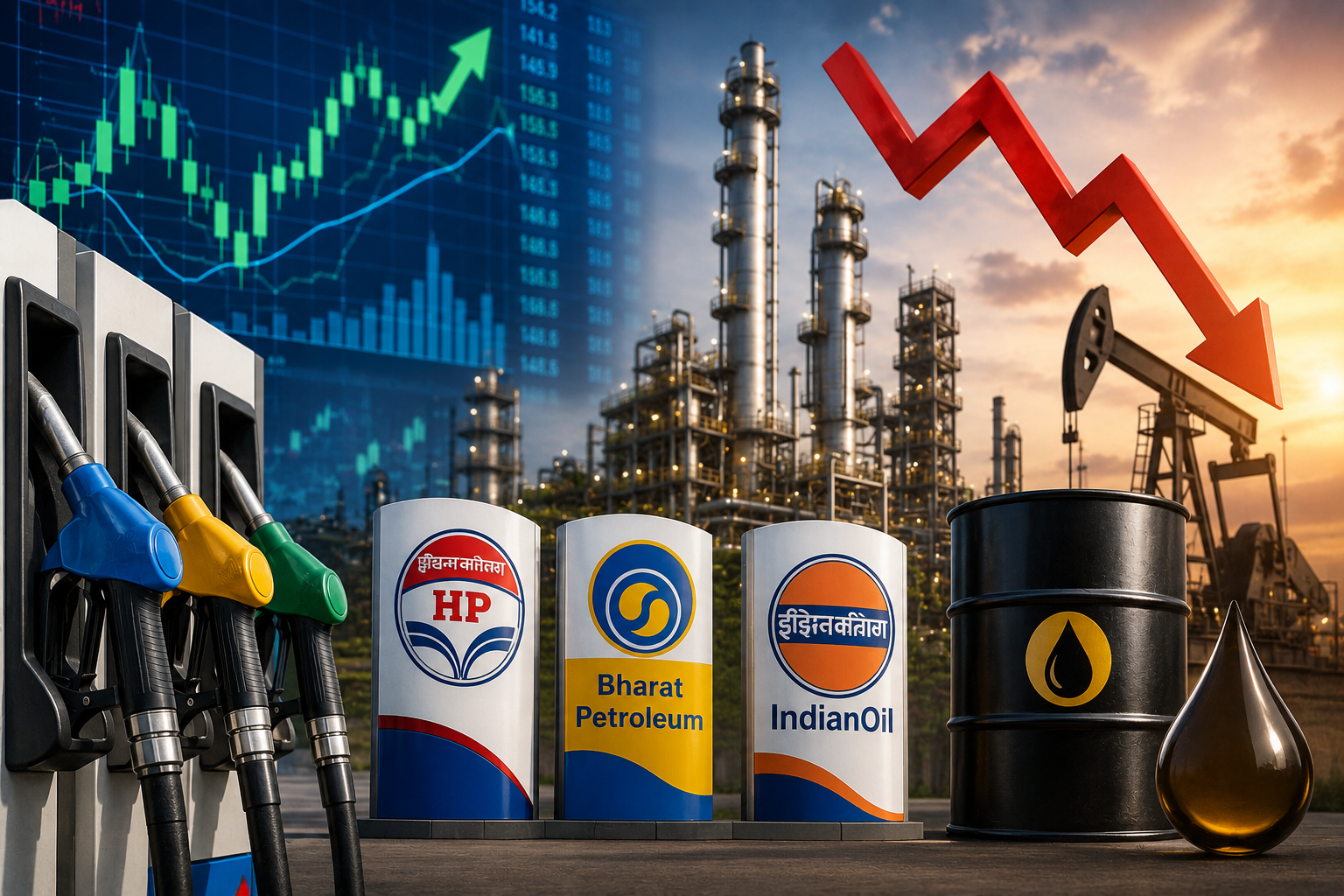
Easing US-Iran Tensions Boost Investor Confidence as Falling Crude Prices Improve Profitability Prospects for India's Oil Marketing Companies
Shares of India's leading oil marketing companies (OMCs) surged in Monday's trading session after international crude oil prices witnessed a sharp decline following signs of easing geopolitical tensions in West Asia. The fall in Brent crude to around US$90 per barrel sparked fresh buying interest in Hindustan Petroleum Corporation Ltd. (HPCL), Bharat Petroleum Corporation Ltd. (BPCL) and Indian Oil Corporation (IOC), as investors anticipated an improvement in refining margins and marketing profitability.
The rally came after reports indicated that both the United States and Iran had paused military strikes, raising hopes of diplomatic negotiations and reducing fears of a prolonged disruption in global oil supplies. Since India imports over 85% of its crude oil requirement, softer oil prices are considered a major positive for both the country's economy and its energy companies.
The development also eased concerns about inflation, freight costs and India's current account deficit, leading to improved sentiment across energy-related stocks.
Oil Marketing Stocks Lead the Rally
Oil marketing companies emerged among the top gainers on Dalal Street as investors welcomed the sharp correction in crude prices.
OMC Share Price Performance
| Company | Intraday Gain |
|---|---|
| Hindustan Petroleum (HPCL) | Up to 3.4% |
| Bharat Petroleum (BPCL) | Around 2.5% |
| Indian Oil Corporation (IOC) | Over 2% |
HPCL led the gains, while BPCL and IOC also attracted strong institutional buying as the market priced in the possibility of improved earnings over the coming quarters.
Brent Crude Witnesses Sharp Correction
International crude oil prices fell significantly after geopolitical tensions showed signs of easing.
Brent crude declined by nearly 6.7%, slipping to approximately US$90.29 per barrel, one of the steepest single-day declines in recent months.
The decline followed:
-
Suspension of military strikes by the United States.
-
Iran's indication that it would halt retaliatory attacks if hostilities ceased.
-
Renewed hopes for diplomatic engagement.
-
Reduced fears of supply disruptions from the Gulf region.
Lower crude prices generally improve profitability for oil refiners and fuel retailers by reducing input costs.
Why Lower Crude Prices Are Positive for OMCs
Crude oil is the primary raw material for oil marketing companies.
When crude prices decline, companies generally benefit through:
-
Lower procurement costs.
-
Improved refining margins.
-
Better fuel marketing profitability.
-
Reduced inventory losses.
-
Improved working capital management.
If retail fuel prices remain relatively stable while crude costs fall, companies can also witness stronger marketing margins, directly supporting earnings growth.
Strait of Hormuz Remains the Key Global Energy Corridor
The easing of tensions around the Strait of Hormuz played a crucial role in improving market sentiment.
The strategic waterway handles nearly one-fifth of the world's crude oil trade, serving as the primary export route for major Gulf producers including:
-
Saudi Arabia.
-
Iraq.
-
Kuwait.
-
United Arab Emirates.
-
Qatar.
Any disruption in this region immediately pushes global oil prices higher due to concerns over supply shortages.
The latest diplomatic developments have reduced fears of shipping disruptions, helping crude prices retreat sharply.
India's Economy Stands to Gain
As one of the world's largest crude oil importers, India is highly sensitive to movements in global energy prices.
Lower oil prices can positively influence several macroeconomic indicators.
Potential Economic Benefits
-
Lower import bill.
-
Reduced inflationary pressures.
-
Improved current account balance.
-
Stable fuel prices.
-
Lower logistics and transportation costs.
-
Reduced pressure on government finances.
A sustained decline in crude prices could also improve consumer spending by lowering overall fuel-related expenses.
Brokerages Remain Constructive on Select OMCs
Several brokerage firms continue to maintain a positive long-term outlook on India's oil marketing companies despite near-term volatility.
Analysts believe that:
-
Improving refining margins.
-
Better fuel marketing economics.
-
Stable domestic demand.
-
Strong refining capacity.
could support earnings recovery once geopolitical uncertainties subside.
However, profitability will continue to depend on international crude prices and government fuel pricing policies.
Nomura Favors BPCL and IOC
Global brokerage Nomura remains optimistic about Bharat Petroleum and Indian Oil.
BPCL
-
Rating: Buy
-
Target Price: ₹395
The brokerage expects BPCL to benefit from stronger gross refining margins over the medium term despite temporary pressure from fuel marketing losses.
Nomura believes improving refinery performance and operational efficiency could support earnings recovery.
Neutral View on HPCL
Nomura continues to maintain a Neutral recommendation on HPCL.
HPCL
-
Rating: Neutral
-
Revised Target Price: ₹420
The brokerage modestly lowered its earnings estimates following changes in refining assumptions but acknowledged that HPCL would also benefit if crude prices remain lower for an extended period.
Gross Refining Margins Remain a Critical Indicator
One of the most important profitability metrics for refiners is the Gross Refining Margin (GRM).
GRM represents the difference between:
-
Cost of crude oil purchased.
-
Value of refined petroleum products sold.
Higher refining margins generally translate into:
-
Stronger operating profits.
-
Better cash flows.
-
Higher earnings.
-
Improved shareholder returns.
Investors are expected to monitor GRM trends closely in upcoming quarterly results.
Marketing Margins Could Improve Further
High crude prices during recent months compressed fuel marketing margins because retail fuel prices were not fully adjusted.
A sustained decline in crude prices could:
-
Reduce petrol marketing losses.
-
Improve diesel profitability.
-
Lower LPG under-recoveries.
-
Strengthen overall operating performance.
This could significantly improve earnings visibility for all three major public sector OMCs.
Broader Market Impact
Lower crude oil prices benefit several sectors beyond oil marketing companies.
Industries likely to gain include:
-
Aviation.
-
Logistics.
-
Cement.
-
Chemicals.
-
Paints.
-
Consumer Goods.
-
Automobiles.
Lower energy costs help reduce operating expenses, improve margins and support corporate profitability across the economy.
Key Risks to Watch
Despite the current optimism, investors should remain cautious about several uncertainties.
Major Risk Factors
-
Fresh geopolitical tensions.
-
OPEC+ production decisions.
-
Global demand slowdown.
-
Exchange rate volatility.
-
Government fuel pricing interventions.
-
Supply disruptions in West Asia.
Any escalation in geopolitical risks could quickly reverse the recent decline in crude oil prices.
Outlook for India's Energy Sector
India's long-term energy demand remains strong, supported by:
-
Rising vehicle ownership.
-
Expanding industrial activity.
-
Growing aviation sector.
-
Infrastructure development.
-
Urbanisation.
Public sector oil marketing companies continue investing in refining capacity expansion, cleaner fuels and energy transition initiatives to strengthen long-term competitiveness.